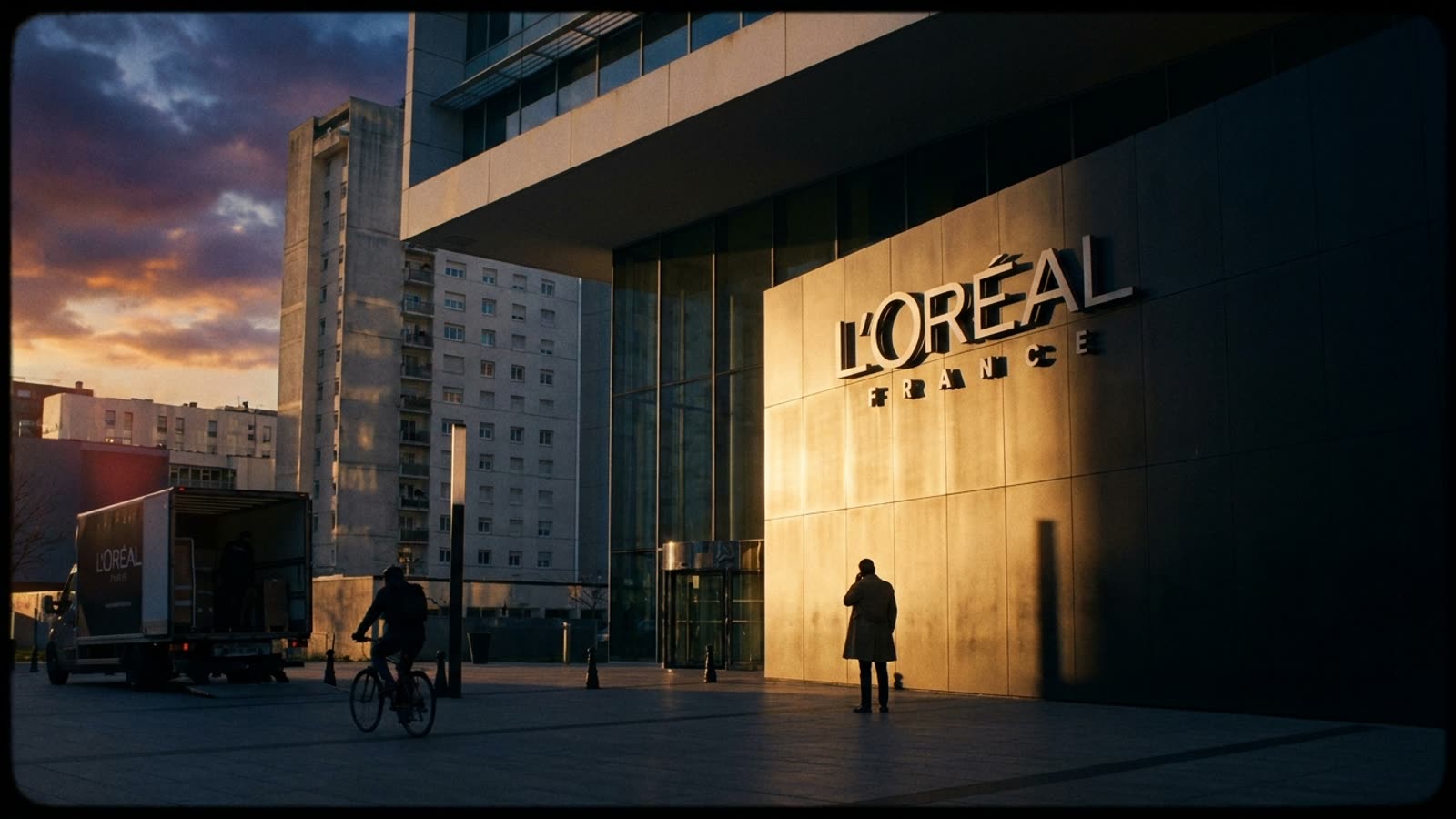
The mass-market beauty giant has never been shy about its Hollywood adjacency—L'Oréal Paris has sponsored the Cannes Film Festival for nearly three decades—but under new global brand president Laetitia Toupet, that relationship is being reframed as something closer to a growth engine than a marketing line item.
Toupet, who assumed the role earlier this year after a long tenure within the L'Oréal group, gave her first extended interview to Vogue this week, and the thesis was unmistakable: the path to €10 billion runs through culture, not just counters. The brand currently sits somewhere north of €8 billion in annual sales, making it one of the largest single beauty labels on the planet. Closing the gap requires finding what Toupet calls "white space"—categories and geographies where L'Oréal Paris has permission to play but hasn't fully pressed the advantage.
The Cannes playbook
For decades, prestige beauty brands have treated film festivals as borrowed equity: a chance to get product on famous faces and hope the association trickles down to the pharmacy aisle. Toupet's framing is more transactional. She describes Cannes as a laboratory for testing hero products in high-visibility conditions, with real-time social feedback loops that inform global rollout strategy. When a L'Oréal Paris ambassador walks the Croisette, the brand's digital team is already tracking search spikes and sentiment by region. The red carpet, in this telling, is a focus group with better lighting.
The white-space question
Toupet was deliberately vague about which categories represent the ripest opportunity, but the contours are legible. L'Oréal Paris has historically dominated hair color and mascara; its skincare and fragrance portfolios remain comparatively modest. The group's luxury division already owns those territories through Lancôme and Yves Saint Laurent, which creates internal tension. Toupet's challenge is to expand without cannibalizing—to convince consumers that a €15 serum from L'Oréal Paris is not a trade-down from a €90 Lancôme equivalent but a different proposition entirely.
The scale paradox
At €8-plus billion, L'Oréal Paris is already larger than many standalone beauty companies. Growth at that scale is arithmetically punishing: a 5 percent increase requires finding €400 million in new sales, roughly the size of a mid-tier indie brand's entire business. Toupet's answer appears to be geographic—emerging markets in Southeast Asia, Latin America, and Africa—combined with demographic expansion, particularly among older consumers who have aged out of the brand's traditional Gen-Z-to-millennial sweet spot. Whether the Cannes halo translates in Lagos or Jakarta as effectively as it does in Lyon remains an open question.
Our take
Toupet is making a sophisticated argument: that mass-market beauty can borrow the playbook of luxury without pretending to be luxury. It's a bet on aspiration without alienation, on glamour that doesn't require a department-store counter. The €10 billion target is ambitious but not fantastical—L'Oréal Paris has the distribution, the R&D pipeline, and the parent company's balance sheet. What it needs is a story that makes a drugstore lipstick feel like a ticket to the Croisette. Toupet seems to understand that the story is the product.