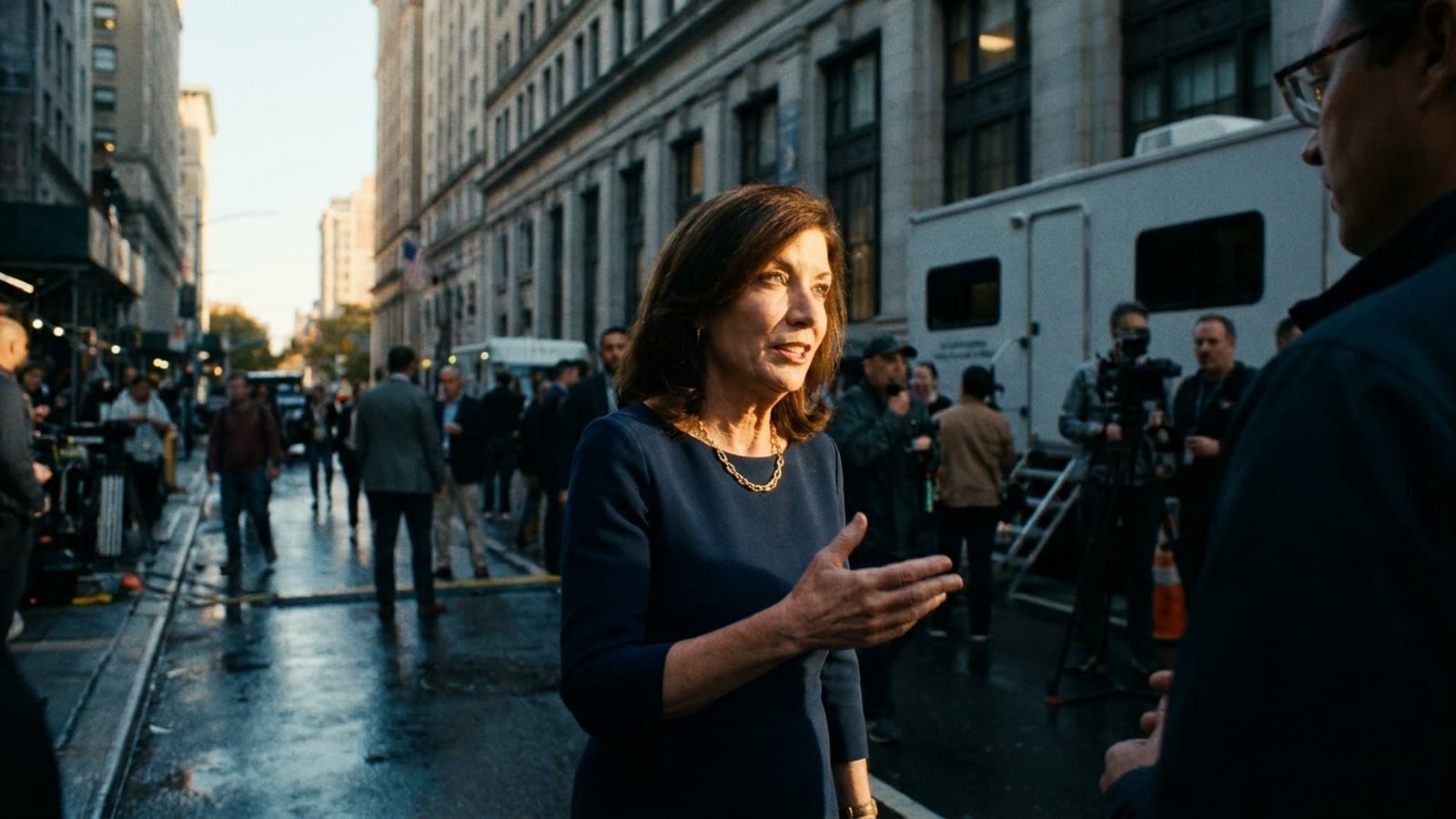
New York's entertainment economy just secured its insurance policy for another four years. Governor Kathy Hochul's decisive reelection Tuesday night guarantees continuity for the aggressive pro-production policies that have transformed the state into a genuine alternative to Los Angeles—not merely a location for gritty crime dramas, but a full-service filmmaking hub with expanding soundstage capacity, generous tax incentives, and a governor who actually returns studio executives' calls.
The victory was never in serious doubt, but its implications for the entertainment industry deserve more attention than they received amid the broader Democratic wave. Hochul has presided over the most significant expansion of New York's film infrastructure since the Silvercup Studios era, and her second term promises more of the same.
The tax credit arms race
New York's film and television tax credit program now exceeds $700 million annually, making it one of the most generous in the nation. Under Hochul, the state has expanded eligibility, streamlined the application process, and—crucially—demonstrated a willingness to negotiate bespoke deals for major productions that might otherwise flee to Georgia, the UK, or increasingly, Canada.
The calculus for studios has shifted accordingly. When Disney needed a home for several Marvel productions during the pandemic-era California shutdown, New York absorbed the work. When Apple TV+ sought East Coast production capacity, it found a willing partner in Albany. The infrastructure buildout has followed: Steiner Studios' expansion at Brooklyn Navy Yard, Lionsgate's facility in Yonkers, and a constellation of smaller stages throughout the five boroughs.
What California isn't doing
The contrast with California grows starker by the year. While Gavin Newsom's successor Xavier Becerra won his own race Tuesday, the incoming governor inherits a state whose entertainment industry advantages are increasingly legacy rather than competitive. California's tax credit program remains capped and oversubscribed, its permitting process byzantine, its cost of living prohibitive for below-the-line workers.
New York has exploited every weakness. The state's pitch to productions emphasizes not just financial incentives but logistical advantages: a deep bench of experienced crew, proximity to Broadway's talent pipeline, and a governor's office that treats entertainment as a genuine economic priority rather than a cultural inevitability.
The talent factor
Beyond the spreadsheet calculations, Hochul's reelection matters because relationships matter. The governor has cultivated genuine connections with industry leaders—attending premieres, hosting roundtables, ensuring that when a production encounters bureaucratic friction, there's a direct line to someone who can resolve it. This soft power is difficult to quantify but impossible to ignore.
The result is a virtuous cycle: more production attracts more crew, which attracts more production, which justifies more infrastructure investment. New York will never replace Los Angeles as the center of the entertainment universe, but it no longer needs to. The goal is to be essential, and Hochul has achieved that.
Our take
Hollywood's bicoastal future is now locked in for the foreseeable future, and that's probably healthy for an industry that had grown complacent about its geographic concentration. Hochul isn't a visionary—she's a competent administrator who recognized an opportunity and executed on it. That's exactly what the entertainment industry needs from its government partners: not inspiration, but reliability. California's new governor would do well to study the playbook.