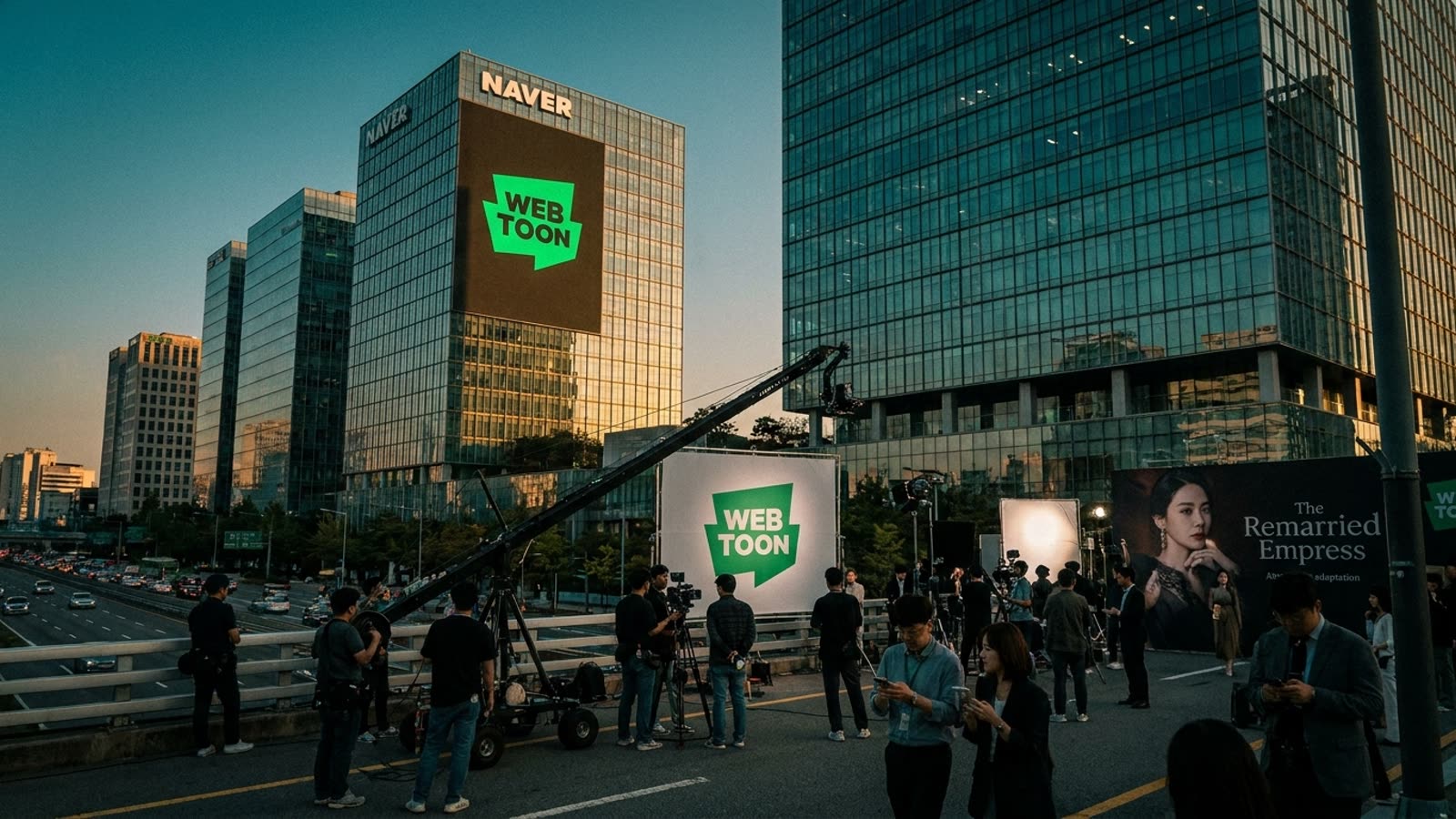
A divorced empress who orchestrates her own reinvention, a cheating emperor who regrets everything, and a narrative structure built for dopamine hits every sixty seconds — The Remarried Empress is not prestige television, and it knows it. Disney+ and Hulu are gambling that this is precisely the point.
The webtoon, which launched on Naver in 2019, has accumulated nearly three billion views across ten languages, making it one of the most consumed pieces of serialized fiction on the planet. Yet outside the devoted corridors of webtoon fandom, the title registers as little more than a curiosity. The live-action adaptation, starring Shin Min-a, Ju Ji-hoon, Lee Jong-suk, and Lee Se-young, is Disney's attempt to change that — and to prove that the webtoon-to-screen pipeline can produce something beyond niche curiosity.
The source material's quiet dominance
Webtoons occupy an odd position in the entertainment hierarchy: massive in reach, marginal in cultural prestige. The Remarried Empress exemplifies the paradox. Its premise — Empress Navier endures her husband's affair, secures her own strategic remarriage, and watches him spiral — is essentially a revenge fantasy wrapped in Regency aesthetics. The format, vertical scrolling panels optimized for phones, encourages binge consumption. Readers devour chapters in minutes, then wait impatiently for the next installment. The engagement metrics are staggering; the critical attention is minimal.
This asymmetry explains why Disney's bet is significant. The platform is not merely licensing a popular title; it is testing whether webtoon audiences — younger, more global, more mobile-native — can be converted into streaming subscribers. The Korean drama market has already proven its export potential through Squid Game and Extraordinary Attorney Woo. The question is whether IP born on phones can carry the same weight as IP born on paper or in writers' rooms.
The cast as insurance policy
Disney has hedged its bets by assembling a cast designed to appeal to multiple demographics. Shin Min-a brings credibility from Hometown Cha-Cha-Cha; Ju Ji-hoon offers the brooding intensity that K-drama audiences expect from morally compromised emperors. Lee Jong-suk and Lee Se-young round out a quartet that functions as both artistic legitimacy and marketing firepower. The strategy is transparent: even if Western audiences remain indifferent to webtoon pedigree, Korean drama enthusiasts will tune in for the faces.
The adaptation also arrives at a moment when Disney's Asian content strategy is under scrutiny. The platform has struggled to replicate Netflix's success in the region, and its Korean originals have yet to produce a breakout hit. The Remarried Empress offers a path forward — or at least a high-profile test case.
Our take
The entertainment industry's obsession with pre-existing IP has reached its logical extreme: a vertical-scroll comic with billions of views is now considered a safer bet than an original screenplay. There is something faintly absurd about this, and something faintly inevitable. The Remarried Empress may or may not become a global phenomenon, but its existence as a prestige K-drama signals that the webtoon-to-screen pipeline is no longer experimental. It is simply how stories get made now. Whether that is a democratization of narrative or a surrender to algorithmic taste is a question Disney would prefer you not ask while subscribing.