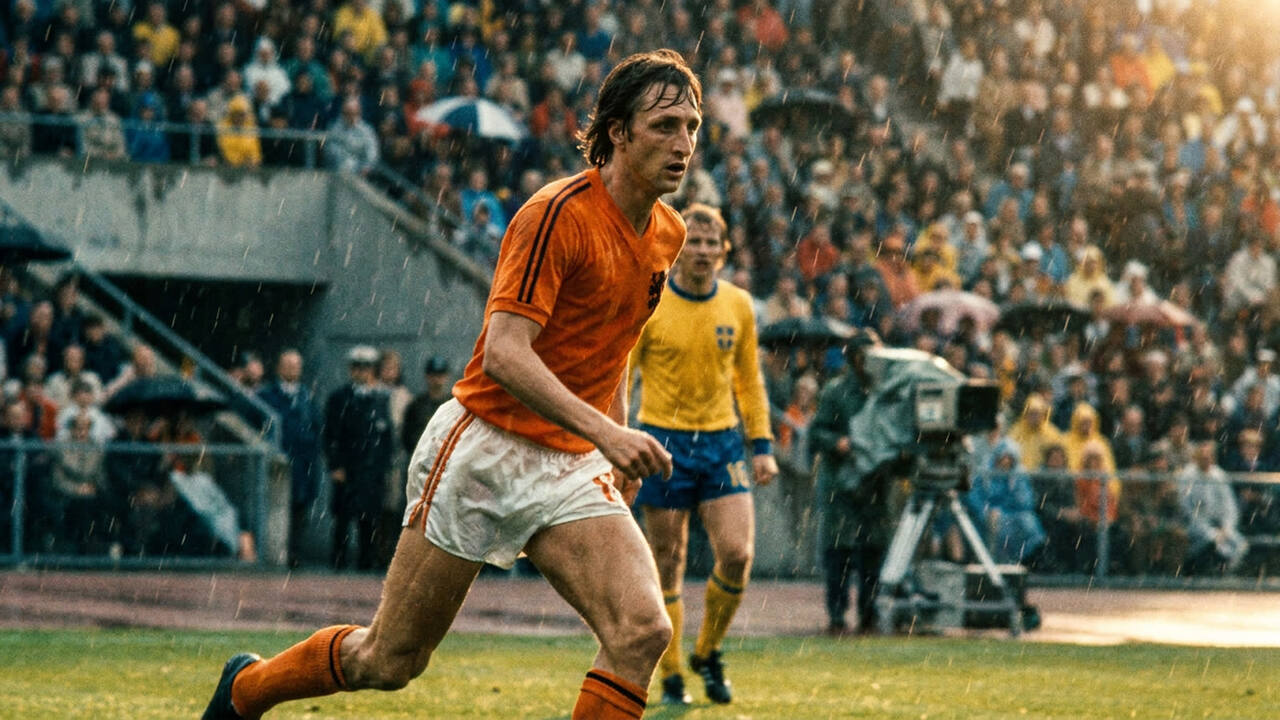
Football history is punctuated by goals, trophies, and tactical revolutions, but it is defined by moments of pure audacity — instants when a player does something so unexpected that the sport's possibilities expand in real time. Johan Cruyff's signature turn against Jan Olsson in the 1974 World Cup group stage is perhaps the purest example: a move that solved no tactical problem, won no title, and yet became the single most referenced piece of individual technique in the game's history.
The mechanics are deceptively simple. Cruyff shaped to cross with his right foot, then dragged the ball behind his standing leg with the inside of his boot, spinning one hundred eighty degrees and accelerating away from a defender left grasping at air. Olsson, a competent Swedish full-back, was not humiliated by lack of ability but by the sheer novelty of what he witnessed. He had no mental template for it. Neither did anyone else.
Why the turn endured
Countless skill moves have emerged and faded — the Marseille turn, the elastico, various stepovers — yet the Cruyff Turn remains the foundational vocabulary of youth academies from São Paulo to Seoul. Part of this is practical: the move is teachable, effective in tight spaces, and requires no exceptional athleticism. But its staying power is also symbolic. The turn embodies a philosophy that Cruyff would later articulate as a manager: that football should be about intelligence and elegance, not merely industry and physicality.
The Dutch "Total Football" system of the early 1970s was built on interchangeability and spatial awareness, and the turn was its perfect microcosm. It required no teammate, no system, just a player's willingness to trust his own creativity over the conventional response. In an era when defenders were taught to close space aggressively, Cruyff demonstrated that space could be manufactured from nothing.
The man behind the move
Cruyff's genius extended far beyond a single feint. He won three consecutive Ballon d'Or awards and transformed Barcelona twice — first as a player who delivered the club's first league title in over a decade, then as a manager who constructed the Dream Team of the early 1990s and laid the philosophical groundwork for what would become the most dominant club side of the twenty-first century. His insistence on youth development and possession-based football created the template that Pep Guardiola would later perfect.
Yet Cruyff never won a World Cup. The Netherlands fell to West Germany in the 1974 final, and he controversially declined to participate in 1978, citing family concerns amid the political situation in Argentina. His legacy, therefore, rests not on silverware but on influence — an unusual position for an athlete, more common among artists and philosophers.
Our take
The Cruyff Turn matters because it proved that football's most lasting contributions are not always measurable. No expected-goals model captures what Olsson experienced in that fraction of a second, and no trophy cabinet explains why children on five continents still practice the move before they learn to tie their boots properly. Cruyff understood something essential: that sport, at its highest level, is a form of expression, and that a single beautiful idea can outlast a thousand forgettable victories. The turn was not just a piece of skill. It was an argument — one that football has been losing, and rediscovering, ever since.