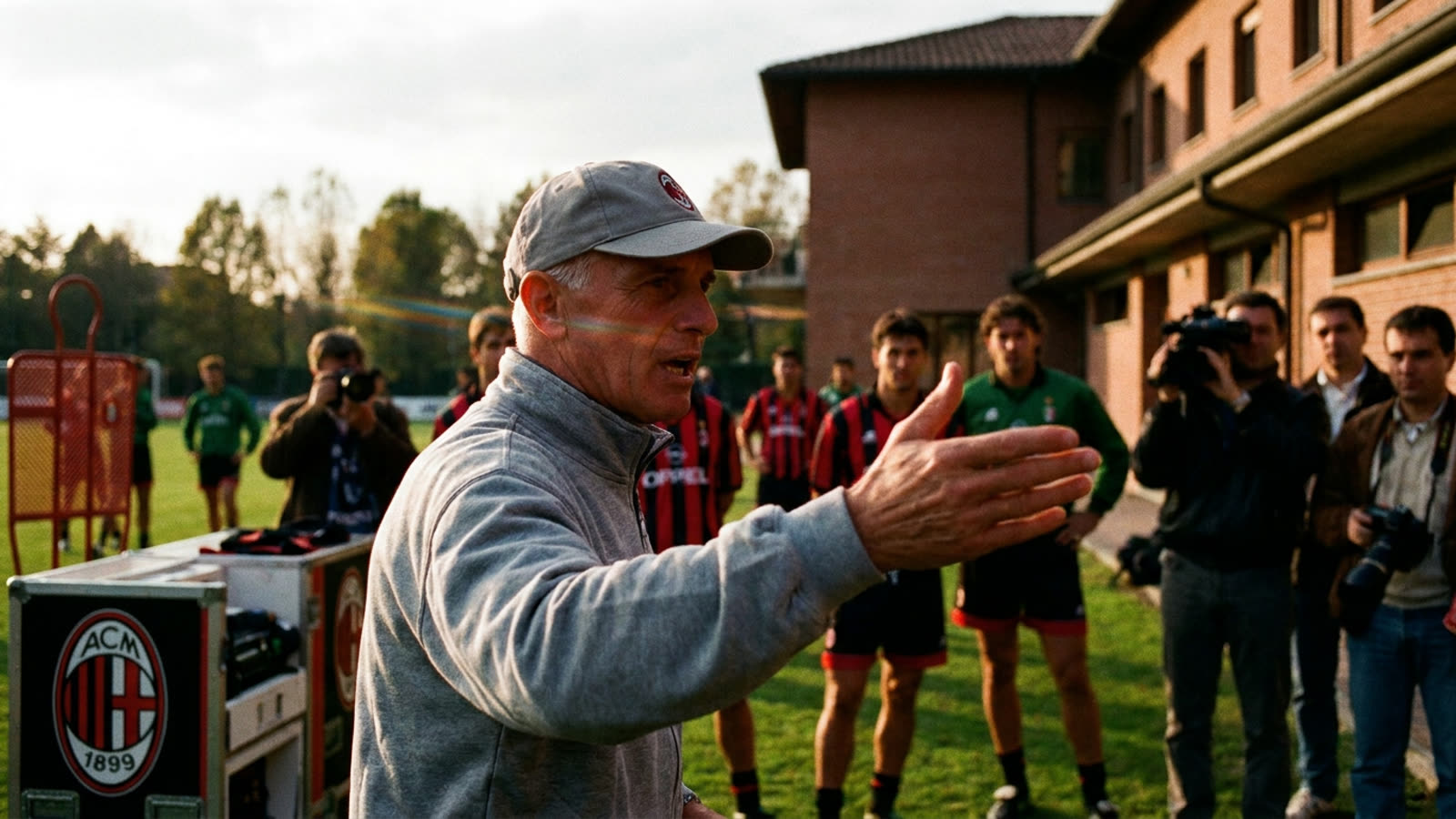
Before Arrigo Sacchi arrived at AC Milan in 1987, Italian football was a fortress sport. Teams defended deep, protected their goalkeeper like a medieval keep, and waited for moments of individual brilliance to break the deadlock. Catenaccio — the bolt — was not merely a tactic but a philosophy: survival first, beauty never. Sacchi, a man who had never played professional football, looked at this tradition and decided it was cowardice dressed as wisdom.
What he built in its place was something the sport had never seen at the highest level: a team that attacked space rather than opponents, that pressed in coordinated waves, that treated the ball as a weapon to be wielded collectively rather than a treasure to be hoarded by the gifted few. His Milan side won back-to-back European Cups in 1989 and 1990, but the trophies were almost incidental to the rupture he caused. Football had found its Copernicus.
The geometry of suffocation
Sacchi's innovation was deceptively simple in theory and brutally difficult in practice: keep the team compressed into roughly twenty-five meters of vertical space, move as a single organism, and press the opponent the moment possession was lost. The back four — Tassotti, Baresi, Costacurta, Maldini — operated as a synchronized line, stepping up in unison to catch attackers offside or collapsing inward to close passing lanes. There was no sweeper lurking behind to clean up mistakes. If the line broke, the goalkeeper was exposed. The margin for error was nonexistent.
This required something unprecedented: players who subordinated their individual instincts to a collective pattern. Sacchi drilled his squad relentlessly, running the same movements until they became reflexive. Franco Baresi, perhaps the greatest defender of his generation, later admitted that Sacchi's training sessions were more exhausting than matches. The players were not learning new skills; they were learning to think identically.
The man without credentials
Sacchi's biography remains one of football's great improbabilities. He sold shoes for a living before coaching amateur teams in the Italian lower divisions. He had no playing career to cite as authority, no famous mentor whose methods he could invoke. When Milan's president Silvio Berlusconi appointed him, the Italian press treated it as either a publicity stunt or evidence of madness.
Yet Sacchi possessed something more valuable than a decorated past: he had watched football obsessively, analytically, without the distortions that come from having succeeded within the old system. He admired Rinus Michels's Ajax and the Dutch total football of the 1970s, but he recognized that Michels's approach required players of extraordinary technical ability. Sacchi's genius was adapting those principles into a system that could be taught, drilled, and replicated with players who were excellent but not necessarily transcendent.
The inheritance
Every major tactical development in football since Sacchi leads back to his doorstep. Pep Guardiola, who has dominated the sport for nearly two decades, openly calls Sacchi his primary influence. Jürgen Klopp's gegenpressing at Liverpool was Sacchi's pressing with German intensity. Even defensive pragmatists like Diego Simeone operate within a framework Sacchi established: the idea that a team's shape off the ball is as important as its creativity on it.
The 2026 World Cup will feature thirty-two nations, and virtually all of them will employ some version of coordinated pressing, a high defensive line, and collective ball recovery. These are not natural developments; they are the downstream effects of a shoe salesman who believed football could be played as a kind of controlled chaos.
Our take
Sacchi's true radicalism was not tactical but philosophical. He insisted that football could be taught, that systems could triumph over individual genius, that a team thinking as one organism could defeat a collection of superior talents. This was heresy in a sport that worshipped the number ten, the playmaker, the singular artist. He was right, and the sport has never recovered from his proof. Whether that is a triumph or a loss depends on what you loved about football in the first place.