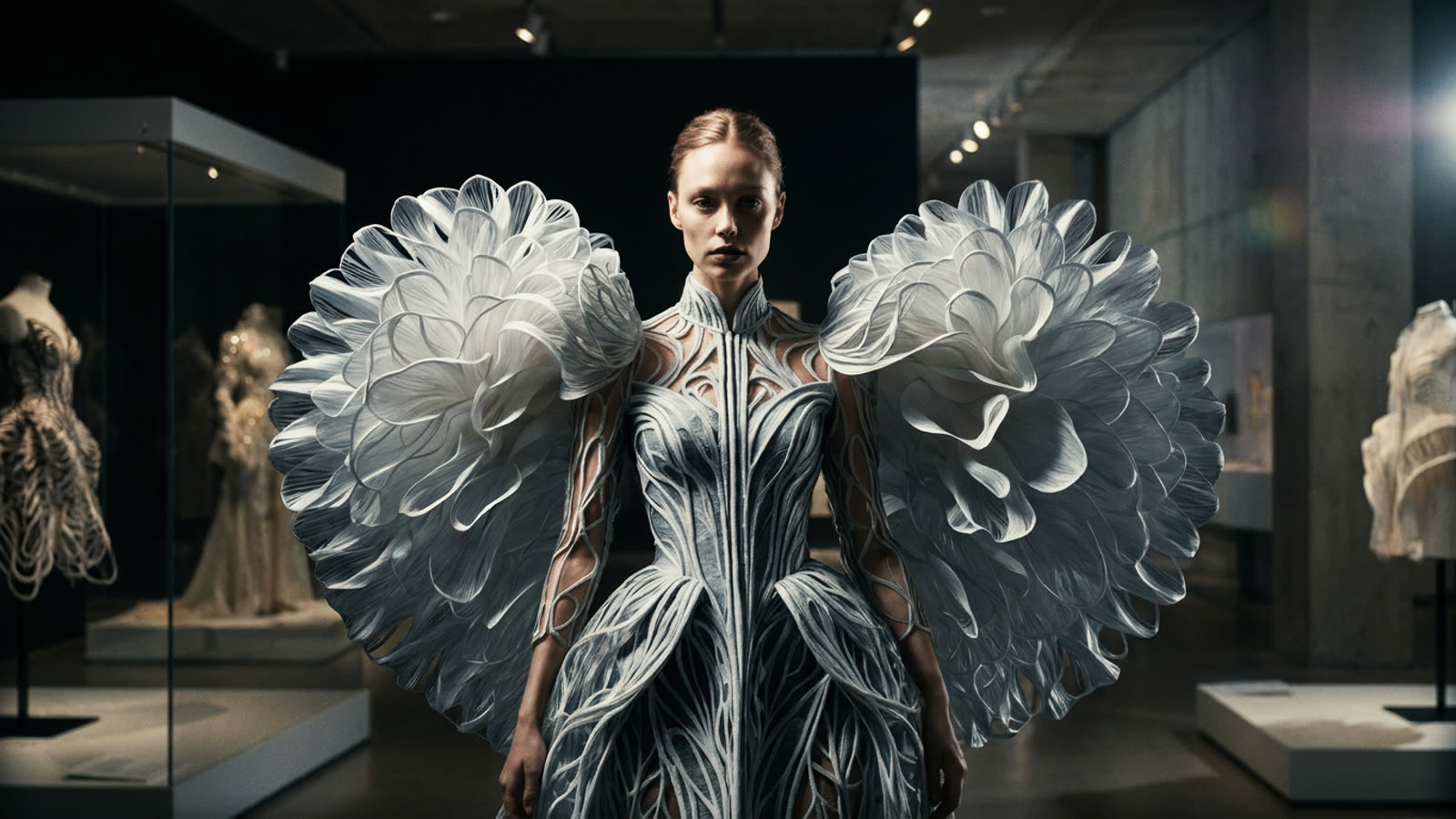
For two decades, Iris van Herpen has been fashion's most committed experimentalist, turning runways into laboratories where 3D printing, magnetic liquids, and laser-cut fabrics converge into garments that look less worn than inhabited. Now, with a major retrospective opening at the Brooklyn Museum, the Dutch designer receives something the fashion world rarely grants its living practitioners: the institutional validation typically reserved for dead painters and conceptual sculptors.
The timing feels deliberate. As fashion grapples with its environmental footprint and existential purpose, van Herpen offers a counternarrative—one where technology serves craft rather than replacing it, where sustainability emerges from innovation rather than nostalgia, and where a dress can carry genuine philosophical weight without becoming unwearable.
The case for fashion as fine art
Museums have long struggled with how to present clothing. The Met's Costume Institute walks a careful line between scholarship and spectacle; the V&A tends toward historical reverence. Brooklyn's approach with van Herpen appears more argumentative: these pieces belong in conversation with the museum's permanent collection of sculpture and installation art. Her skeletal corsets and undulating gowns—constructed from materials ranging from recycled ocean plastic to hand-painted silicone—demand the same contemplative attention as any Giacometti or Bourgeois.
The show reportedly emphasizes van Herpen's collaborative process, highlighting partnerships with architects, biologists, and digital artists. This framing matters. It positions her not as a lone genius but as a conductor of interdisciplinary inquiry, someone whose atelier functions more like a research institute than a traditional fashion house.
Why interconnectedness is the message
Van Herpen has described her work as exploring "the space between the body and its environment," and the retrospective apparently takes this seriously. Pieces are arranged to suggest dialogue—with each other, with the viewer's body, with the Brooklyn skyline visible through the museum's windows. The curatorial thesis seems to be that fashion, at its most ambitious, can articulate ideas about human existence that other mediums cannot.
This is a bold claim, and not everyone will buy it. Critics of fashion-as-art exhibitions often argue that clothing's functionality disqualifies it from pure aesthetic consideration. But van Herpen's couture pieces—unworn by anyone except models and collectors—exist in a liminal space. They reference the body without serving it in any practical sense.
Our take
The Brooklyn retrospective matters less for what it says about van Herpen than for what it signals about fashion's cultural positioning. A generation of designers trained on sustainability mandates and digital fabrication is watching to see whether institutions will take their work seriously or continue treating fashion as a lesser decorative art. Van Herpen's elevation suggests the former. Whether that opens doors for others or simply confirms her as fashion's sole acceptable crossover remains to be seen.