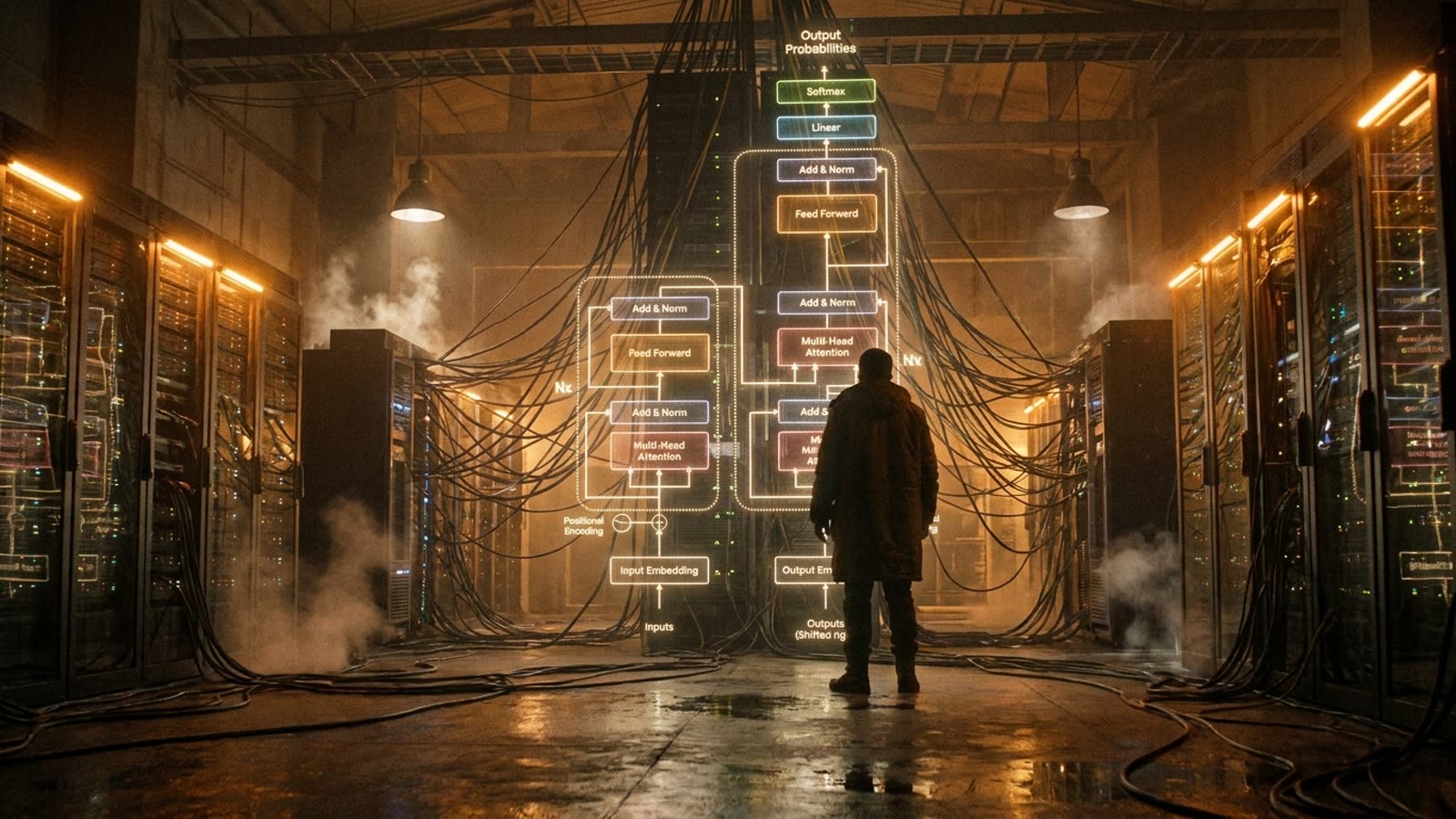
The most seductive illusion in modern artificial intelligence is continuity. You type a message to a chatbot, it responds, you reply, and the conversation flows as if you were speaking with someone who genuinely remembers what you said three exchanges ago. This is a conjuring trick. Large language models do not remember anything; they re-read the entire conversation from scratch every time they generate a response, and they can only re-read so much before the oldest words fall off a cliff into oblivion.
This constraint is called the context window, and understanding it is the single most useful thing a non-technical person can learn about how these systems actually work.
The architecture of amnesia
When you send a message to a model like GPT-4 or Claude, the system concatenates your new input with everything that came before—your prior messages, its prior responses, any system instructions—and feeds the entire blob of text through its neural network to predict what should come next. The network has no separate memory module, no filing cabinet, no hippocampus. Its only access to the past is whatever fits inside a fixed-length buffer of tokens, the atomic units into which text is chopped.
Early transformer models had context windows of a few thousand tokens, roughly equivalent to a long essay. By 2024, some models stretched to 128,000 tokens or beyond—the length of a short novel. This sounds generous until you realize that a single complex document, plus a few rounds of back-and-forth, can exhaust the budget. Once the window fills, the oldest material is simply discarded. The model does not summarize it, archive it, or compress it. It vanishes.
Why this matters for every user
The context window explains a host of behaviors that frustrate users. Why does the chatbot contradict something it said an hour ago? Because that exchange is no longer in the window. Why does it lose track of your project requirements halfway through a long session? Same reason. Why do retrieval-augmented systems sometimes surface irrelevant documents? Because the retrieval layer must guess which excerpts to inject into a finite window, and guessing is imperfect.
Power users have learned to work around the constraint: they paste summaries of prior work at the start of new sessions, they break large tasks into modular chunks, they treat the model as a brilliant amnesiac who needs constant re-briefing. The interface design of most chatbot products obscures this reality, presenting a scrolling history that implies persistence where none exists.
The research frontier
Extending or circumventing the context window is one of the hottest areas in AI research. Some teams pursue longer windows through more efficient attention mechanisms; others experiment with external memory stores that the model can query mid-generation. A few explore recurrent architectures that compress old context into latent states, trading verbatim recall for gist. None of these approaches has yet produced a system that truly remembers the way humans do—continuously, selectively, and indefinitely.
Our take
The context window is not a bug awaiting a fix; it is a design choice with profound implications. It keeps inference costs bounded, prevents models from accumulating unbounded personal data, and forces a kind of epistemic humility: the machine must work with what it can see right now. Users who grasp this constraint will extract far more value from these tools than those who treat them as omniscient oracles. The first step to using AI well is understanding exactly where its attention ends.