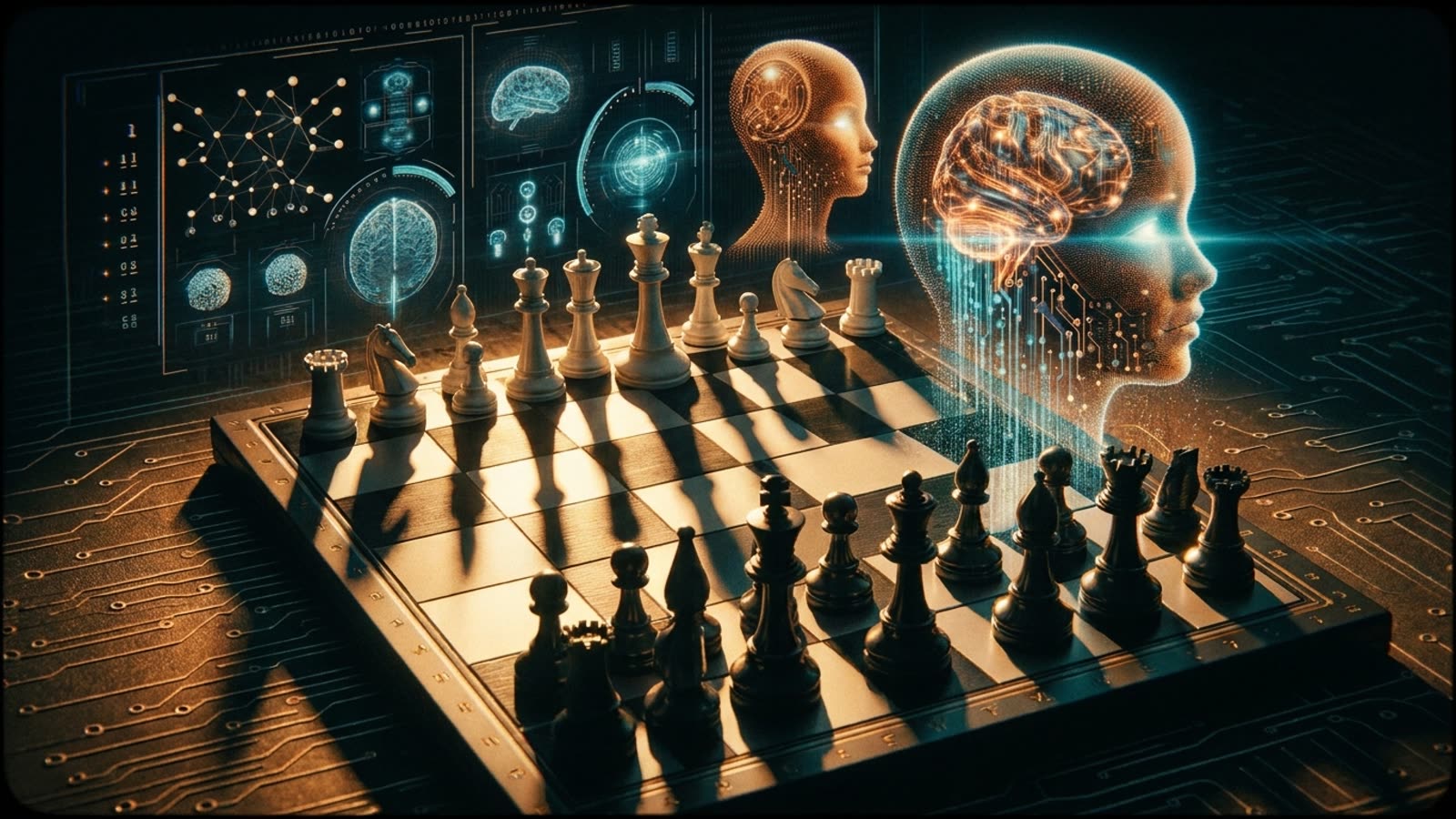
The grandmaster who loses to a chess engine today is not experiencing tragedy. She is experiencing Tuesday. Every serious player on earth now trains with software that could demolish them blindfolded, and this arrangement has produced something unexpected: the most creative, aggressive, and entertaining chess in the game's fifteen-hundred-year history.
This is not the future anyone predicted when IBM's Deep Blue defeated Garry Kasparov in 1997. The assumption then was that machine supremacy would drain chess of meaning, reducing human competition to a quaint exhibition, like watching horses race cars. Instead, the opposite happened. Chess is more popular now than at any point in recorded history, and the humans who play it have become demonstrably better precisely because they stopped being the best.
The training revolution
Before engines, elite players learned from books, coaches, and painful experience. They memorized opening lines that had been refined over generations, treating established theory as something close to scripture. Engines obliterated this deference. Software doesn't care that a move has been played thousands of times by titled players; it only cares whether the move is good. And frequently, the answer is no.
Modern grandmasters now use engines not as opponents but as tutors with infinite patience and zero ego. They can test any idea instantly, receive honest feedback, and explore variations that human teachers would have dismissed as unsound. The result is a generation of players who are tactically sharper, more willing to sacrifice material, and far less beholden to tradition. Openings that were considered dubious for decades have been rehabilitated because engines revealed hidden resources that humans missed.
The paradox of computer-assisted humanity
Here is the strange part: games between top humans have become more unpredictable, not less. When everyone has access to the same superhuman preparation tool, the advantage shifts toward creativity, psychological resilience, and the ability to steer positions into murky territory where memorized analysis runs out. The players who thrive are those who can think independently once the engine's guidance ends.
This dynamic has made elite chess more watchable. Decisive results are more common. Wild sacrifices appear in serious tournament games. The careful, drawish style that dominated the late twentieth century has given way to something more volatile, because players know their opponents have also seen the computer's best lines and will punish passive play.
A template for coexistence
Chess offers a model for how professions might adapt when machines surpass human capability in narrow domains. The game did not disappear; it evolved. Human players did not become irrelevant; they became more interesting to watch because the stakes shifted from raw calculation to judgment, creativity, and nerve. The machine handles the grunt work; the human supplies the meaning.
This is not a universal template. Chess is a closed system with perfect information, which makes human-machine collaboration unusually clean. Most professions involve ambiguity, ethics, and social context that engines cannot navigate. But the chess experience suggests that displacement is not the only possible outcome, and that tools which outperform us can also elevate us if we are willing to redefine what we are trying to do.
Our take
The lesson from chess is not that humans should surrender to machines or pretend we can still compete on their terms. It is that the interesting question was never who is better. The interesting question is what humans do once better is no longer the point. Chess players answered by becoming students of their conquerors and using that education to entertain each other in ways that matter to other humans. That is not defeat. That is adaptation, and it is the most hopeful precedent we have for the century ahead.