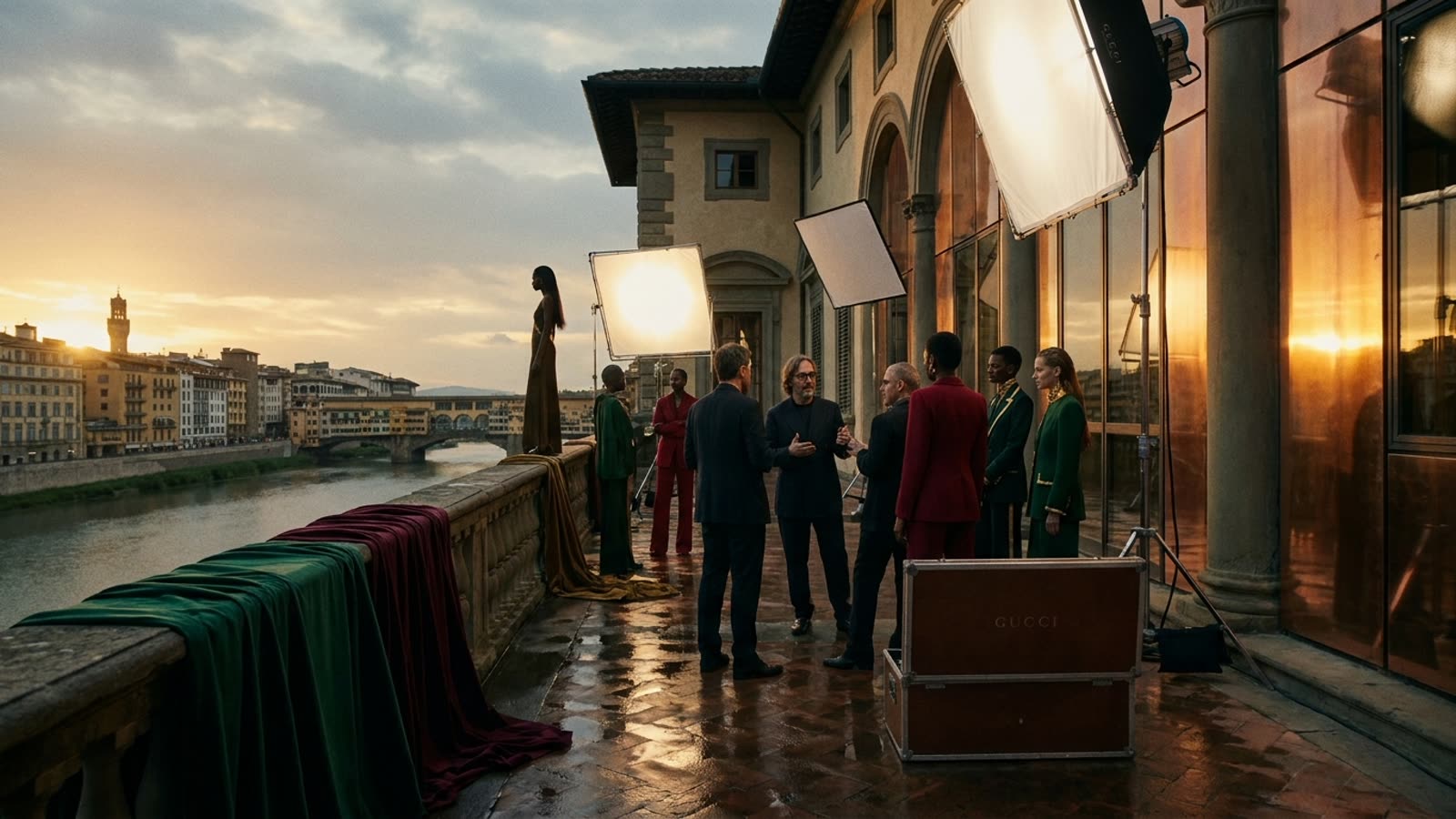
Sabato De Sarno has been playing a long game at Gucci, and Resort 2027 suggests he's finally ready to show his cards. Presented in Florence—the city where Guccio Gucci opened his first shop in 1921—the collection marks a deliberate homecoming, both geographical and aesthetic. After seasons of careful recalibration following the maximalist Alessandro Michele era, De Sarno has arrived at something that feels neither reactive nor tentative: a wardrobe built on proportion, texture, and the quiet confidence of clothes that don't need to explain themselves.
The Florentine proposition
The choice of Florence over Milan or some far-flung destination resort was strategic. De Sarno staged the show against the backdrop of the city's Renaissance architecture, but resisted the obvious temptation to costume his models in period drama. Instead, he leaned into what Florence represents in the Italian imagination: craftsmanship as birthright, beauty as civic duty. The leather pieces—supple trenches, structured bags with minimal hardware—read as arguments for Gucci's artisanal credentials at a moment when the luxury sector is drowning in logo-heavy mediocrity.
A vocabulary emerges
What distinguishes this collection from De Sarno's earlier outings is coherence. The silhouettes have settled into a recognizable language: sharp shoulders balanced by fluid skirts, abbreviated hemlines paired with covered-up necklines, menswear that borrows from womenswear's ease without tipping into costume. The palette moved through terracotta, sage, cream, and a particular shade of dusty rose that appeared on everything from tailored shorts to evening gowns. If Michele's Gucci was a fever dream of references, De Sarno's is a curated apartment—every piece chosen with intention, nothing shouting for attention.
The commercial calculation
Gucci's parent company Kering has been transparent about needing the house to stabilize after years of declining sales. Resort collections, which account for a significant portion of luxury revenue, are where creative vision meets commercial reality. De Sarno seems to understand the assignment: these are clothes that photograph well, travel well, and—crucially—sell well. The accessories, always Gucci's profit engine, were refined rather than reinvented. A new iteration of the Jackie bag appeared in shrunken proportions; loafers came in unexpected textures. Nothing revolutionary, but everything desirable.
Our take
De Sarno's Gucci will never generate the cultural frenzy of Michele's tenure, and that's probably the point. What he's building is more sustainable: a house style rather than a house spectacle. Resort 2027 won't break the internet, but it might break the brand's losing streak. Sometimes the most radical thing a creative director can do is make beautiful clothes that people actually want to wear.