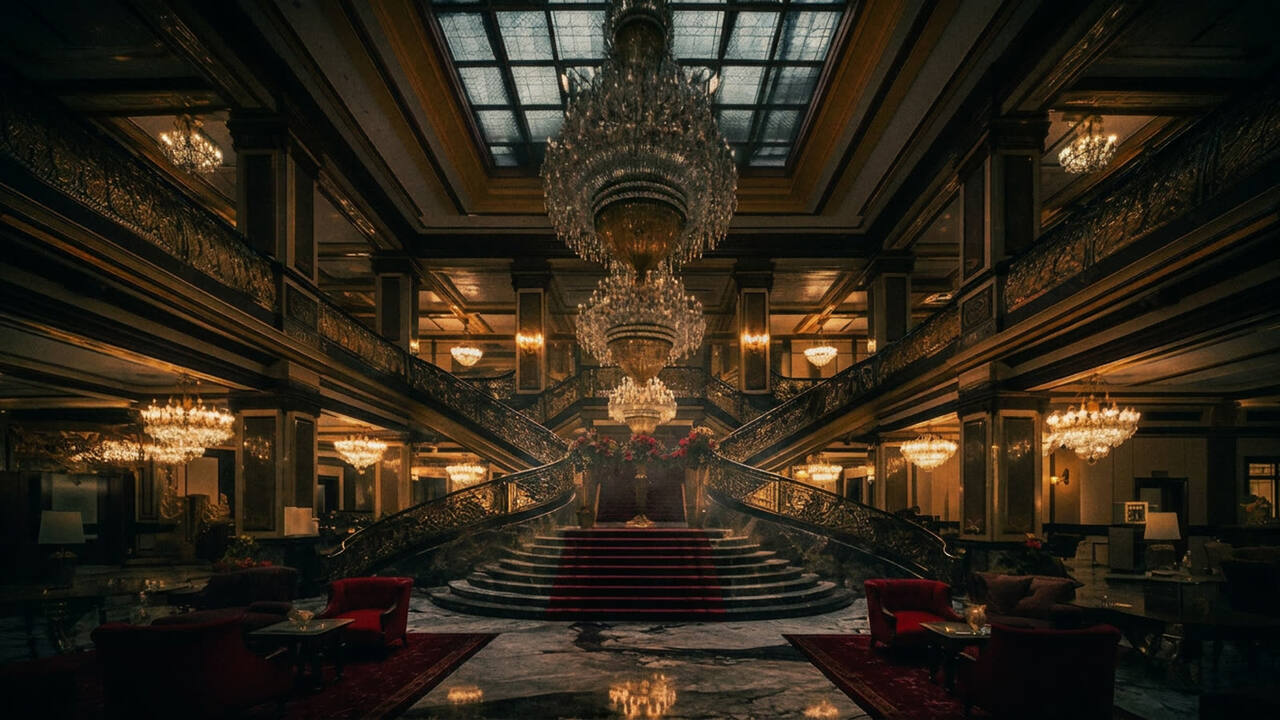
There was a time when arriving at a hotel meant something. The Ritz Paris, the Plaza in New York, the Savoy in London—these were not merely places to sleep but stages upon which guests performed the ritual of arrival. Bellhops in brass-buttoned uniforms, concierges who remembered your name, marble floors that echoed with the footsteps of the almost-famous and the genuinely rich. The grand lobby was architecture as social contract: you dressed for it, you lingered in it, you were seen.
That theater is closing, one renovation at a time.
The efficiency imperative
The forces dismantling the grand lobby are boringly practical. Real estate economics now prize revenue-generating square footage over ceremonial space. A lobby that once sprawled across several thousand square feet can be compressed into a sleek reception pod, freeing room for a ground-floor restaurant paying market rent. Mobile check-in eliminates the need for a staffed desk entirely. Some newer luxury properties have reduced the lobby to little more than an elevator bank with good lighting.
The pandemic accelerated what was already underway. Contactless everything became not just convenient but virtuous. Guests who once expected to be greeted now prefer to be processed—quickly, silently, with minimal human friction. The lobby as waiting room became the lobby as pass-through.
What we lose when we stop arriving
The grand lobby served functions that efficiency metrics cannot capture. It was a decompression chamber between the chaos of travel and the privacy of the room, a liminal space where strangers shared the same air and occasionally the same conversation. It was democratic in a way that gated amenities are not: anyone could walk into the Waldorf-Astoria and sit in a chair, at least for a while.
More subtly, the lobby taught guests how to be guests. Its formality imposed a gentle discipline—you straightened your posture, you modulated your voice, you participated in a collective performance of civility. The modern hotel, by contrast, asks nothing of you. It processes your credit card and points you toward the elevator. You could check in wearing pajamas and no one would blink, which is perhaps freedom but is certainly not theater.
The preservationists and the purists
A handful of properties resist the trend, treating their lobbies as heritage assets rather than inefficient liabilities. The Gritti Palace in Venice maintains its waterfront salon as a living room for guests and visitors alike. Claridge's in London continues to staff its entrance with doormen whose job is partly functional and partly ceremonial. These hotels understand that luxury, at its highest expression, is not about invisible service but about visible care—the choreography of welcome.
Yet even preservation can curdle into museum-keeping. A lobby maintained for Instagram backdrops is not the same as a lobby where life actually happens. The question is whether contemporary travelers want to participate in arrival rituals or merely document them.
Our take
The grand hotel lobby was never just about hospitality; it was about the idea that travel should transform you, if only for the duration of a threshold crossing. Its decline reflects a broader cultural retreat from shared public rituals into private convenience. We check in from our phones, we eat in our rooms, we experience cities through the curated distance of apps and algorithms. The lobby asked us to show up, literally and figuratively. We have decided, collectively, that we would rather not.