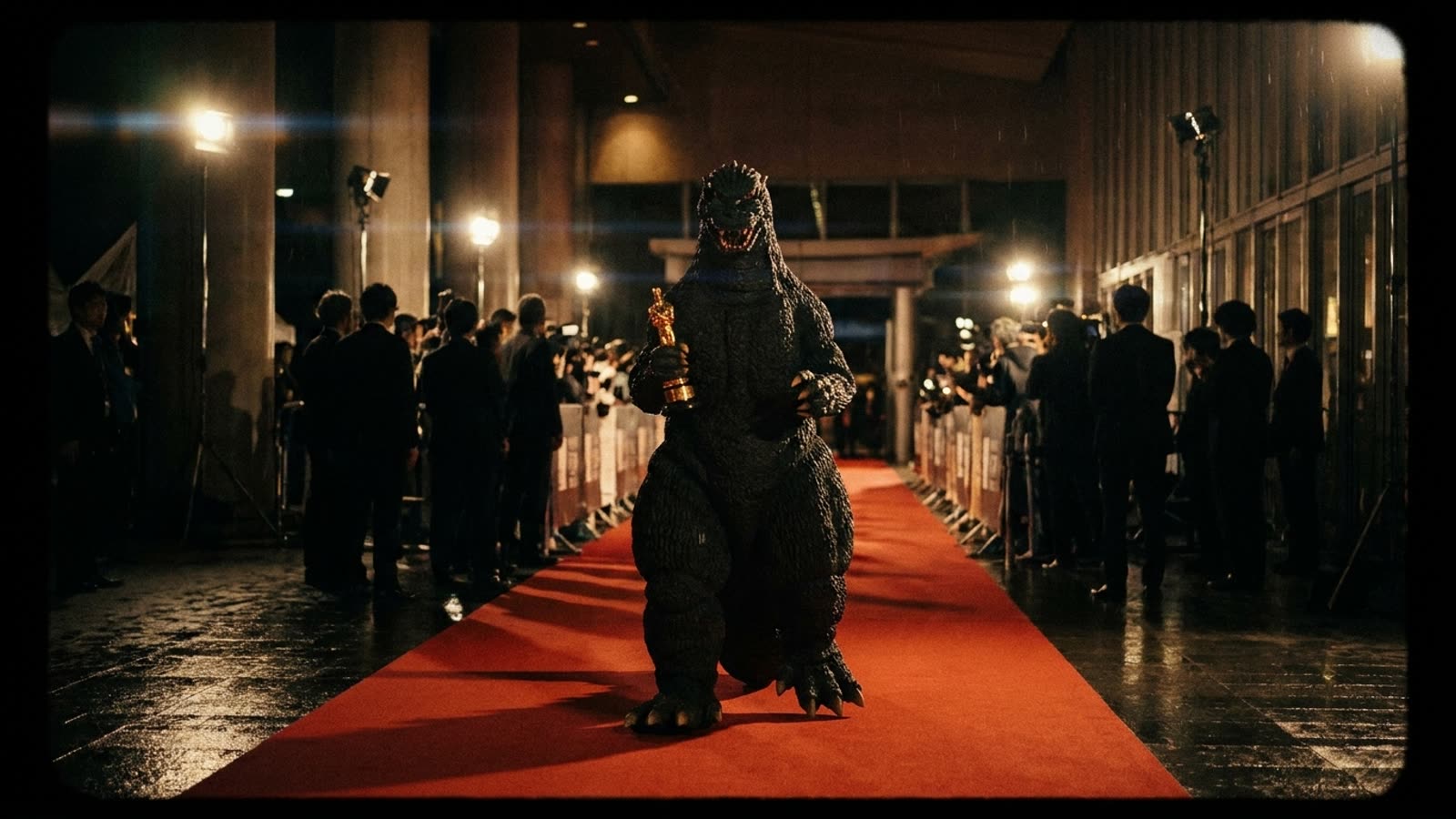
The standing ovation lasted nearly four minutes. At Sunday's sold-out screenings of Godzilla Minus Zero at the 39th Tokyo International Film Festival, stars Ryunosuke Kamiki and Minami Hamabe walked a red carpet flanked by fans in rubber monster suits, clutching figurines, some weeping openly. It was less a film premiere than a coronation ceremony—Japan's kaiju culture receiving its flowers after director Takashi Yamazaki's Godzilla Minus One became the first Japanese-language film to win the Academy Award for Best Visual Effects.
The sequel, opening domestically on November 3, arrives freighted with expectations that would crush most franchises. Yamazaki has spoken of the pressure as "unbearable joy"—a phrase that captures the peculiar position Japanese cinema now occupies. Hollywood validated what Japanese audiences always knew: that a monster movie made for a fraction of a Marvel budget could outclass the industry's biggest spenders on pure craft.
The weight of a golden statue
Yamazaki's Oscar victory in March 2024 sent shockwaves through both Tokyo and Los Angeles. The film cost roughly $15 million—less than the catering budget on some superhero productions—yet its visual effects sequences depicting Godzilla's rampage through postwar Tokyo earned near-universal praise from the same Academy voters who typically reserve the category for Industrial Light & Magic and Weta. The win validated a thesis Japanese filmmakers have long held: technical excellence doesn't require nine-figure budgets, just vision and obsessive attention to detail.
At Sunday's festival appearance, Kamiki recalled the Hollywood premiere where American audiences chanted Yamazaki's name. "I had never heard anything like it," he told the Tokyo crowd. "Americans shouting a Japanese director's name like he was a rock star." The moment, he said, made him understand that Godzilla had finally completed a journey that began seventy-two years ago in Toho's studios.
Franchise resurrection as cultural diplomacy
Godzilla has always been more than entertainment in Japan—the original 1954 film was a meditation on nuclear trauma, released less than a decade after Hiroshima and Nagasaki. Yamazaki's films return to that gravity, setting their stories in the immediate postwar period and treating the monster as metaphor rather than mere spectacle. The approach resonated globally in ways that Toho's previous attempts at international crossover never managed.
The Tokyo Film Festival's decision to give Minus Zero prime placement signals the Japanese film industry's recognition that this moment matters beyond box office. Festival director Shozo Ichiyama called the screenings "a homecoming for a national treasure," carefully avoiding the word "comeback"—because in Japan, Godzilla never left.
Our take
There's something quietly satisfying about watching Japan celebrate a Hollywood validation it never actually needed. Yamazaki's films succeed because they ignore the blockbuster playbook entirely, treating spectacle as earned rather than obligatory. The rapturous Tokyo crowds weren't cheering an Oscar—they were cheering the confirmation that their aesthetic sensibility, their patient storytelling, their willingness to let a monster mean something, had finally been recognized by an industry that usually demands the opposite. The sequel will almost certainly be excellent. More importantly, it will be Japanese on its own terms.