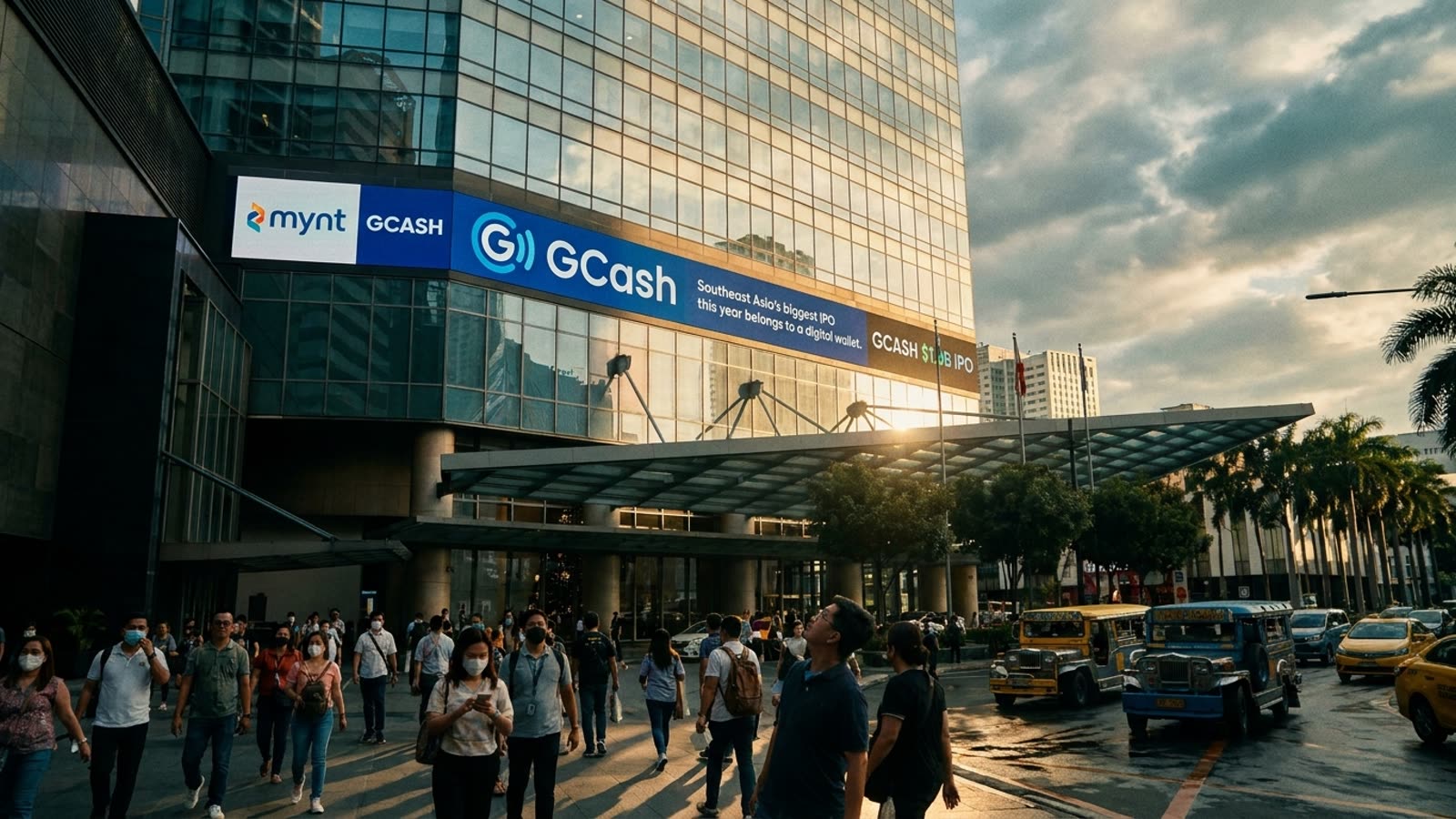
For years, the narrative around Southeast Asian fintech was one of potential: hundreds of millions of unbanked consumers, smartphone penetration racing ahead of financial infrastructure, and patient venture capital willing to subsidize growth. Now that story has a price tag. The parent company of GCash, the Philippines' dominant digital wallet, is set to begin trading in what will be the region's largest initial public offering of 2026, raising approximately $1 billion and valuing the business at a level that forces public-market investors to take emerging-market fintech seriously.
The timing is instructive. Southeast Asian equity markets have been sluggish, caught between a strong dollar, cautious foreign flows, and political noise in several capitals. Yet GCash's owner found enough institutional appetite to push through a deal of this size, suggesting that the right asset—one with genuine scale, recurring revenue, and a defensible position—can still command capital even in a risk-off environment.
Why GCash matters beyond the Philippines
GCash claims more than 90 million registered users in a country of roughly 115 million people. That penetration rate is extraordinary for a market where traditional banking long remained the preserve of the urban middle class. The wallet now handles remittances, bill payments, micro-loans, and even government disbursements, effectively functioning as financial plumbing for a large share of the Philippine economy. For investors, the question is whether that dominance can translate into durable margins as competition intensifies and regulators demand more consumer protection.
The IPO also tests appetite for the broader Southeast Asian fintech thesis. Grab, Sea, and GoTo all went public at lofty valuations only to see their shares battered when growth-at-all-costs fell out of fashion. GCash's listing arrives in a different climate: investors now want proof of profitability, not just user counts. If the stock performs, it could reopen the IPO window for a generation of fintech companies that have been waiting in the wings.
What the deal says about regional capital markets
Southeast Asia has struggled to keep its best companies from listing elsewhere. Tech founders have historically looked to New York or Hong Kong for deeper liquidity and higher multiples. A billion-dollar debut on home turf—reportedly in Manila—suggests that local exchanges are becoming credible venues for growth-stage companies, at least when the underlying business is strong enough to attract global funds.
That maturation matters for the region's economic development. Liquid domestic equity markets channel savings into productive enterprise, reduce reliance on foreign capital, and give employees a realistic path to wealth through stock compensation. If GCash's IPO succeeds, it will be harder for the next generation of founders to argue that they have no choice but to list abroad.
Our take
The GCash IPO is less a single company's milestone than a referendum on Southeast Asian fintech's coming-of-age. If public investors reward the listing, capital will flow more freely to the region's digital-finance startups, accelerating financial inclusion and forcing incumbents to adapt. If the stock stumbles, the lesson will be that emerging-market fintech still needs to prove it can generate returns, not just users. Either way, a billion-dollar digital-wallet IPO in Manila is a sentence that would have seemed improbable a decade ago. The region's financial architecture is shifting beneath our feet.