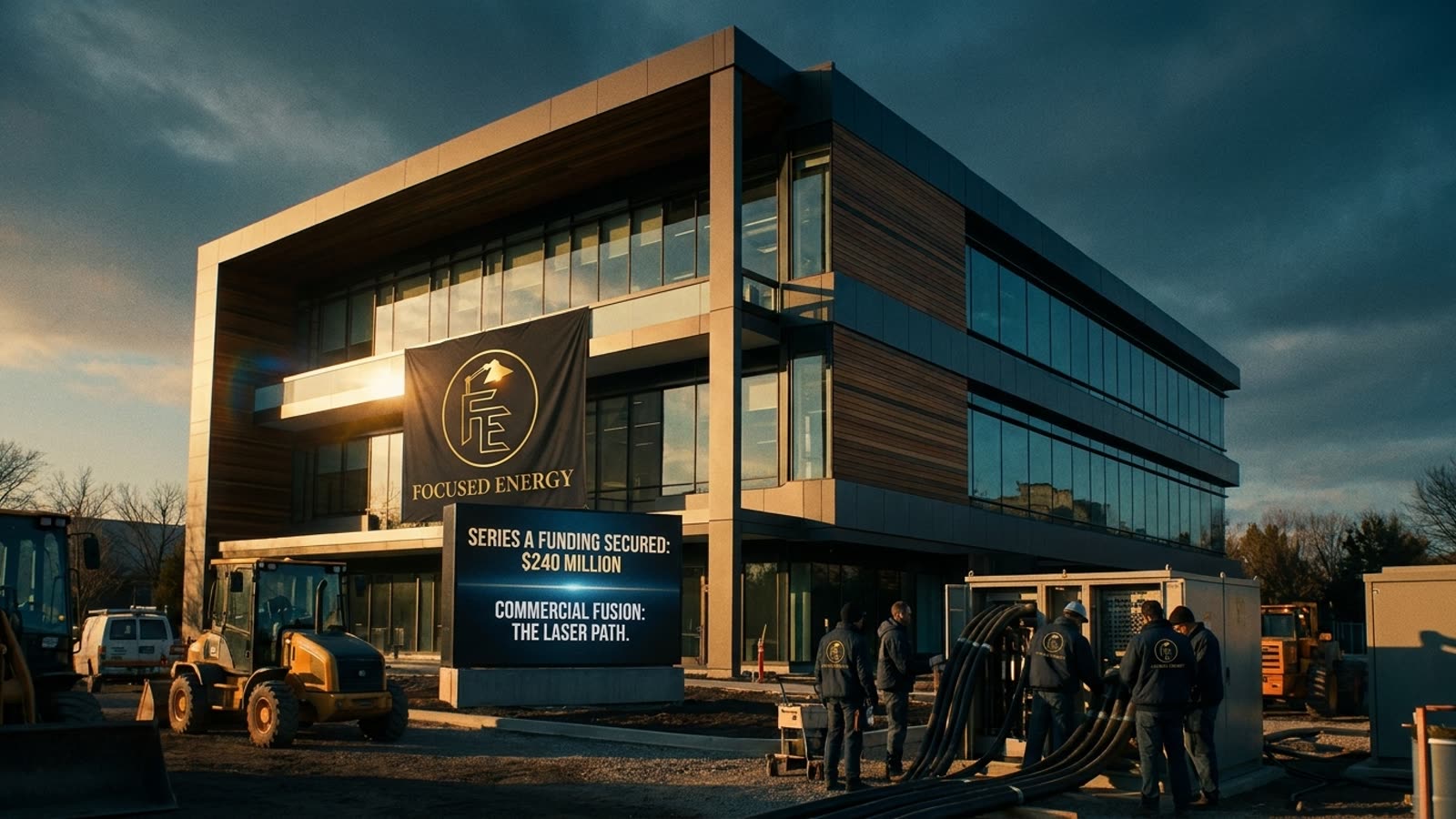
The fusion industry has spent seven decades promising electricity "in twenty years," but the capital markets have decided to stop waiting for the punchline. Focused Energy, a German-American startup pursuing laser-driven inertial confinement fusion, has closed a $240 million Series A—a figure that would have been a respectable growth round for a SaaS company and is, for a pre-revenue physics experiment, genuinely extraordinary.
The round arrives at a peculiar moment for deep-tech funding. Venture capital has spent the past eighteen months chasing generative AI with the fervor of a gold rush, leaving hardware-intensive bets starved of attention. Focused Energy's haul suggests a counter-current: a cohort of investors willing to underwrite decade-long timelines and billion-dollar capex in exchange for the possibility of limitless clean energy.
Why lasers, not tokamaks
Most fusion ventures—Commonwealth Fusion Systems, Helion, TAE Technologies—rely on some variant of magnetic confinement, trapping superheated plasma in doughnut-shaped reactors. Focused Energy is betting on a different physics pathway: firing ultra-high-powered lasers at tiny fuel pellets to trigger micro-explosions. The approach gained credibility in December 2022 when the U.S. National Ignition Facility achieved net energy gain using the same principle, albeit with a facility the size of a stadium and a shot rate measured in days rather than seconds.
Focused Energy's pitch is that advances in laser diodes and target fabrication can shrink the economics. The company, founded by veterans of NIF and Germany's national labs, claims its architecture could eventually fire multiple shots per second—turning a physics demonstration into something resembling a power plant.
The capital calculus
A $240 million Series A is not, by itself, enough to build a commercial reactor; it is enough to prove out key subsystems and attract the next, larger tranche. The round's size reflects a broader repricing of fusion risk. Since NIF's ignition milestone, private fusion companies have collectively raised north of $6 billion, according to the Fusion Industry Association. Investors have grown comfortable with the thesis that even a low-probability, high-magnitude payoff—decarbonizing the grid, powering data centers, enabling synthetic fuels—justifies the ticket.
The timing also matters. With AI infrastructure straining electrical grids from Virginia to Singapore, the demand case for abundant baseload power has never been clearer. Fusion, if it works, sidesteps the intermittency problems of solar and wind and the political baggage of fission.
Our take
Focused Energy's round is less a verdict on laser fusion than a statement about capital allocation in an era of existential bets. The company may spend a decade burning through cash before producing a single commercial watt—or it may never get there at all. But the willingness of sophisticated investors to write nine-figure checks for hard-science moonshots, even as AI sucks oxygen from the room, is itself newsworthy. Fusion has always been a faith-based investment; the faith, at least, is solvent.