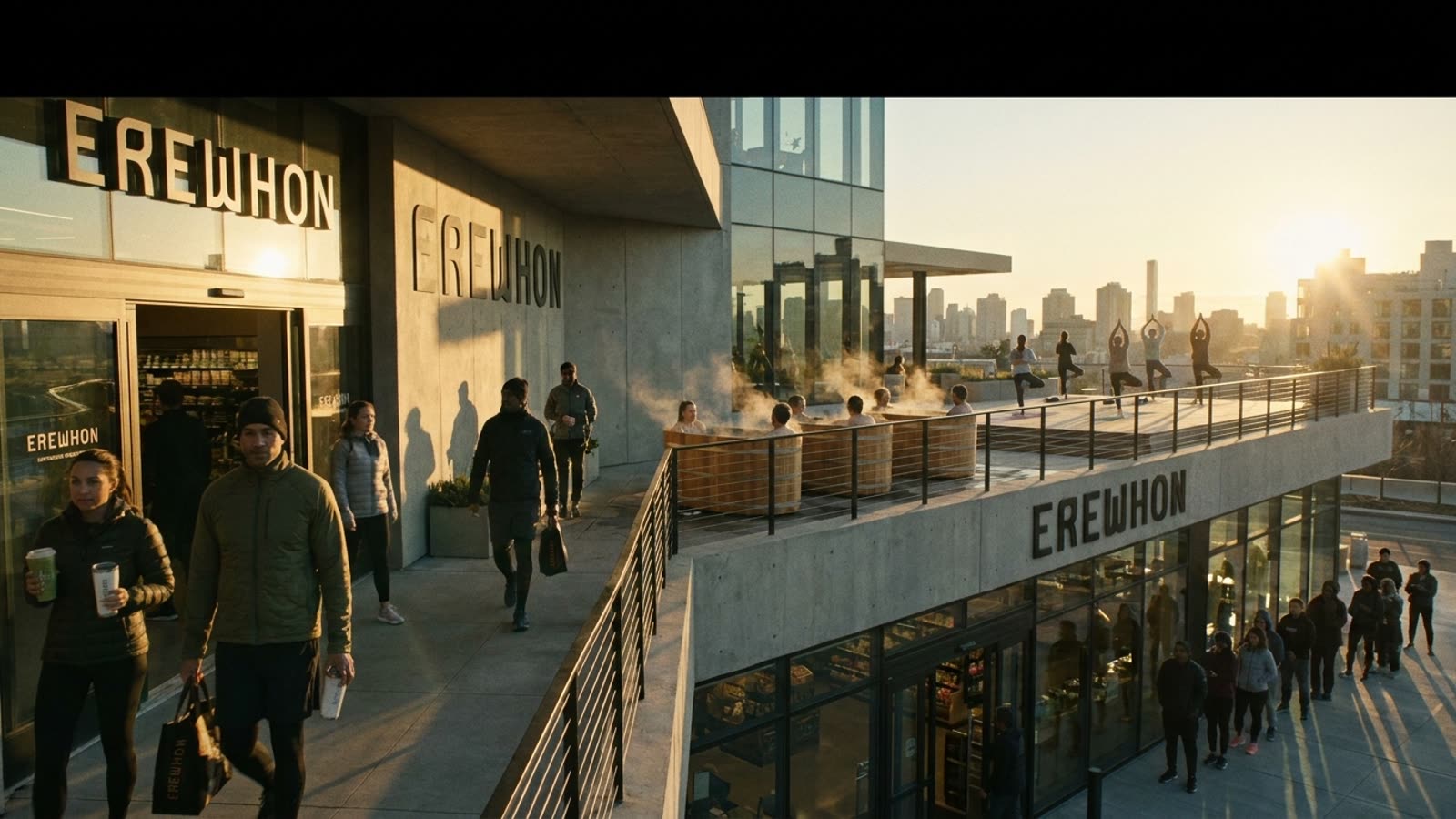
New York used to pride itself on being ungovernable—a city where dinner started at 10 p.m., bars closed when they felt like it, and wellness meant surviving another winter. That city is increasingly difficult to locate. In its place stands something stranger: a coastal metropolis that has imported Los Angeles wholesale, from its Erewhon outposts to its photo-ban restaurants to its pathological fear of staying up past eleven.
The transformation is not subtle. Manhattan's social calendar has shifted earlier by roughly three hours over the past decade, with the most coveted reservations now landing at 6 p.m. rather than 9. Nightclubs that once anchored downtown have either closed or rebranded as "wellness spaces." The city's new power brokers meet at sunrise workouts, not after-hours lounges.
The smoothie as status symbol
Erewhon, the Los Angeles grocery chain that charges $19 for a jar of almond butter and treats celebrity smoothie collaborations as product launches, has become the unlikely totem of this shift. Its expansion into New York—once unthinkable for a brand so aggressively Californian—now feels inevitable. The stores function less as groceries than as social clubs, places where being seen matters more than what you purchase. New Yorkers, it turns out, were hungry for exactly this kind of performative consumption, having exhausted the possibilities of bottle service and gallery openings.
The death of the late night
What disappeared wasn't just a schedule but an entire theory of urban life. New York's old compact held that the city existed to enable excess—that its density and anonymity permitted behaviors impossible elsewhere. The new compact is therapeutic: the city exists to optimize you. Restaurants now enforce phone-free policies not as pretension but as selling points. Fitness studios have replaced nightclubs as the venues where deals get made and relationships form. The question "What are you doing tonight?" has been supplanted by "What time do you wake up?"
Our take
This is not gentrification in the traditional sense—nobody is being priced out of staying up late. It is something more like cultural colonization, the slow replacement of one city's values with another's. Whether you find this development tragic or liberating depends largely on when you were born and how you feel about adaptogenic mushrooms. But the old New York, the one that ran on cigarettes and ambition and the conviction that sleep was for the weak, is not coming back. It has been replaced by something cleaner, earlier, and considerably more expensive. The city that never sleeps has learned to love its eight hours.