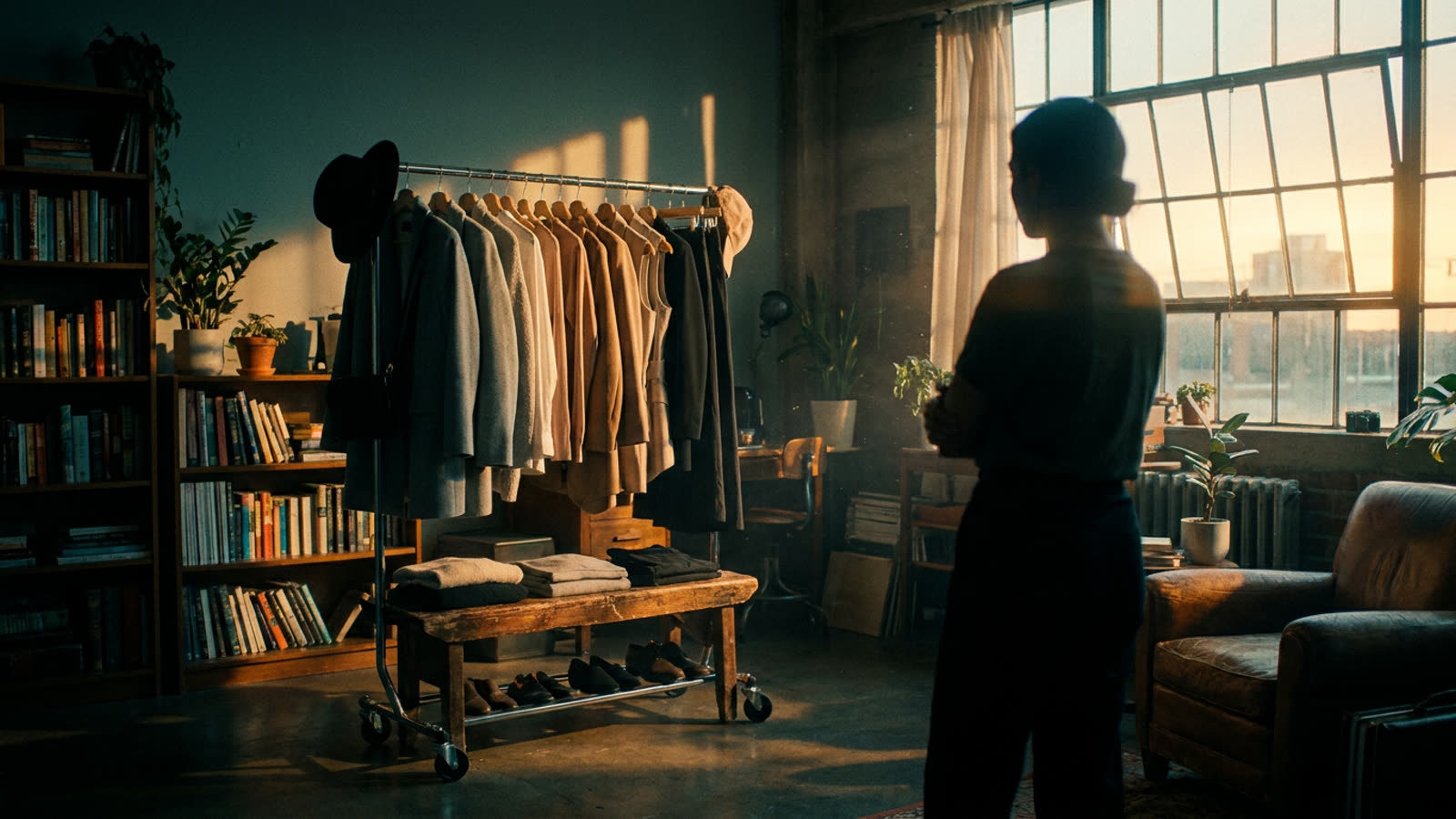
The capsule wardrobe is not, strictly speaking, a fashion idea. It is a coping mechanism dressed in neutral tones.
The term entered the lexicon in the 1970s, coined by Susie Faux, owner of the London boutique Wardrobe. Her proposition was elegant: a small collection of essential, interchangeable pieces that could be supplemented seasonally with trend-driven items. Donna Karan popularized a version of the concept in the mid-1980s with her "Seven Easy Pieces" collection, aimed at working women who needed to look polished without thinking too hard about it. But the capsule wardrobe's true cultural moment arrived decades later, when the internet transformed personal style from a private matter into a public performance requiring constant justification.
The anxiety engine
Scroll through any lifestyle platform and you will find capsule wardrobe content performing remarkably well. The appeal is obvious: in an era of decision fatigue, algorithmic shopping nudges, and closets stuffed with fast fashion regret, the capsule promises liberation through constraint. Thirty-three pieces. Thirty-seven pieces. Forty pieces and no more. The specific number matters less than the existence of a number at all.
What the capsule wardrobe really sells is the fantasy of a solved life. If you can reduce your clothing to a perfect, curated collection, perhaps you can reduce everything else too—your schedule, your relationships, your interior monologue. The capsule is less about fashion than about the contemporary hunger for systems that promise to eliminate the exhausting work of choosing.
The class question
There is, of course, a material reality that the capsule discourse tends to elide. A true capsule wardrobe—one built on quality basics that transcend seasons—requires substantial upfront investment. The women in the original Donna Karan campaign were not shopping at discount retailers. They were buying wool crepe and cashmere, pieces meant to last years.
The democratization of the capsule concept through social media has created a strange tension. Influencers demonstrate their thirty-piece wardrobes while linking to affordable alternatives, but the math rarely works. Cheap basics pill, stretch, and fade. The capsule wardrobe, in its purest form, remains a luxury good masquerading as minimalist virtue.
Why it persists
And yet the concept endures, adapted and readapted across generations and economic circumstances. This persistence suggests the capsule wardrobe addresses something real, even if its promises are oversimplified. The closet is one of the few domains of modern life where an individual can exercise genuine control. You cannot capsule-wardrobe your career, your health insurance, or the housing market. But you can, theoretically, open your closet each morning and feel a small sense of mastery.
The best capsule wardrobe advice acknowledges this psychological dimension rather than pretending the exercise is purely practical. Knowing what you own, understanding what you actually wear, building a visual vocabulary that feels authentically yours—these are worthwhile pursuits, even if they do not require a rigid piece count.
Our take
The capsule wardrobe is neither the revolutionary solution its evangelists claim nor the classist fantasy its critics suggest. It is a useful thought experiment that becomes counterproductive the moment it hardens into dogma. The real insight buried in all that content about neutral palettes and versatile blazers is simpler and older: pay attention to what you put on your body, and why. That advice does not require a spreadsheet or a specific number. It requires only the willingness to be honest with yourself about who you are and who you are trying to become—which is, in the end, what getting dressed has always been about.