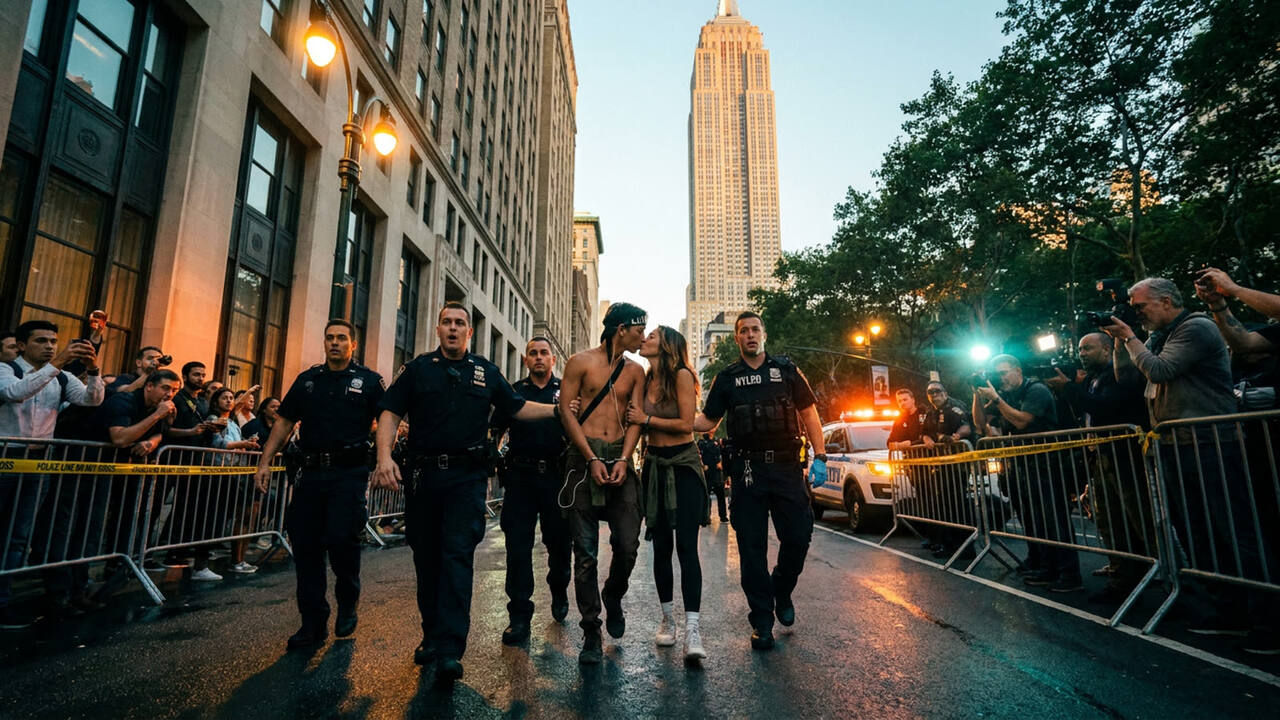
The footage is undeniably cinematic: two figures ascending the Art Deco setbacks of the Empire State Building at dawn, NYPD helicopters circling, the whole of Manhattan spread beneath them like a promise. Hours later, released from custody, they kissed for the cameras. The internet did what the internet does.
This is not a love story. It is a business plan.
The anatomy of a viral moment
The climbers—whose names are already trending, whose Instagram followers have multiplied exponentially since their release—executed what marketing professionals would recognize as a flawless product launch. The location was iconic enough to guarantee news coverage. The timing was calibrated for maximum social media engagement. The kiss provided the emotional payoff that transforms a news item into a shareable narrative.
What distinguishes this particular stunt from the long history of daredevil publicity grabs is the sophistication of its emotional packaging. Previous generations of attention-seekers—tightrope walkers, flagpole sitters, barrel-over-Niagara types—offered spectacle. These climbers offered romance, which is to say, they offered content optimized for the algorithmic preferences of every major platform.
The legal theater
The charges they face are presumably serious enough to satisfy the appearance of consequences without being so severe as to interrupt the monetization window. This, too, follows an established playbook. The modern attention economy has discovered that a night in jail functions as a kind of authentication—proof that the stunt was real, that risks were taken, that the protagonist is not merely performing but living.
New York City, for its part, finds itself in an awkward position. Prosecuting too harshly risks creating martyrs; prosecuting too leniently invites imitation. The Empire State Building's owners must weigh the security implications against the undeniable fact that their building just received more free publicity than their marketing budget could purchase in a decade.
The influencer pipeline
What happens next is predictable because we have seen it before. Podcast appearances. A documentary deal, probably. Brand partnerships with outdoor equipment companies willing to overlook the illegality in exchange for association with the viral moment. Perhaps a book proposal, though books are increasingly optional in the modern fame trajectory.
The climbers have, in effect, performed the labor of becoming famous. The kiss was the closing argument—a signal to potential business partners that they understand the assignment, that they can deliver not just spectacle but narrative, not just content but emotion.
Our take
There is something almost admirable about the efficiency of it all, even as it leaves a faintly sour taste. The Empire State Building stunt represents the logical endpoint of a culture that has systematically collapsed the distinction between achievement and performance, between doing something and being seen doing something. The climbers broke the law, certainly, but they also understood something true about how fame works in 2026: the act matters less than the story you tell about it afterward. That kiss was not spontaneous. It was a pitch deck.