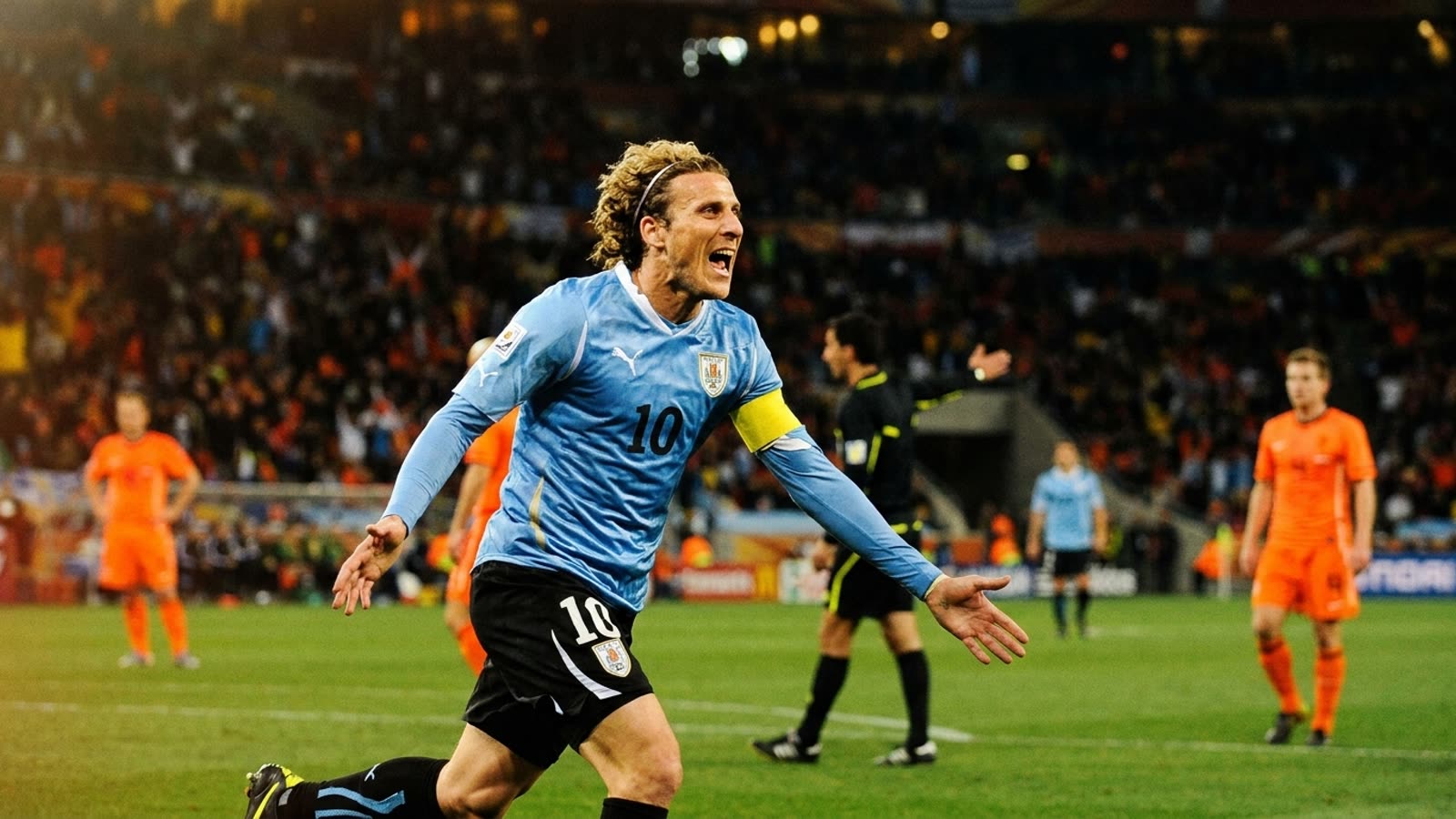
The Golden Ball at a World Cup is supposed to anoint the tournament's dominant force, the player who bent the competition to his will. Diego Forlán won it in 2010 by doing something subtler and more affecting: he made an entire nation believe it could matter again.
Uruguay arrived in South Africa as afterthoughts. A country of three million people, two ancient World Cup trophies gathering dust, and a squad that had barely qualified. Forlán was their talisman, but he was also 31, playing for Atlético Madrid in a league that English pundits still dismissed as a stepping stone. His career arc had been written off years earlier, when Manchester United sold him after just 17 league goals in two and a half seasons. He was, by the conventional wisdom of the time, a player who couldn't cut it at the highest level.
The redemption no one saw coming
What Forlán did in South Africa was not merely score goals, though he scored five, tied for the tournament lead. It was the manner of them. A swerving free kick against South Africa. A thunderous strike from distance against Germany. A nerveless penalty in the quarterfinal shootout against Ghana. Each goal carried the weight of a country's aspirations, and Forlán bore it with an almost unsettling calm.
The semifinal against the Netherlands ended in defeat, but not before Forlán had hit the crossbar in extra time with a shot that, had it dropped an inch lower, would have sent Uruguay to the final. The third-place match against Germany was a 3-2 loss, yet Forlán scored again. He was everywhere, and then he was done.
Why the timing matters
Footballers peak at different ages, but the window for World Cup glory is mercilessly narrow. The tournament arrives every four years, indifferent to personal form or circumstance. Forlán's previous World Cup, in 2002, had been a disaster—Uruguay eliminated in the group stage, the player anonymous. His next, in 2014, would see him as a 35-year-old substitute, a sentimental inclusion.
The 2010 edition caught him at the precise intersection of experience, physical capacity, and psychological readiness. He had spent years rebuilding his reputation in Spain, winning two Pichichi trophies as La Liga's top scorer, learning to lead rather than defer. When the moment came, he was ready in a way he could not have been at 23 or 27.
The loneliness of the late bloomer
Forlán's story resonates because it defies the cult of prodigy that dominates football discourse. We celebrate teenagers who arrive fully formed, and we are quick to write off those who struggle early. Forlán's failure at Old Trafford could have defined him. Instead, it became a footnote to a career that reached its zenith on the biggest stage.
There is something almost novelistic about his trajectory: the son of a former Uruguayan international, carrying his father's unfulfilled World Cup dreams; the humiliation in England; the slow, patient reconstruction in Villarreal and then Atlético; and finally, the golden summer in South Africa. It is a story about persistence, certainly, but also about the strange alchemy of timing and circumstance that separates the remembered from the forgotten.
Our take
The Golden Ball is often awarded to players from successful teams, a consolation prize for the runner-up or a rubber stamp for the champion's best performer. Forlán won it while his team finished fourth, which tells you everything about how undeniable his performances were. More than a decade later, his tournament remains a reminder that careers are not linear, that peak moments arrive on their own schedule, and that the sport's greatest stories are often written by those who refused to accept the ending others had scripted for them.