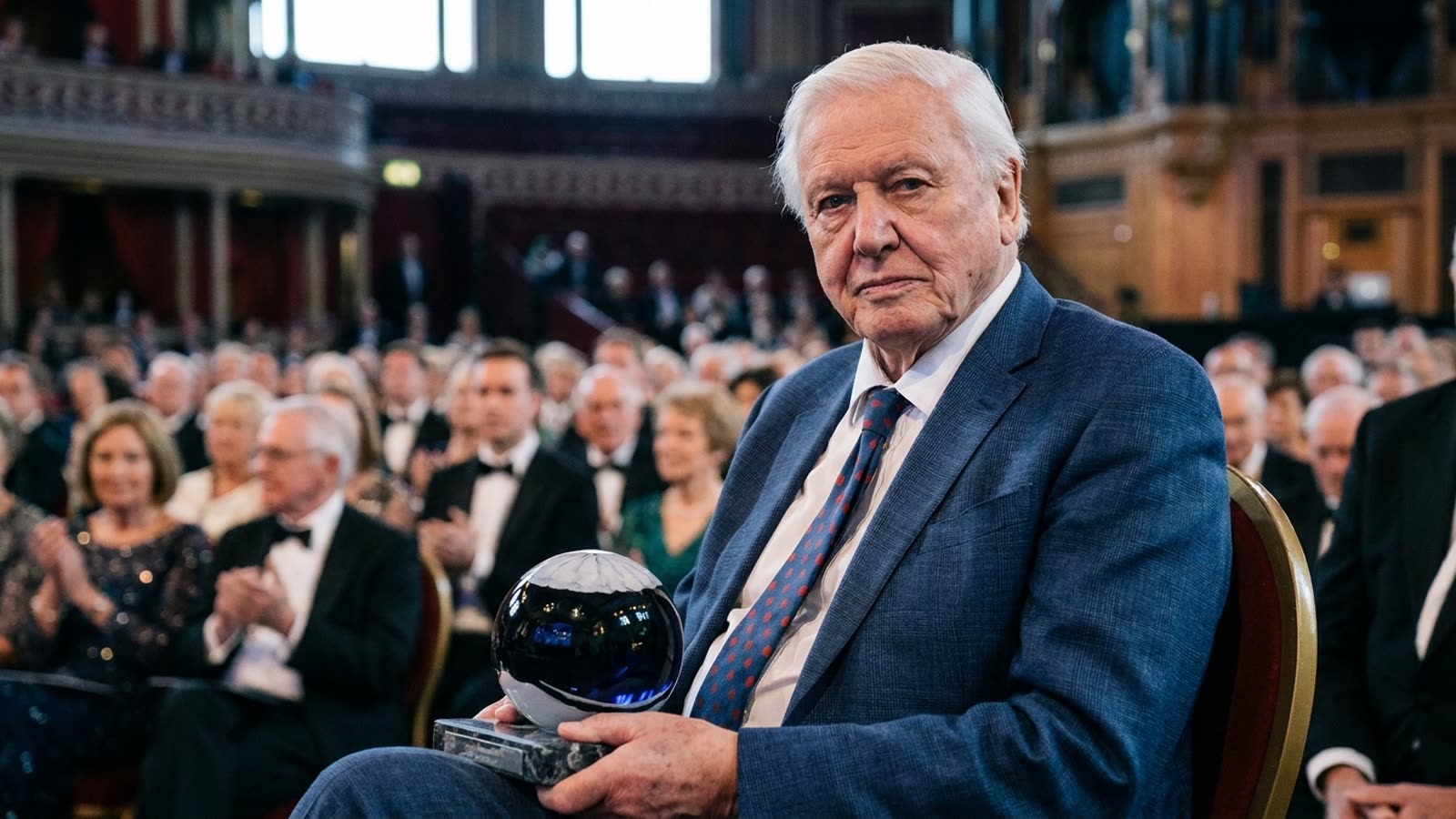
There is no one else in public life for whom a centennial birthday could plausibly unite King Charles III, Prince William, Kate Winslet, Leonardo DiCaprio, Cate Blanchett, and two surviving members of Monty Python in a single room without anyone finding the guest list odd. David Attenborough has spent so long as the voice of nature documentaries that he has become something rarer: a genuinely universal figure, claimed by environmentalists and nostalgists, by the BBC establishment and by TikTok accounts that remix his narration over capybara footage.
The gala at London's Royal Albert Hall on Friday evening was, by all accounts, precisely the kind of event Attenborough has always seemed mildly embarrassed to attend. Tributes from the royals were sincere and slightly stiff; DiCaprio's video message leaned on their shared climate advocacy; Winslet recalled watching The Blue Planet with her children. The real draw was archival footage—decades of Attenborough crouching beside mountain gorillas, whispering at bird-of-paradise mating dances, and lying flat in the Borneo mud to get eye-level with a beetle.
The longevity paradox
Attenborough's career is so long that it predates the very concept of the nature documentary as prestige television. He joined the BBC in 1952, became controller of BBC Two in 1965, and could have spent the rest of his life as a broadcasting executive. Instead, he returned to fieldwork and, in 1979, began Life on Earth, the series that established the template still used today: slow-building sequences, orchestral scores, and Attenborough's voice threading wonder through scientific fact.
That he is still working at 100—a new series is reportedly in post-production—is less a testament to modern medicine than to a particular kind of English stubbornness. Attenborough has never stopped because, by his own account, the work is not finished. His later documentaries have shifted from celebration to elegy, cataloging extinction rates and coral bleaching with the same measured cadence he once used for elephant migrations.
What the tributes revealed
The presence of Charles and William was unsurprising; the royal family has long treated Attenborough as a kind of secular saint, and the feeling appears mutual. More interesting was the breadth of the entertainment contingent. Blanchett and Winslet are both vocal climate advocates, but DiCaprio's appearance underscored how Attenborough has become the acceptable face of environmentalism for people who might otherwise tune out. He is not angry, not accusatory, not young. He simply describes what he has seen, and lets the loss speak for itself.
The Monty Python reunion—John Cleese and Michael Palin, both in their eighties—added a note of absurdist levity. Palin, who has spent his post-Python decades as a travel documentarian, joked that Attenborough had "ruined the curve for the rest of us."
Our take
Attenborough's centennial is a reminder that longevity in public life is not, by itself, an achievement. What matters is whether the work endures, and whether the person remains curious. By both measures, Attenborough is unmatched. He has outlived most of the ecosystems he first filmed, and he has spent his final decades making sure we understand exactly what we are losing. The gala was a celebration, but it was also, quietly, a wake—for the biodiversity that will not see its own centennial, and for the era when a single voice could make a planet feel knowable.