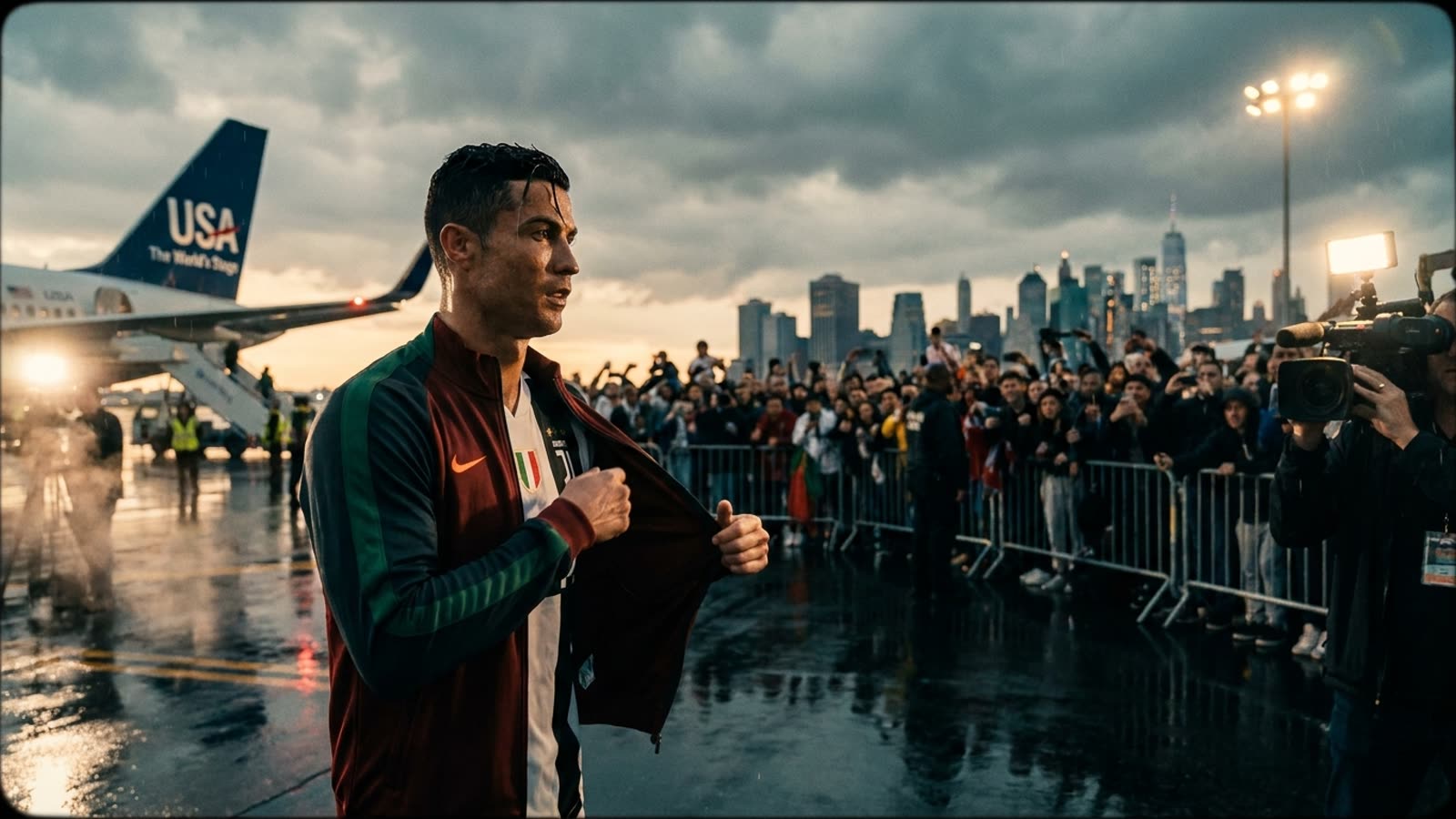
The private jet touched down in New Jersey on Friday, and with it came the familiar theater: the sculpted jaw, the designer luggage, the phone cameras of airport staff capturing content for accounts that will never matter. Cristiano Ronaldo, 41 years old and playing his club football in Saudi Arabia for a reported $200 million annually, has arrived for what even his most devoted followers must acknowledge is a farewell tour.
The numbers remain absurd. Ronaldo is the most followed person on Instagram, his 650 million followers dwarfing entire nations. He has scored more international goals than any player in history. He has won everything the sport offers except, crucially, a World Cup—and this tournament, hosted partly in the country that has never quite known what to make of him, represents his final chance.
The body versus the brand
The uncomfortable truth Portugal must navigate is that Ronaldo in 2026 is two separate entities. The brand has never been stronger: the social media empire, the hotels, the underwear, the documentary crews that follow him like pilot fish. The footballer, however, has become a liability that his national team coach Roberto Martínez cannot publicly acknowledge.
At Al-Nassr, Ronaldo scores freely against defenders who would struggle in the English Championship. But the Saudi Pro League is not the World Cup, and the explosive acceleration that once terrorized Sergio Ramos and Giorgio Chiellini has long since departed. In Portugal's recent qualifiers, he was frequently their least mobile attacker, dropping deep to collect the ball and slowing transitions that Bruno Fernandes and Rafael Leão would prefer to run at speed.
The squad knows this. The coaching staff knows this. Portuguese media, never shy about their opinions, has spent months debating whether the captain's armband has become a ceremonial burden. Yet benching Ronaldo remains unthinkable—not because of his current ability, but because of the commercial and political consequences that would follow.
America's complicated relationship
Ronaldo's arrival also highlights soccer's peculiar status in the United States. He is simultaneously one of the most famous athletes on the planet and someone the average American sports fan could not pick out of a lineup. The World Cup aims to change that calculus, but Ronaldo's presence cuts both ways: he draws casual eyeballs while representing exactly the kind of aging-star spectacle that has historically defined American soccer consumption.
MLS spent years as a retirement league for European names past their prime—Beckham, Henry, Pirlo—before pivoting toward younger talent and competitive credibility. Ronaldo in 2026 is the ghost of that old model, arriving not to play in America but merely to perform one last time on its soil.
Portugal opens their campaign against Poland on Monday, a match they should win regardless of Ronaldo's involvement. The deeper rounds, should they arrive, will pose harder questions.
Our take
There is something melancholy about watching greatness negotiate with time. Ronaldo has earned the right to define his own exit, and if that exit involves one more World Cup in which he starts every match through sheer force of celebrity, so be it. But Portugal's genuine title hopes—and they have a squad capable of winning this tournament—may require Martínez to do something no coach has managed: tell the most famous footballer alive that the game has moved on. The smart money says he won't. The smart money is probably right.