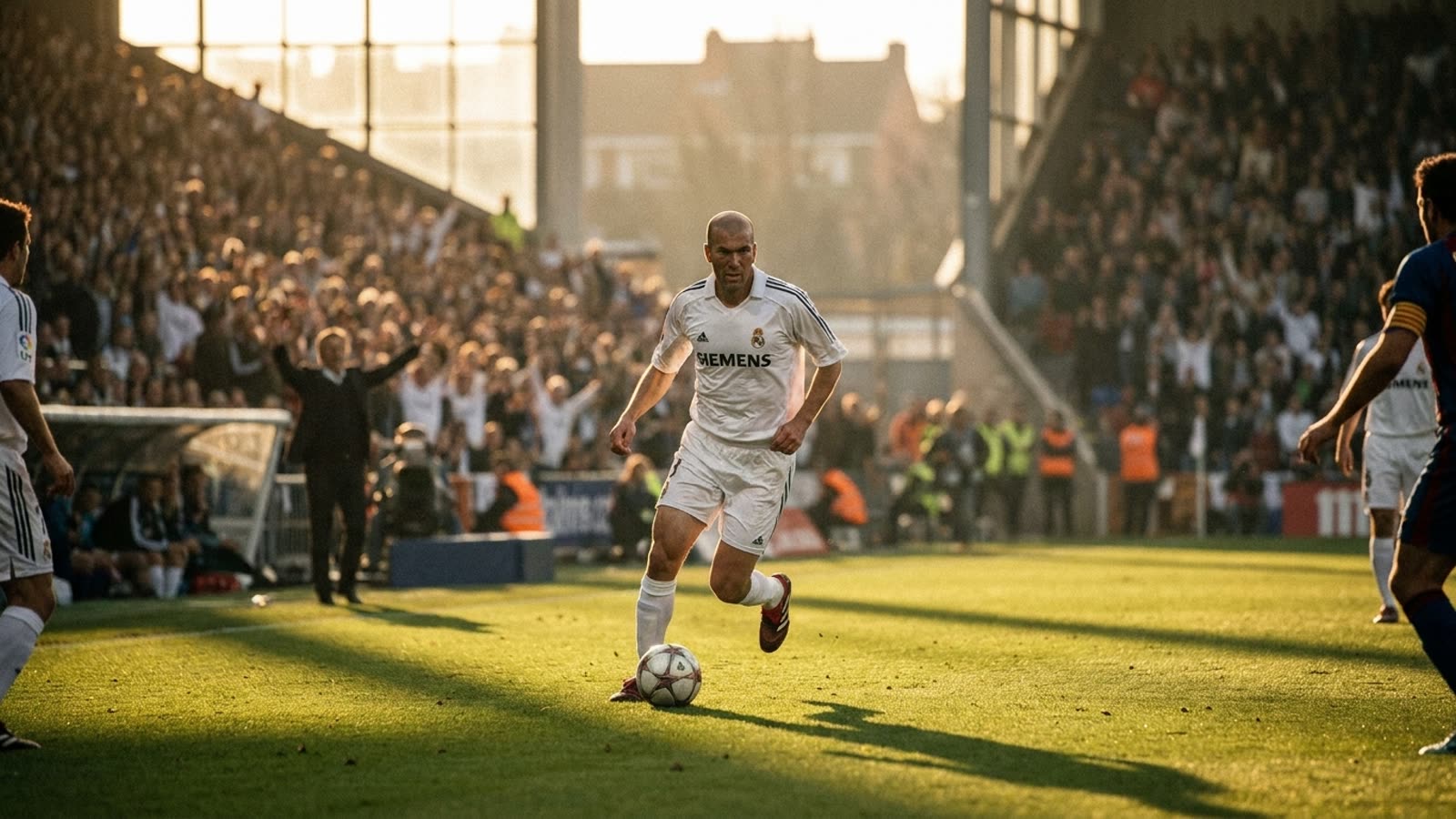
Zinedine Zidane was ninety minutes from the perfect ending. The greatest midfielder of his generation, playing his final professional match, had already scored a nerveless Panenka penalty to give France the lead against Italy in the 2006 World Cup final. He was gliding through Berlin's Olympiastadion like a man determined to write his own farewell in gold leaf. Then Marco Materazzi said something, and Zidane drove his skull into the Italian defender's chest, and everything shattered.
The red card, the lonely walk past the trophy, the extra-time collapse, the Italian triumph—all of it has been replayed endlessly. But what endures is not the tactical consequence or even the result. It is the sheer, bewildering humanity of the act. Here was a player who had spent two decades mastering the art of composure, whose entire genius resided in his preternatural calm under pressure, undone by words we still do not fully know.
The weight of the moment
Zidane had already delivered one of the great World Cup final performances. His penalty, a delicate chip down the center as Gianluigi Buffon dove left, required either supreme confidence or supreme indifference—possibly both. His control of midfield was imperious. At thirty-four, playing through chronic injuries, he was somehow better than he had been at twenty-four. The script was obvious: France wins, Zidane lifts the trophy, retirement becomes canonization.
Instead, the script became tragedy. Materazzi's provocation—reportedly involving Zidane's sister—found the one nerve that technique could not protect. The headbutt was not calculated or strategic. It was pure, unfiltered rage, the kind that bypasses the brain entirely. Zidane later said he would rather die than apologize to Materazzi. He meant it.
Genius and its shadows
The incident forced a reckoning with how we construct sporting legends. Zidane's career was already studded with moments of volcanic temper—the stamp on a Saudi Arabian player in 1998, the headbutt on a Hamburg defender in 2000, assorted red cards that suggested a man perpetually at war with his own intensity. We had chosen to treat these as footnotes, minor blemishes on an otherwise immaculate canvas. Berlin made that impossible.
What emerged was something more interesting than a simple fall from grace. Zidane's headbutt humanized him in ways his balletic turns and impossible volleys never could. The roulette, the Champions League final winner against Bayer Leverkusen, the destruction of Brazil in 2006—these belonged to football's highlight reels, perfect and untouchable. The headbutt belonged to everyone who had ever lost control at precisely the wrong moment, who had ever let emotion override every rational instinct.
Our take
Sporting immortality usually demands a clean narrative arc, but Zidane's career resists that neatness. He remains one of the five or six greatest players in football history, and his final act remains one of the sport's most confounding moments. The headbutt did not diminish his legacy so much as complicate it, adding a layer of tragic fallibility to a career otherwise defined by grace. Perhaps that is why it still resonates: not because it revealed Zidane as flawed, but because it reminded us that even transcendence has its limits. The beautiful game, it turns out, is played by people.