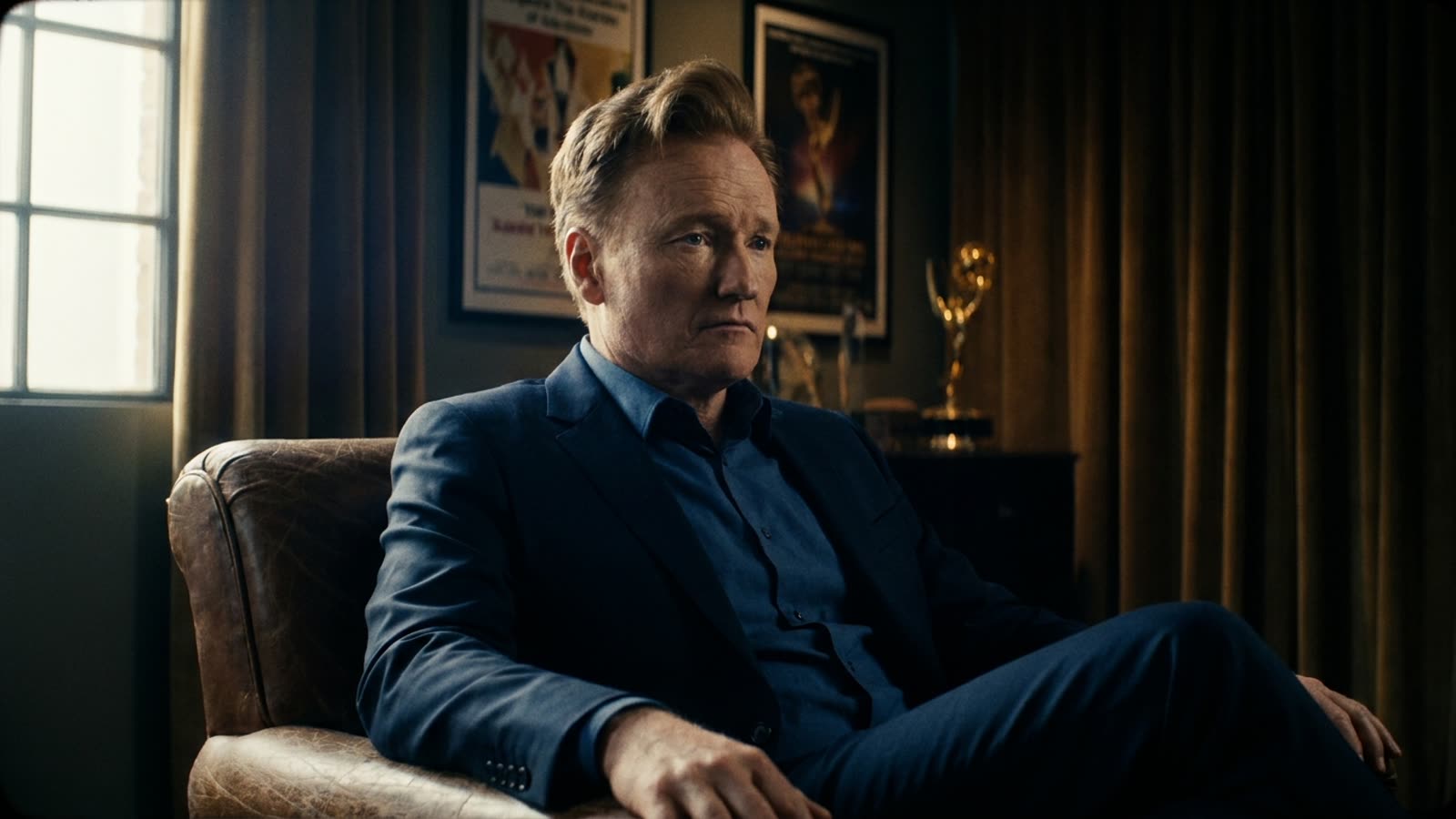
The Academy of Motion Picture Arts and Sciences announced Tuesday that Conan O'Brien will return to host the 2027 ceremony, making him the first person to emcee three consecutive Oscar telecasts since the format's chaotic reinvention era began in the mid-2010s. Producers Raj Kapoor and Katy Mullan, now in their fourth year, will return alongside head writers Jeff Ross and Mike Sweeney, creating what amounts to an institutional lock on the show's creative direction.
This is not how the Oscars have operated in living memory. For the better part of a decade, the ceremony treated its host slot like a high-stakes casting call, cycling through comedians, actors, and occasionally no one at all, each choice generating its own news cycle of speculation, backlash, and post-mortem analysis. The 2019 hostless experiment, born from Kevin Hart's withdrawal, was declared a success largely because expectations had cratered. The subsequent years brought more experiments, more anxiety, more thinkpieces about whether the telecast could survive its own identity crisis.
The O'Brien thesis
O'Brien's first outing in 2025 was a calculated risk that paid off in ways the Academy hadn't experienced in years. His style—self-deprecating, institutionally skeptical, allergic to earnestness—turned out to be precisely what a room full of nervous celebrities needed. He mocked the show's bloat without contempt, honored the winners without sycophancy, and kept the broadcast moving without visible panic. Ratings didn't surge, but they stabilized, and the cultural conversation shifted from "what went wrong" to "that was fine, actually."
His 2026 return confirmed the pattern. The Academy, an organization constitutionally incapable of leaving well enough alone, appears to have finally internalized a lesson that late-night television learned decades ago: audiences don't want to be surprised by their host. They want to be comfortable.
What stability costs
The O'Brien era does raise a question the Academy would prefer to avoid: has the Oscars conceded that it cannot generate excitement on its own terms? The host carousel, for all its chaos, produced genuine cultural moments—Ellen's selfie, the Moonlight-La La Land envelope disaster, Chris Rock's opening monologue in 2016. A three-peat signals that the Academy has stopped chasing virality and started managing decline.
This isn't necessarily a criticism. The Oscars remain the industry's most-watched self-congratulation, and there's something to be said for a ceremony that knows what it is. O'Brien, at 63, brings the authority of someone who has already outlasted multiple television formats. He doesn't need the Oscars to validate his career, which makes him the rare host who can treat the gig as a job rather than an audition.
Our take
The Academy's decision to bring O'Brien back is less a creative choice than an admission: the Oscars have entered their legacy phase. The show will never again be the monocultural event it was in the network-television era, and no host can reverse that trajectory. What O'Brien offers is something more modest and more valuable—a steady hand on a broadcast that has spent too many years lurching between reinvention and nostalgia. Three consecutive years isn't a streak; it's a strategy. The Academy has finally stopped asking what the Oscars could be and started accepting what they are.