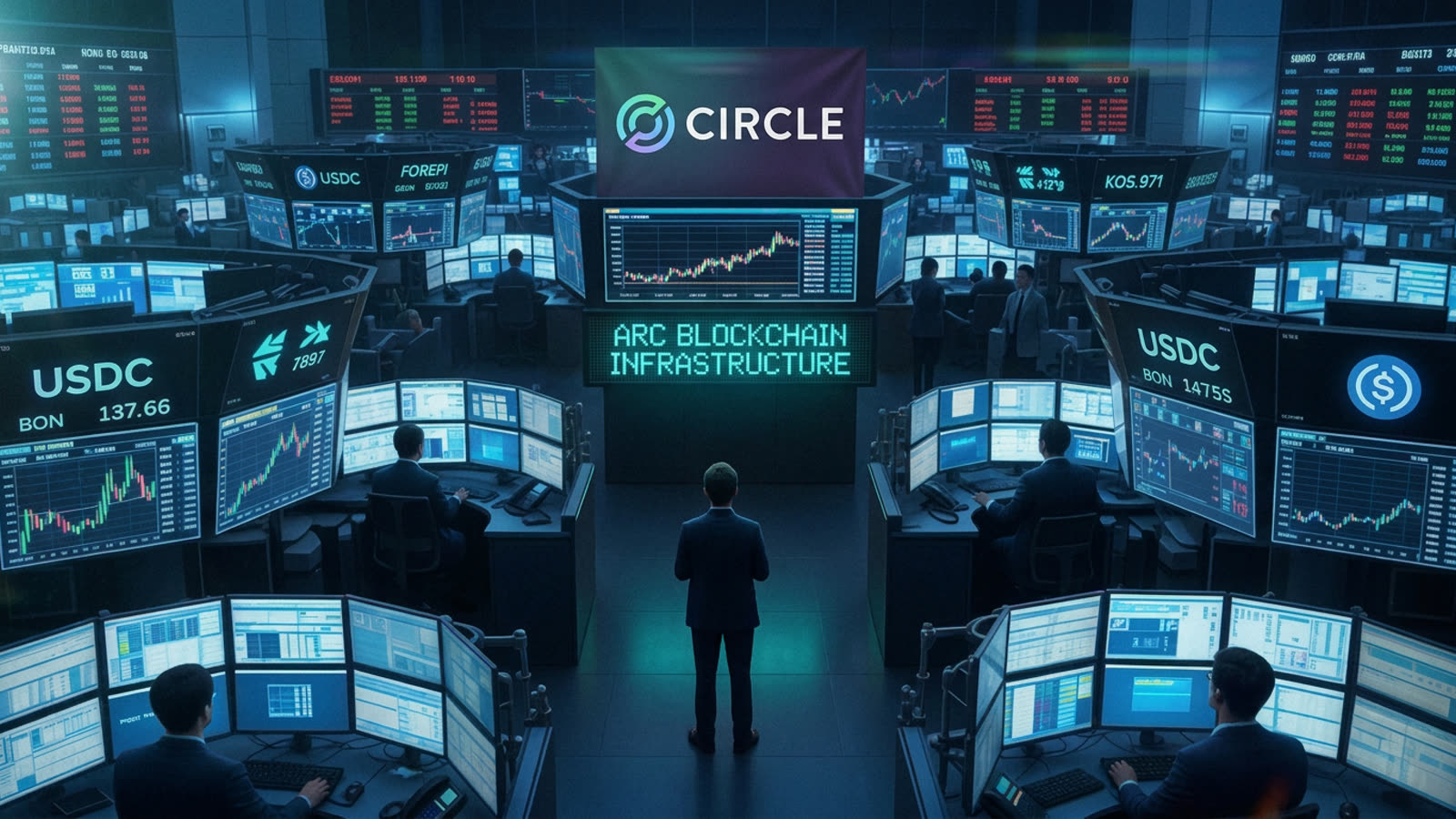
The company that made stablecoins boring—in the best possible sense—now wants to own the rails they travel on. Circle, issuer of the $60 billion USDC stablecoin, is developing Arc, a purpose-built blockchain designed to optimize stablecoin transfers, programmable payments, and institutional settlement. It is a bet that the future of digital dollars belongs not just to whoever prints them, but to whoever controls the infrastructure beneath them.
The move reframes Circle's competitive position. For years, USDC has played the compliant, transparent alternative to Tether's USDT, winning market share through regulatory friendliness rather than aggressive expansion. But compliance alone does not build moats. Tether remains dominant, and newer entrants—PayPal's PYUSD, Ripple's RLUSD—are circling the same institutional clients Circle covets. Arc is Circle's answer: vertical integration.
Why build a chain?
Stablecoins currently live as tenants on other people's blockchains. USDC circulates on Ethereum, Solana, Base, Arbitrum, and a dozen other networks, each with its own fee structures, finality times, and liquidity fragmentation. Circle captures minting and redemption fees, but the underlying networks capture transaction value. Arc flips that equation. By controlling the base layer, Circle can optimize for stablecoin-specific use cases—instant settlement, programmable compliance, lower fees for high-volume institutional flows—while capturing more of the economic activity USDC generates.
The approach mirrors what Coinbase achieved with Base, its Ethereum Layer 2. Base gave Coinbase a home-field advantage for on-chain activity originating from its exchange, plus a share of sequencer revenue. Circle appears to be pursuing similar logic: if USDC is going to move trillions of dollars annually, Circle wants a cut of every basis point.
The institutional angle
Arc's design reportedly emphasizes features that matter to banks and payment processors: identity layers, compliance hooks, and settlement guarantees. This is not a chain for retail degens trading memecoins. It is infrastructure for the same institutions Circle has spent years courting—the BlackRocks and BNY Mellons exploring tokenized assets. The timing aligns with broader Wall Street interest in blockchain settlement; just this week, DTCC announced plans to bring tokenized assets to Stellar. Circle is positioning Arc as the stablecoin-native alternative to such experiments.
The risk is fragmentation. If every major stablecoin issuer builds its own chain, interoperability suffers. USDC's current strength is its ubiquity across ecosystems. A Circle-controlled chain could cannibalize that network effect, or it could become just another island in an increasingly balkanized crypto landscape.
Our take
Circle building Arc is the logical endgame of stablecoin competition. When your product is a commodity—dollars are dollars—differentiation comes from infrastructure, speed, and integration. Tether won the offshore market through sheer liquidity and willful opacity. Circle is betting it can win the regulated market through vertical control. Whether Arc becomes essential plumbing or an expensive distraction depends on execution, but the strategic intent is sound: in crypto, as in payments, owning the rails beats renting them.