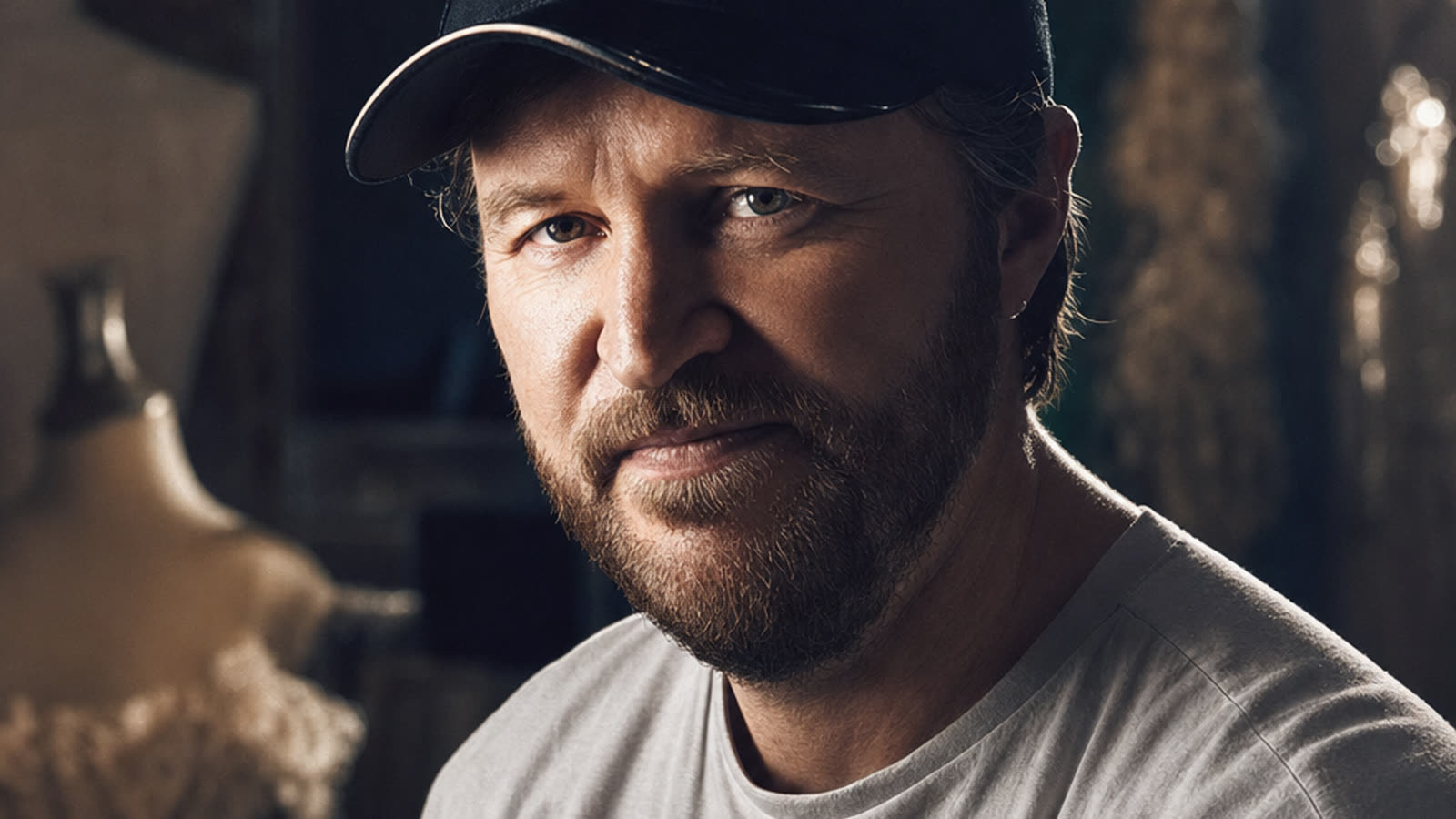
The most compelling fashion story of the 1990s was never really about clothes. It was about a working-class boy from Lewisham who cut fabric like a surgeon and a blue-blooded eccentric who wore lobsters on her head — and the strange, symbiotic love that bound them until it destroyed one of them. Now Andrew Haigh, the British director who has made a career of excavating the architecture of intimate relationships, is bringing Alexander McQueen and Isabella Blow to the screen in "Wild Bird," a short film that pairs Russell Tovey as the designer with Olivia Colman as his discoverer and greatest champion.
The casting alone is a statement. Tovey, compact and coiled, shares McQueen's East London energy and physical intensity; Colman, chameleonic and capable of devastating emotional precision, seems born to capture Blow's manic aristocratic fragility. That Haigh is working again with producer Sarah Brocklehurst, his collaborator on "All of Us Strangers," suggests this is no vanity exercise but a serious attempt to distill one of fashion's most mythologized relationships into something emotionally true.
Why this story, why now
McQueen died by suicide in 2010, days after Blow's own death by the same means three years earlier. Their relationship — she bought his entire graduate collection for £5,000, launched his career, and was later frozen out as he ascended to Givenchy — has been the subject of documentaries, biographies, and endless retrospectives. But it has never been dramatized with actors of this caliber under a director of this specificity. Haigh's gift is for showing how people fail each other in small, irreversible ways; the McQueen-Blow dynamic, with its class tensions, creative codependency, and mutual destruction, is ideal material for his sensibility.
The short-film calculation
That "Wild Bird" is a short rather than a feature is intriguing. It suggests either a proof-of-concept for a larger project or a deliberate choice to capture a single moment rather than a sprawling biopic. Given Haigh's recent trajectory — "All of Us Strangers" was a modest commercial success that dominated awards conversations — a short film allows experimentation without the burden of a full production apparatus. It also positions the project for festival play at Cannes, Venice, or Telluride, where a 20-minute Haigh film starring Colman would be an instant prestige acquisition.
The fashion-film problem
Fashion has historically resisted good cinema. The industry is too insular, too visual, too dependent on surfaces that flatten under dramatic scrutiny. The best fashion films — "Phantom Thread," "The September Issue" — succeed by treating clothes as symptoms of deeper psychological conditions rather than objects of worship. Haigh understands this instinctively. His films are about what people cannot say to each other, the silences that accumulate into tragedy. McQueen and Blow communicated through fabric, through spectacle, through gestures of extravagant devotion that masked profound mutual need. That is Haigh's territory.
Our take
This is the rare fashion-adjacent project that feels genuinely exciting rather than obligatory. Haigh has earned the right to tell difficult stories about difficult people, and the McQueen-Blow relationship is one of the great unresolved narratives of recent cultural history — a love story, a class drama, and a cautionary tale about the cost of genius, all compressed into a decade of runway shows and tabloid tragedy. If "Wild Bird" works, it will not be because it explains McQueen or Blow but because it captures the specific texture of their entanglement. That is a harder thing, and a more valuable one.