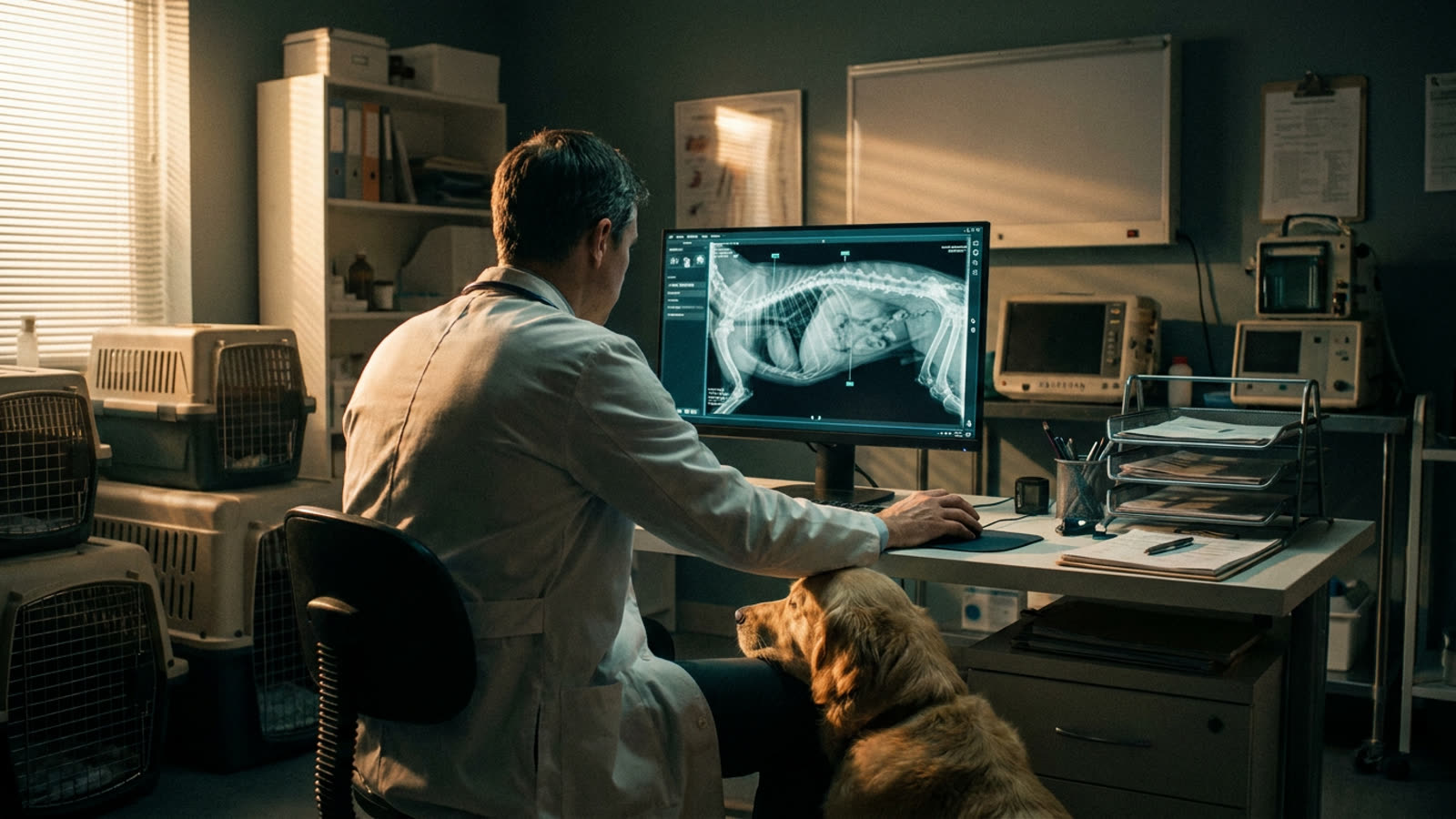
Veterinary medicine has always been an exercise in translation. The patient cannot describe the pain, point to the ache, or explain when symptoms began. For generations, this interpretive challenge made the profession unusually dependent on practitioner intuition—the accumulated pattern recognition of thousands of exams distilled into a hunch. Now that hunch has company.
Across veterinary clinics in North America, Europe, and increasingly Asia, AI-powered diagnostic tools have become unremarkable features of daily practice. Radiograph analysis software flags suspicious masses. Dermatology apps parse skin lesion photographs. Cardiac monitoring systems detect arrhythmias in real time. The technology arrived not with fanfare but with the quiet pragmatism that characterizes a profession accustomed to working with imperfect information.
The appeal of the algorithmic second opinion
Unlike human medicine, where AI adoption has been slowed by regulatory caution, liability concerns, and physician resistance, veterinary practice offered a more permissive proving ground. The regulatory pathway is simpler. Malpractice exposure is lower. And crucially, veterinarians—often working alone or in small practices without specialist colleagues down the hall—genuinely wanted help.
The economics reinforced the appeal. Referring a pet to a veterinary radiologist for a second read might cost the client substantial additional fees and delay treatment by days. An AI system that provides a probabilistic assessment in seconds, for a fraction of the cost, solved a real workflow problem. Practitioners describe it less as replacement than as augmentation—a tireless colleague who never takes lunch and never forgets a rare presentation.
What the machines see and miss
The technology performs unevenly across domains. Radiograph analysis has proven the strongest use case; the structured, two-dimensional nature of X-rays suits machine learning well, and the systems have demonstrated genuine utility in detecting subtle orthopedic abnormalities and early-stage tumors that might escape a rushed first glance. Dermatology tools show promise but struggle with the variability of real-world photographs taken under inconsistent lighting. Behavioral analysis—attempts to diagnose pain or anxiety from video—remains largely aspirational.
Veterinarians who have integrated these tools report a consistent pattern: the AI is most valuable not when it confidently identifies a condition but when it expresses uncertainty about something the practitioner had dismissed. The flag that says "this region warrants closer examination" has caught findings that might otherwise have waited until the next visit, or the one after that.
The profession adapts
The cultural response has been notably undramatic. Veterinary medicine lacks the prestige anxieties that complicate AI adoption in human healthcare. Practitioners tend toward practical problem-solving rather than jurisdictional defensiveness. The prevailing attitude might be summarized as: if it helps the animal, use it.
Yet the integration raises questions the profession is only beginning to address. How should AI-assisted findings be documented? What happens when the algorithm and the veterinarian disagree? Who bears responsibility for a missed diagnosis when the software was available but not consulted? Veterinary schools are starting to incorporate AI literacy into curricula, though consensus on best practices remains elusive.
Our take
Veterinary medicine's quiet embrace of AI diagnostics offers a useful counterpoint to the overwrought discourse surrounding the technology elsewhere. Here is a profession that adopted algorithmic assistance not because it was forced to, not because venture capitalists demanded disruption, but because practitioners identified a genuine gap and found a tool that helped close it. The lesson is not that AI will replace professional judgment—veterinarians remain firmly in charge of treatment decisions—but that the professions most likely to benefit from these systems are those humble enough to acknowledge what they might be missing. The dog cannot tell you where it hurts. Sometimes the algorithm can point you in the right direction.