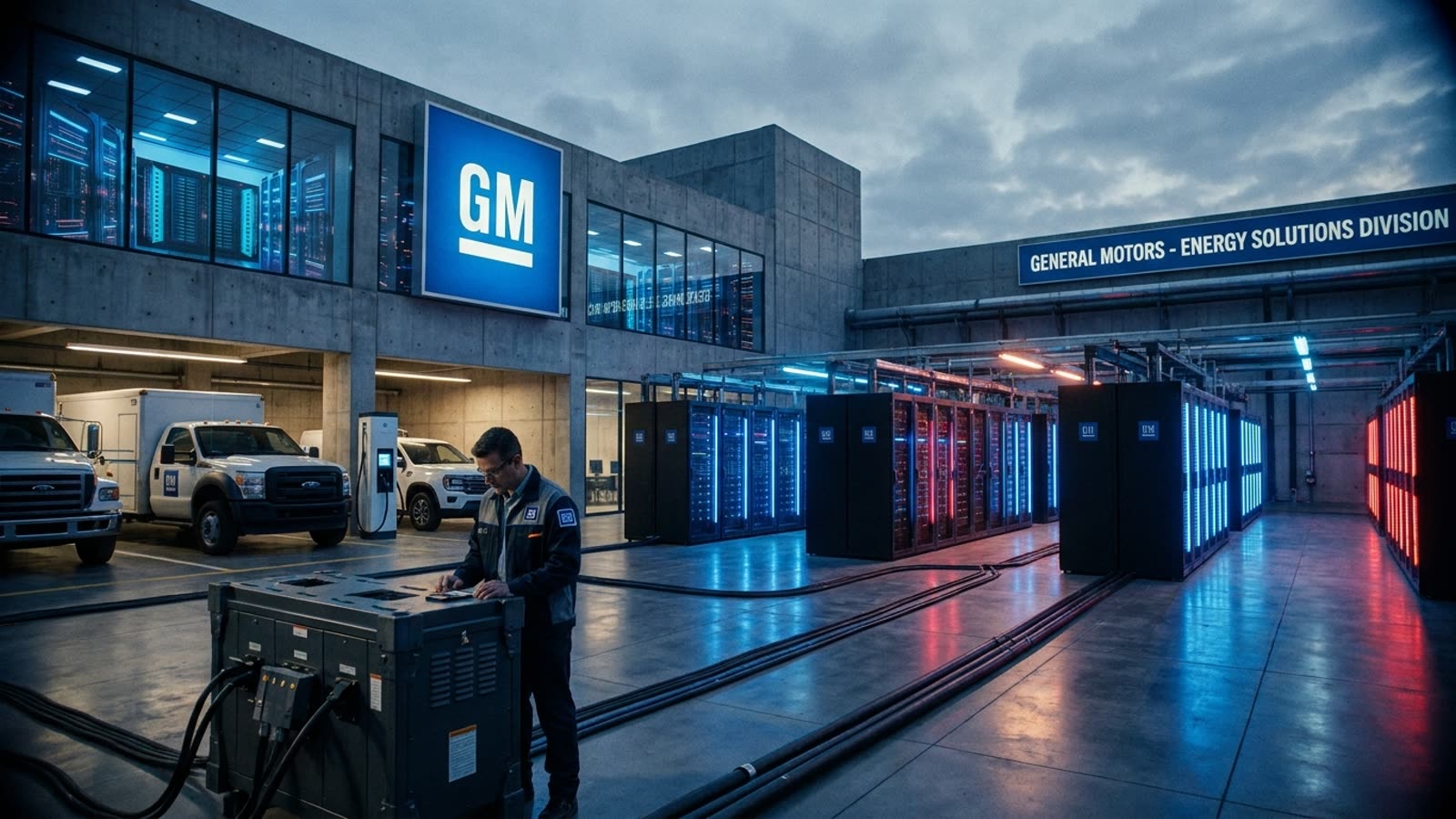
The most consequential pivot in General Motors' 118-year history may have nothing to do with cars. The automaker announced Monday it is entering the race to supply battery storage systems for AI data centers and electrical grids—a market that barely existed five years ago but now represents one of the fastest-growing segments of the global energy economy.
The move is both opportunistic and existential. GM has spent billions developing battery technology for electric vehicles, only to watch EV demand plateau while its manufacturing capacity sits underutilized. Meanwhile, Microsoft, Google, Amazon, and Meta are engaged in a frantic scramble to secure enough electricity to run their AI operations, with data center power consumption projected to triple by 2030. GM believes it can solve both problems simultaneously.
The energy crisis nobody saw coming
The AI boom has created an infrastructure emergency that makes the chip shortage of 2021 look quaint. Training a single frontier model now consumes as much electricity as a small city uses in a month. Inference—running those models at scale—is even more demanding. Hyperscalers have signed deals with nuclear plants, invested in geothermal startups, and in some cases simply bought entire power utilities. But generation is only half the problem; storage and grid stability matter just as much.
This is where GM sees its opening. The company's Ultium battery platform, originally designed for the Hummer EV and Cadillac Lyriq, can be repurposed into stationary storage units that help data centers manage peak loads and maintain operations during grid instability. GM claims its automotive-grade cells offer superior thermal management and longer cycle life than purpose-built grid storage—advantages honed through the punishing demands of vehicle applications.
Detroit meets Silicon Valley
The cultural gap between automakers and tech companies is vast, but GM is not the first legacy manufacturer to attempt this crossover. Tesla's energy storage division quietly became a multi-billion-dollar business while everyone focused on its cars. But GM brings something Tesla lacks: excess manufacturing capacity and a desperate need to fill it. The company's Spring Hill, Tennessee plant alone could produce enough battery cells to supply dozens of major data center installations annually.
The timing is also notable. GM's announcement comes as utilities across the American South and Southwest impose moratoriums on new data center connections, citing grid capacity constraints. Tech companies that once enjoyed their pick of locations are now competing fiercely for any site with reliable power access. A battery storage partner who can help smooth their relationship with local utilities suddenly looks very attractive.
Our take
This is either the smartest diversification play in automotive history or a desperate lunge by a company that missed the EV transition and is now chasing the next shiny object. We lean toward the former. GM has real battery expertise, real manufacturing scale, and real motivation to make this work. The AI energy crisis is not a temporary blip—it is a structural feature of the technology's economics. If GM can position itself as the company that helps Big Tech keep the lights on, it may matter more to the American economy in 2035 than it ever did selling Silverados.