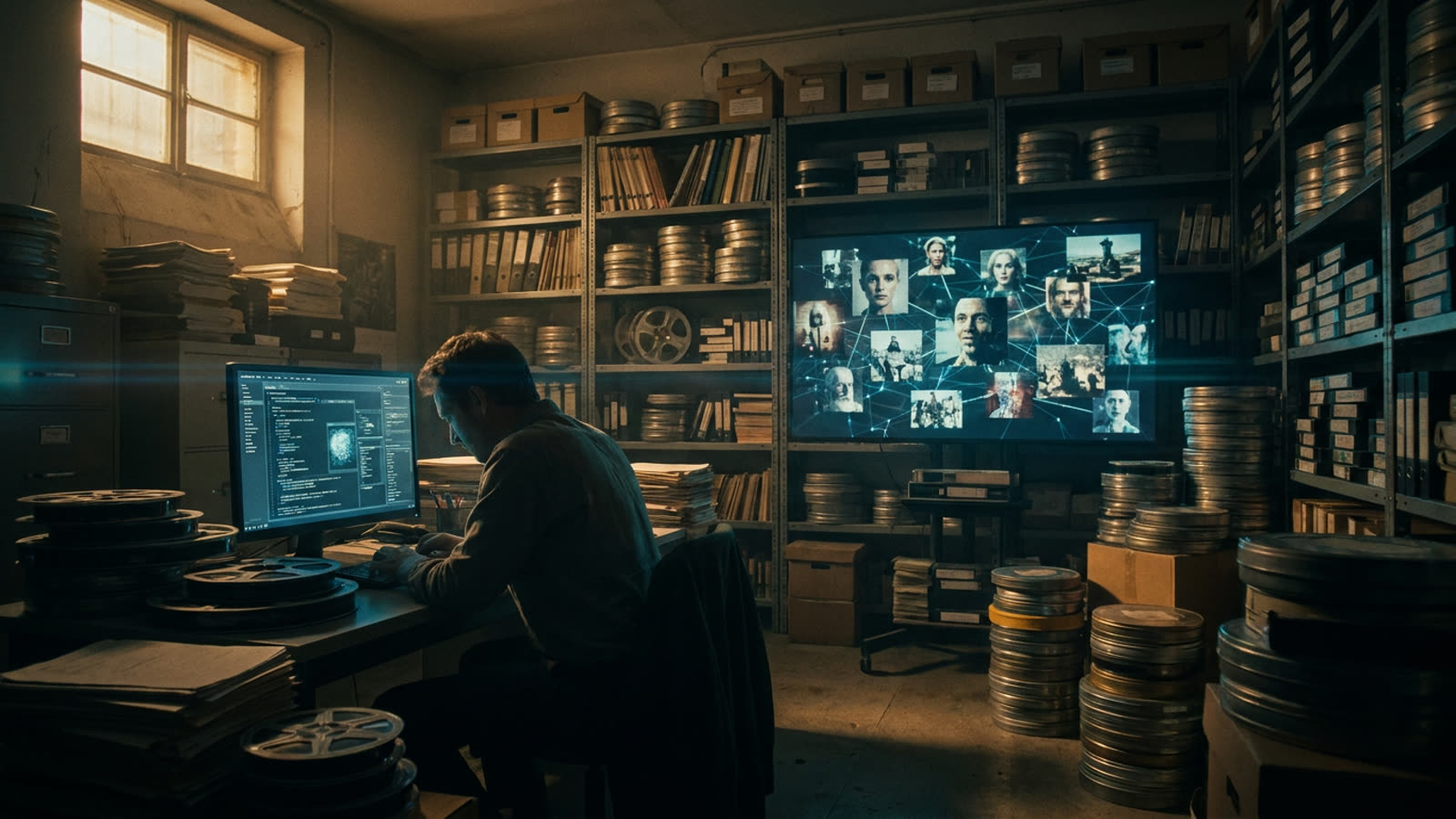
For most of documentary filmmaking's history, the researcher was the unsung engine of the form. Someone had to spend months in archives, watching hundreds of hours of footage to find the twelve seconds that would make a scene work, cross-referencing dates in yellowed newspapers, tracking down the nephew of a witness who might still have photographs in a shoebox somewhere. This work was expensive, slow, and fundamentally human. It is now being automated at startling speed, and the consequences for the art form are only beginning to emerge.
The transformation is not hypothetical. AI-powered archival search tools can now parse vast video libraries, transcribe and translate interviews across dozens of languages, identify faces and objects across thousands of hours of footage, and surface connections that would take human researchers weeks to find. What once required a team and a substantial budget can now be accomplished by a solo filmmaker with a laptop and a subscription.
The democratization problem
The optimistic read is straightforward: more people can now make more ambitious documentaries. A filmmaker in Nairobi can search the BBC's digitized archives with the same efficiency as a production company in London. Stories that were economically impossible to tell—requiring research across multiple countries, languages, and decades—are suddenly viable.
But democratization has a shadow. When everyone can access the same tools and the same archives, the films begin to converge. The quirky, serendipitous discoveries that came from a researcher stumbling onto something unexpected while looking for something else—the archival equivalent of browsing a bookstore—are replaced by optimized search queries that return exactly what was requested and nothing more. The films become more efficient and less surprising.
What gets lost in translation
The deeper concern is epistemological. A skilled human researcher brings judgment to the archive. They know when a source is unreliable, when a photograph has been staged, when an interview subject is performing for the camera rather than remembering. They understand context in ways that current AI systems fundamentally do not.
When AI surfaces a piece of footage, it does so based on pattern matching—visual similarity, keyword relevance, metadata alignment. It cannot tell you that the person speaking was known to exaggerate, or that the newspaper clipping comes from a publication with a particular political agenda, or that the photograph was taken by someone with a complicated relationship to the subject. These layers of context are precisely what separates documentary from propaganda, and they remain stubbornly resistant to automation.
The new aesthetic
Some filmmakers are leaning into the strangeness rather than fighting it. A new wave of documentaries treats AI-assisted research not as invisible infrastructure but as part of the film's texture—acknowledging the algorithmic mediation, making the search process itself visible, questioning what it means to construct a historical narrative from machine-curated fragments. The results are often formally interesting and intellectually honest about their own limitations.
Others are moving in the opposite direction, using AI efficiency to produce documentaries at unprecedented scale and speed. Streaming platforms hungry for content have embraced this model, commissioning films that can be researched, assembled, and delivered in timelines that would have been impossible a few years ago. The quality is uneven, but the volume is undeniable.
Our take
The documentary researcher is not quite dead, but the job description is changing beyond recognition. The valuable skill is no longer the patience to sit in an archive for months; it is the judgment to know what questions to ask the machine and the wisdom to distrust its answers. The films that will matter in this new era will be made by people who understand that AI is a powerful tool for finding things and a terrible tool for understanding them. The archive has never been more accessible. The truth remains as elusive as ever.