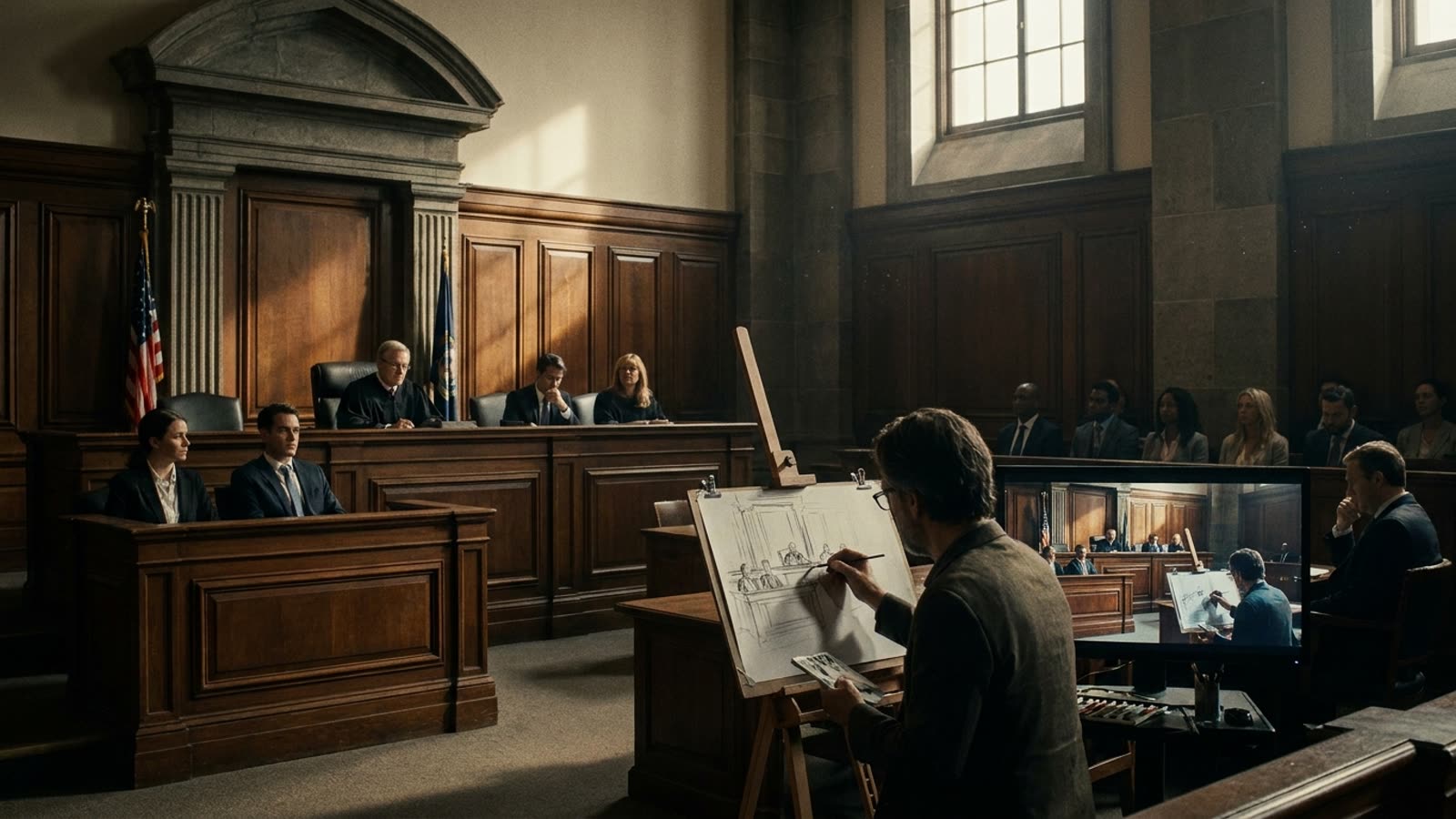
For nearly two centuries, courtroom sketch artists have occupied one of journalism's strangest niches: visual reporters who work in silence, rendering history in pastels and watercolors while cameras remain banned from the most consequential rooms in democracy. Now that profession—perhaps a hundred practitioners strong in the United States, fewer still elsewhere—finds itself contemplating a future where the machines can draw faster, if not necessarily better.
The tension is not hypothetical. Several artists have begun experimenting with AI-assisted workflows, using generative tools to block in compositions or suggest color palettes before applying their own hand to the final work. Others view the technology as an existential threat to a craft that has always traded on irreplaceable human presence. Both camps are grappling with the same question: what is the actual value of a courtroom sketch?
The speed problem and the soul problem
Courtroom sketching has always been a race against deadline. An artist might have minutes to capture a defendant's expression during a key moment of testimony, then hours to refine the image before evening broadcasts. AI image generators can produce a plausible courtroom scene in seconds—but they cannot be in the room. They cannot watch a witness's hands tremble or notice how a juror's posture shifts during cross-examination. The sketch artist's product has never been mere illustration; it has been witnessed interpretation, a visual record filtered through human judgment and legally sanctioned access.
This distinction matters more than it might appear. News organizations pay for courtroom art not because photography is technically impossible—phones exist—but because the courts have decided that the presence of cameras changes the nature of proceedings. The sketch artist is tolerated precisely because they are slow, quiet, and interpretive rather than mechanical. An AI cannot satisfy those conditions.
Augmentation versus replacement
The artists who have embraced AI tools describe them as labor-saving rather than creative. One veteran of federal trials has spoken publicly about using generative software to experiment with background compositions, freeing more time for the portraiture that clients actually care about. Another uses AI to generate reference images for courtroom furniture and architecture—the mundane elements that consume time but carry little editorial weight.
Critics within the profession argue that this augmentation is a slippery slope. If an AI can handle backgrounds today, why not faces tomorrow? The counterargument is pragmatic: the profession is aging, underpaid, and undersupplied. If technology can reduce the drudgery without compromising the essential human witness, it might actually preserve the craft by making it economically viable for younger artists to enter.
The authenticity premium
What may ultimately protect courtroom sketch artists is the same thing that protects handmade luxury goods: the market's willingness to pay for provenance. A sketch by an artist who sat in the gallery during a historic verdict carries a different weight than an AI-generated approximation, no matter how visually similar. News organizations, courts, and collectors all have reasons to value that authenticity—legal, editorial, and aesthetic.
The profession will likely shrink further regardless. But the survivors may find themselves repositioned as something closer to fine artists than commercial illustrators, their work valued not despite its inefficiency but because of it.
Our take
Courtroom sketch artists are not being replaced by AI; they are being forced to articulate why they exist. The answer turns out to be more interesting than speed or skill. It is about bearing witness, about the legal and cultural decision that some rooms should not be photographed, and about the stubborn human preference for images made by hands that were actually there. The profession will contract, but it will not vanish—and the artists who remain will command a premium precisely because they cannot be automated.