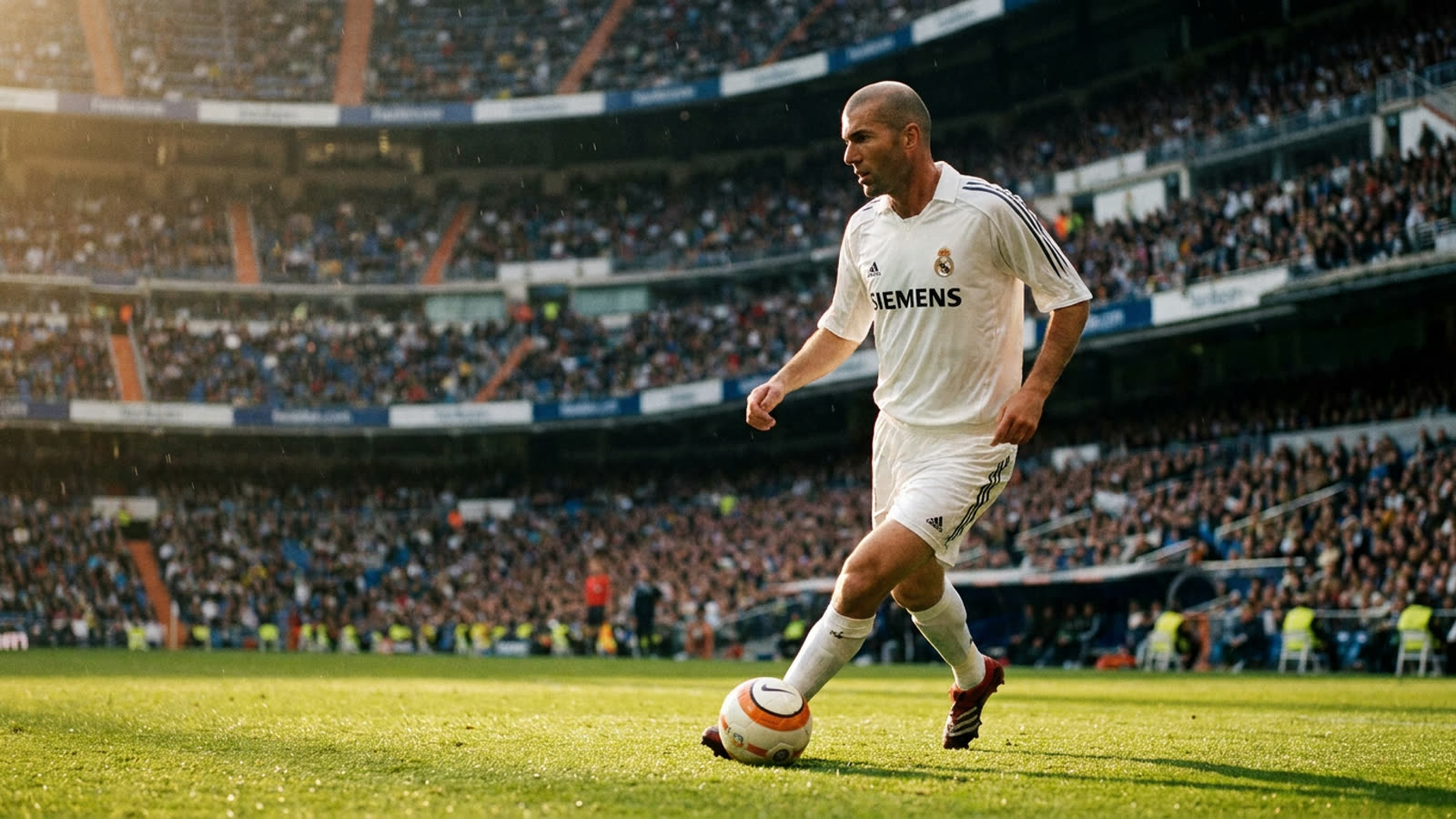
The first touch is football's most honest moment. It reveals whether a player is thinking or merely reacting, whether the ball is a tool or a burden. Zinedine Zidane's first touch suggested a third possibility: that the ball had been expecting him all along.
This was not technique in the mechanical sense that modern academies worship. It was something closer to temporal manipulation—the ability to create time where none existed, to find stillness in chaos. Zidane received the ball in spaces that should have been traps and transformed them into stages. Defenders arrived to find he had already left, though he appeared never to have hurried.
The geometry of calm
Zidane's signature move, the roulette, was not a trick but a statement of philosophy. Where other players used skill to escape pressure, he used it to demonstrate that pressure was an illusion. The spin kept the ball magnetically attached to his instep while his body pivoted through markers who suddenly looked like they were moving through water. It was humiliation delivered with the courtesy of a bow.
His 2002 Champions League final volley against Bayer Leverkusen remains the sport's most aesthetically complete goal—not because of its difficulty, though that was considerable, but because of its composure. The ball arrived at an awkward height, falling from a considerable distance, in the biggest club match on earth. Zidane adjusted his body with the unhurried precision of a man hanging a picture frame, then struck it with his weaker foot into the corner. The goal did not look difficult. That was the point.
Why the template broke
Football has spent the subsequent years searching for the next Zidane and discovering that the search is structurally impossible. The modern game's evolution has moved decisively against his archetype. Pressing systems have compressed the time and space that he seemed to conjure from nothing. Data analytics have made coaches suspicious of players who cannot be quantified, and Zidane's value lay precisely in what spreadsheets could not capture—the way his mere presence on the ball seemed to calm teammates and unsettle opponents simultaneously.
The playmaker role he occupied has been disaggregated. His passing range now belongs to deep-lying midfielders. His dribbling burden falls to wingers. His creative responsibility is distributed across systems rather than concentrated in individuals. Football decided that depending on genius was inefficient, and it was probably right. But something was lost in the optimization.
The 2006 coda
Any honest appreciation must reckon with Berlin. Zidane's final act as a professional—a headbutt to Marco Materazzi's chest in a World Cup final—was so jarringly out of character that it forced a reappraisal of what his character actually was. The man who had made control into an art form revealed that control had always been a choice, not a nature. The violence was clarifying: Zidane was not serene because he lacked fire. He was serene because he contained it.
This made him more interesting, not less. The headbutt was indefensible and also, in its way, magnificent—a refusal to perform dignity when dignity had been stripped away. He walked past the trophy he would never touch with the bearing of someone who had decided that some insults outweigh silverware. It was the wrong decision. It was also unmistakably his.
Our take
Zidane's legacy is not a blueprint but a reproach. He demonstrated that football at its highest level could be played with the cadence of poetry rather than the relentlessness of industry, and then the sport collectively decided that poetry was too expensive. The choice was probably correct—modern football is faster, fitter, and more tactically sophisticated than the game Zidane graced. But on certain evenings, when a promising young midfielder receives the ball in traffic and immediately looks for the safe pass, you sense the ghost of an alternative: a player who would have turned, surveyed the chaos, and made it wait.