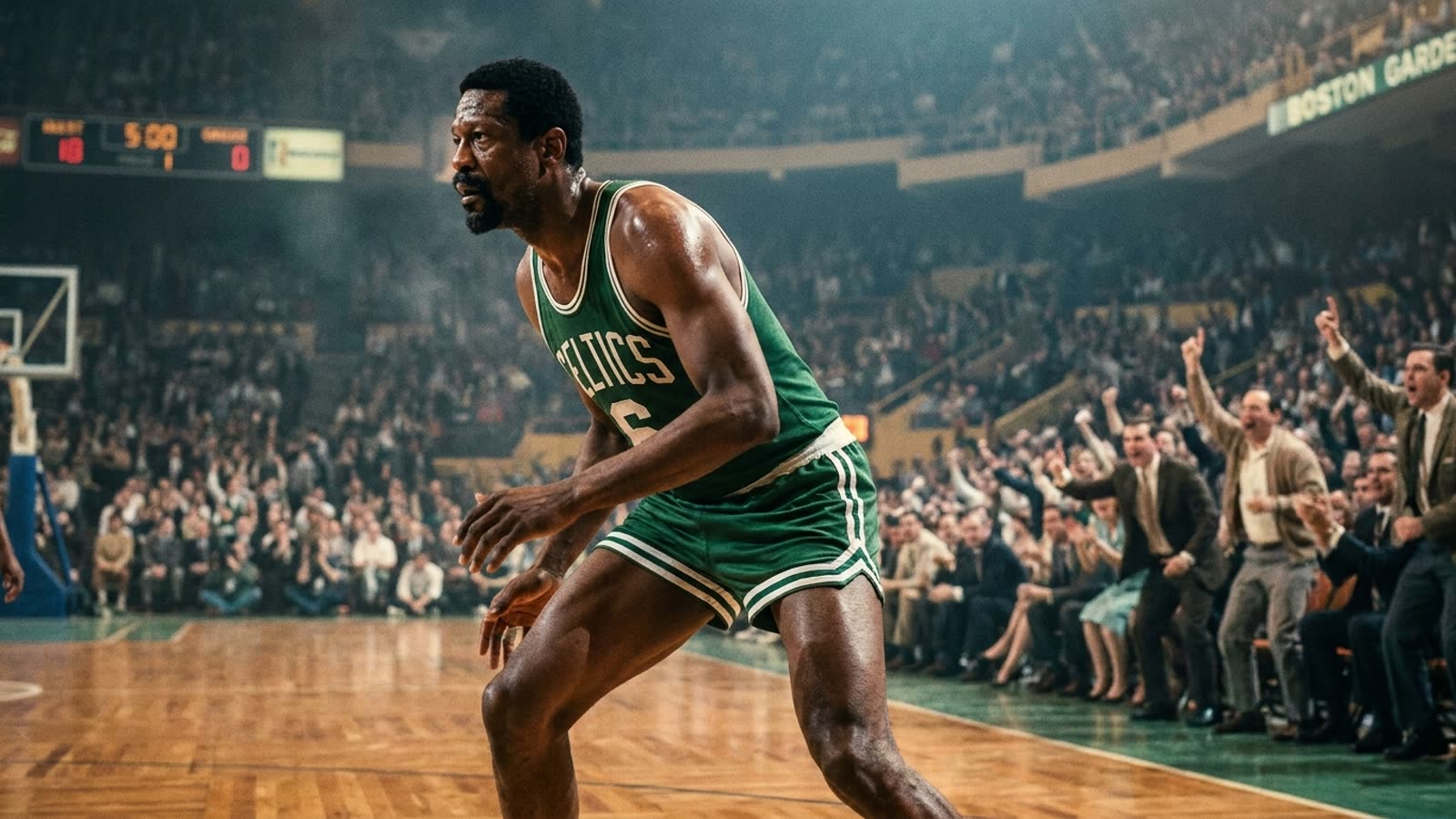
The most decorated winner in the history of North American professional team sports never led the league in scoring. Bill Russell averaged 15.1 points per game across his career—respectable, unremarkable, the kind of number that gets buried in box scores. Yet he won eleven NBA championships in thirteen seasons, including eight consecutive titles from 1959 to 1966, a streak of sustained excellence that no other major sport has approached.
This paradox sits at the center of any serious conversation about athletic greatness. We have been conditioned to measure dominance through accumulation—points, goals, touchdowns, the individual statistics that fill highlight reels and fuel arguments. Russell offers a different thesis: that winning itself can be a skill, perhaps the rarest one, and that some athletes possess an almost mystical ability to make everyone around them better.
The architecture of team defense
Before Russell arrived in Boston in 1956, professional basketball was essentially a series of one-on-one battles strung together. Defenders guarded their man; help defense was improvised, inconsistent, almost accidental. Russell reimagined the entire geometry of the court. He positioned himself not to guard a single opponent but to protect the rim as a roving presence, daring teams to shoot over him, funneling drivers into his wingspan.
The blocked shot became his signature, but the statistics of the era didn't track blocks, so we have no official count. Contemporaries estimated he averaged somewhere between eight and ten per game—numbers that would lead the league by a wide margin today. More importantly, he changed shots that never appeared in any box score: the layups abandoned mid-drive, the passes rerouted, the offensive sets that collapsed simply because he was standing in a particular spot.
Red Auerbach, his coach and later general manager, understood that Russell's value transcended measurement. The Celtics built their dynasty around a simple principle: Russell would erase mistakes. Perimeter defenders could gamble for steals because Russell waited behind them. Fast breaks could be launched recklessly because Russell would clean up missed shots. He was both safety net and springboard.
The weight of winning
Russell's rivalry with Wilt Chamberlain defined an era and crystallized a philosophical divide that still animates sports discourse. Chamberlain was the superior physical specimen—taller, stronger, a more prolific scorer who once averaged over 50 points per game for an entire season. In head-to-head matchups, Chamberlain often outscored Russell by substantial margins. Yet Russell's teams won the series, again and again, and the championships accumulated on his side of the ledger.
The easy explanation is that Russell had better teammates, and there's truth in this—the Celtics of that era featured multiple Hall of Famers. But this framing misses something essential. Russell made those teammates better in ways that Chamberlain, for all his individual brilliance, never quite managed. He subordinated his ego to the collective project. He accepted that his statistical profile would never match his impact.
This required a peculiar kind of confidence, the willingness to be undervalued by casual observers while trusting that the scoreboard would eventually vindicate his approach. Russell was not humble—he possessed an almost ferocious competitive pride—but he directed that pride toward outcomes rather than recognition.
Our take
The modern NBA has rediscovered defense as an intellectual exercise, with analytics departments mapping shot quality and defensive positioning with granular precision. Yet no amount of data can fully capture what Russell understood intuitively more than six decades ago: that basketball is a game of space and time, and that controlling both matters more than filling a stat sheet. His eleven rings remain the most eloquent argument ever made for a kind of greatness that resists quantification—the greatness of making winning feel inevitable.