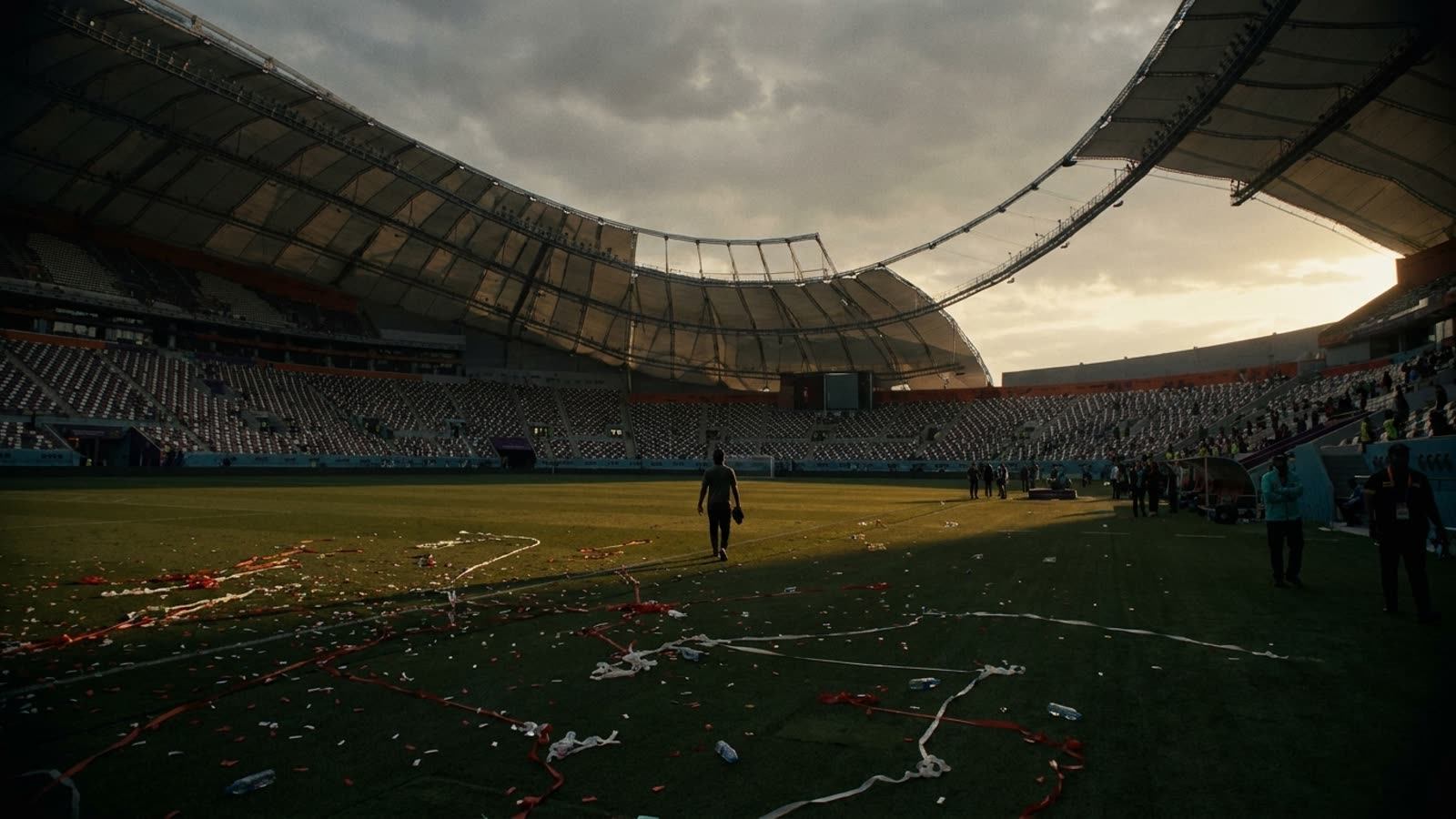
The third-place match is the tournament's orphan fixture, scheduled on a Saturday afternoon when the world's attention has already migrated to Sunday's final. Two teams that wanted desperately to be elsewhere trudge onto the pitch, their dreams of glory extinguished forty-eight hours earlier, asked to summon competitive fire for a bronze medal that FIFA doesn't actually award. Players routinely describe it as the worst game of their careers. And yet.
And yet the third-place match has produced some of the most liberated, joyful football in World Cup history. Freed from the paralyzing stakes that turn finals into cagey, error-averse affairs, losing semifinalists often rediscover why they fell in love with the game in the first place.
The paradox of lowered stakes
Consider the incentive structure. In a World Cup final, the cost of conceding is existential—one goal can define a career, haunt a nation for generations. Managers turn conservative. Fullbacks stop overlapping. The beautiful game becomes a chess match played in molasses. But in the third-place match, what exactly is at stake? Pride, certainly. A slightly larger bonus check. The difference between telling your grandchildren you finished third or fourth. It's not nothing, but it's not enough to justify parking the bus.
The result is often basketball on grass. France defeated Belgium four goals to two in the 1986 third-place match in a game that featured more attacking verve than the final that followed. Germany's four-nil demolition of Portugal in 2014 showcased a team playing with the handbrake finally released, Thomas Müller completing his Golden Boot campaign with a performance of gleeful menace.
The consolation that became a coronation
For certain players, the bronze match has served as an unlikely stage for career-defining moments. Just Fontaine's thirteen goals in 1958 remain the single-tournament record, and he scored four of them in France's third-place victory over West Germany. That match transformed him from prolific striker to eternal legend. Had France reached the final and lost, Fontaine might have finished with eleven goals and a reputation as a nearly-man.
The fixture also offers something increasingly rare in modern football: genuine unpredictability. Without the weight of history pressing down, teams take risks they'd never contemplate in an elimination match. Substitutes who've barely featured get extended runs. Tactical experiments emerge. The third-place match is football's jazz club, where improvisation trumps the setlist.
The abolition debate
FIFA has periodically considered scrapping the fixture entirely. The arguments are practical: players are exhausted, injury risk is elevated, television ratings lag behind group-stage matches. Some federations have openly lobbied against it. After losing their 2018 semifinal, Belgian players publicly questioned why they should bother.
But abolition would sacrifice something harder to quantify. The third-place match is one of the few remaining spaces in elite football where joy can coexist with competition, where the sport's essential playfulness survives the crushing machinery of modern tournament football. It's a reminder that not everything valuable can be measured in trophies.
Our take
The third-place match endures because it answers a question nobody asked and, in doing so, reveals something true about competition itself. Not every contest needs to determine the best. Sometimes the point is simply to play one more game, to delay the ending, to let two wounded teams discover they still have something left to give. In an era when football has been optimized within an inch of its life, the bronze match remains gloriously, stubbornly pointless—and therefore essential.