The conventional wisdom that penalty shootouts are a coin flip is one of football's most persistent and most comforting lies. Coaches invoke it to shield their players from blame. Pundits repeat it to fill airtime. But the evidence tells a different story: certain nations win shootouts with suspicious regularity, certain players crumble with suspicious predictability, and the psychological architecture of the exercise is anything but random.
Germany, across major tournament history, has converted shootouts at a rate that defies chance. England, until recently, had become synonymous with shootout catastrophe—a national trauma renewed every few years with metronomic cruelty. If penalties were truly a lottery, these patterns would not persist across generations of players who share nothing but a shirt color and a set of expectations.
The weight of walking
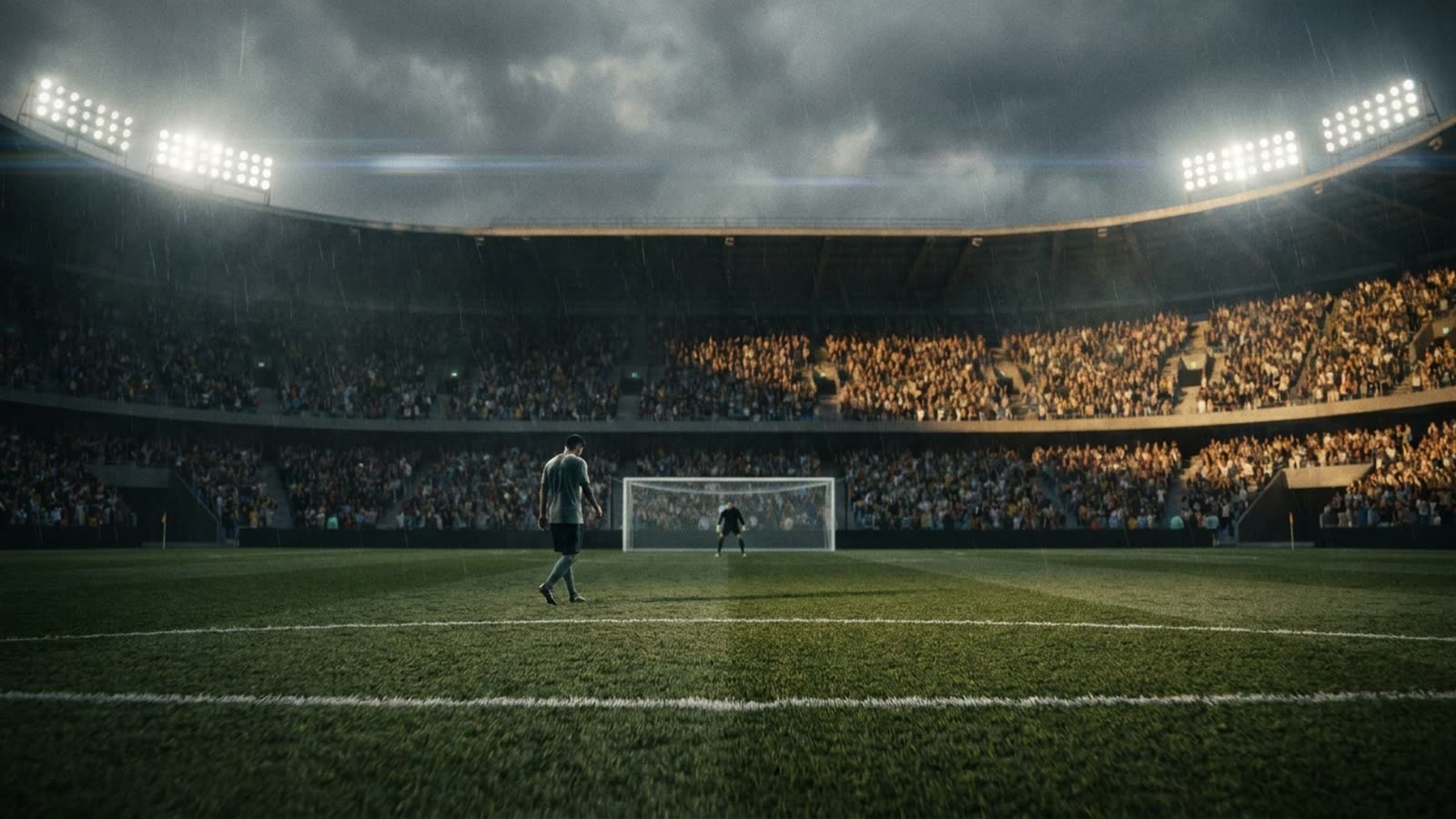
The walk from the center circle to the penalty spot takes roughly fifteen seconds. In that interval, a player must manage an internal environment that evolution did not design for public performance: elevated cortisol, narrowed peripheral vision, the ancient mammalian urge to flee. The goalkeeper, by contrast, has a simpler cognitive task—react, guess, hope—while the taker must execute a precise motor skill under conditions that actively degrade motor precision.
Research into gaze behavior has shown that players who fixate on the goalkeeper rather than their target zone are significantly more likely to miss. The anxious mind seeks information about the threat rather than the task. This is why the best penalty takers often appear almost bored: they have learned to treat the goalkeeper as furniture.
The order effect
Teams that shoot first in a shootout win more often than teams that shoot second—a finding that has held across decades of data. The psychological mechanism is straightforward: the team shooting second is perpetually reacting to pressure rather than creating it. Miss when you are behind, and elimination becomes immediate. Miss when you are ahead, and you have merely squandered an advantage. The asymmetry compounds with each round.
This is why some tournament formats have experimented with alternating the advantage, letting the second team shoot first in subsequent rounds. The intervention acknowledges what players have always known: going second is a different sport.
National styles, national scars
England's historic struggles were never really about technique. English football culture long treated penalties as an afterthought—something you practiced for five minutes at the end of training, if at all. The assumption was that professionals should be able to do something so basic. But the penalty spot is not basic. It is a stage, and stages require rehearsal.
The transformation in English shootout fortunes in recent years coincided with a deliberate program of psychological preparation: visualization exercises, pressure simulations, explicit conversations about fear. The players who stepped up in recent tournaments had been inoculated against panic in ways their predecessors never were.
Our take
The penalty shootout endures because it is brutal, and brutality clarifies. In a sport that can meander through ninety minutes of tactical stalemate, the shootout strips everything to its essence: one player, one ball, one chance to be a hero or a cautionary tale. Calling it a lottery is a way of avoiding the uncomfortable truth that some people handle pressure better than others, and that this capacity can be trained. The twelve yards are not a game of chance. They are a test of character administered in public, and the results are exactly as unforgiving as they should be.