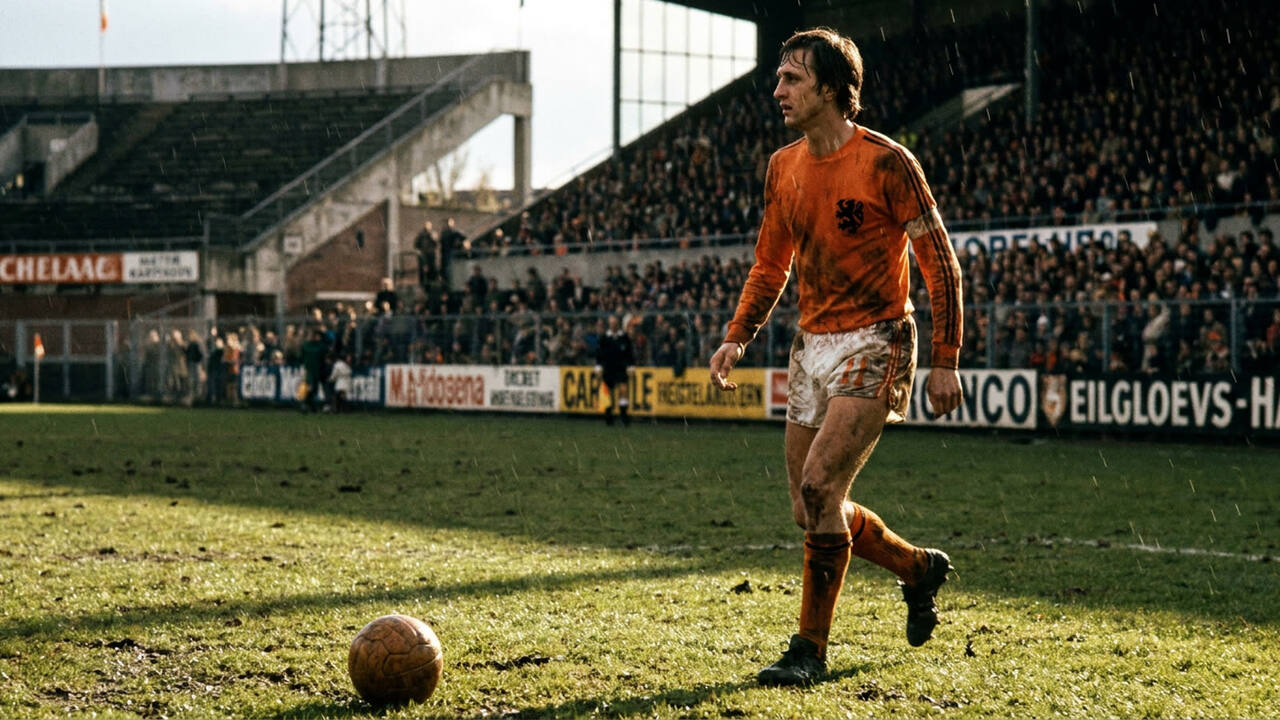
Every great footballer has a trick, but only one has a trick that became a philosophy. Johan Cruyff's eponymous turn — that split-second feint where he dragged the ball behind his standing leg while pivoting 180 degrees — has been imitated millions of times since he unveiled it against Sweden in the 1974 World Cup. But the turn itself was never the point. The point was that Cruyff saw football as a problem to be solved through wit rather than force, and the turn was simply the most elegant proof of concept.
The move's genius lies in its economy. No extra touches, no theatrical wind-up, just a single motion that simultaneously deceives the defender, changes direction, and accelerates into space. It requires no particular physical gift — any reasonably coordinated teenager can learn it in an afternoon. What it requires is the audacity to attempt it in a World Cup match, with a defender bearing down, in front of millions of viewers, as if it were the most natural thing in the world.
The architect of total football
Cruyff's influence extended far beyond his playing career, but even as a player he functioned more as a conductor than a soloist. The Dutch "totaalvoetbal" system of the early 1970s demanded that every player be comfortable in every position, that the team move as a single organism, that space be created and exploited through collective intelligence. Cruyff was its avatar because he embodied its central premise: that thinking faster matters more than running faster.
His Barcelona career, both as player and later as manager, institutionalized these ideas in ways that continue to shape the sport. The famed La Masia academy, with its emphasis on technical development and positional play, bears Cruyff's fingerprints. Pep Guardiola, arguably the most influential coach of the modern era, has never stopped crediting Cruyff as his primary intellectual influence. The tiki-taka style that dominated world football in the early 2010s was, in essence, Cruyff's vision executed at industrial scale.
Why the turn endures
Football's history is littered with forgotten tricks — the flip-flap, the rabona, various step-over combinations that briefly dazzled before fading into obscurity. The Cruyff turn persists because it solves a universal problem: what do you do when a defender has closed down your space and your momentum is carrying you toward trouble? The answer Cruyff provided was counterintuitive — you don't try to go around the obstacle, you go through the obstacle's expectations.
This is what separates a trick from a technique. The Cruyff turn works at every level of the game, from Sunday league to the Champions League final, because it exploits a fundamental truth about human reaction time. By the time a defender's brain has processed what's happening, Cruyff — or whoever is executing his move — is already gone.
Our take
Cruyff died in 2016, but his ideas have become so embedded in football's DNA that we barely recognize them as innovations anymore. The notion that a midfielder should be comfortable receiving the ball under pressure, that a center-back should be able to play out from the back, that a striker should press from the front — these were radical propositions when Cruyff articulated them. Now they're baseline expectations. The turn was a magic trick; the philosophy was the real sleight of hand.