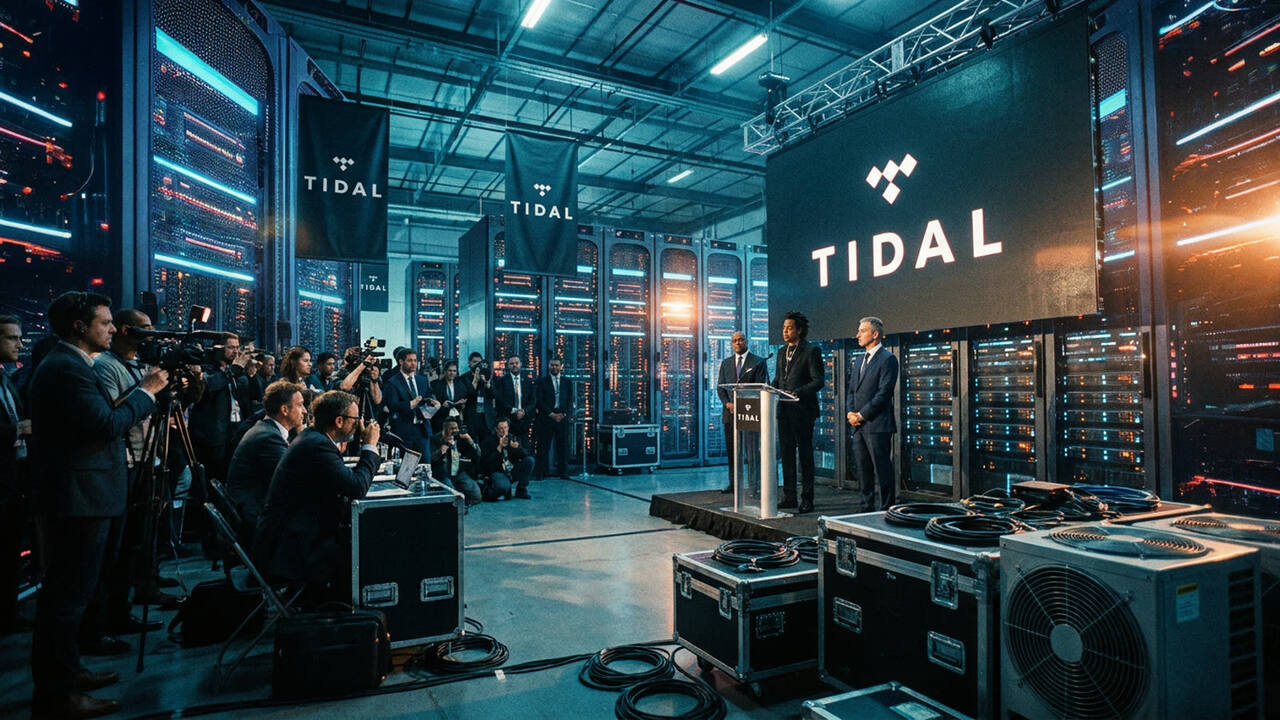
TIDAL has announced it will no longer pay royalties on music generated by artificial intelligence, making it the first major streaming platform to explicitly draw a commercial boundary between human and machine-made sound. The policy, which takes effect immediately for new uploads and will be enforced retroactively within 90 days, represents the boldest statement yet from a streaming service on where the value in recorded music actually resides.
The move is characteristically TIDAL—a platform that has always positioned itself as the artist's ally, from its founding promise of higher royalty rates to its ownership structure that once included stakes held by Beyoncé, Rihanna, and other marquee names. But this isn't merely brand positioning. It's an early answer to a question the entire music industry has been studiously avoiding: what happens when anyone can generate a passable pop song in thirty seconds?
The economics of infinite supply
Streaming economics already operate on razor-thin margins. Spotify pays roughly $0.003 to $0.005 per stream; artists need millions of plays to earn a living wage. Now imagine that pool diluted by an effectively unlimited supply of AI-generated ambient tracks, lo-fi beats, and functional background music—content that costs nothing to produce and can be uploaded at industrial scale.
This isn't hypothetical. Over the past eighteen months, streaming platforms have been flooded with AI-generated tracks designed to capture playlist placements and accumulate micro-royalties. Some estimates suggest AI content now accounts for nearly 8% of new uploads across major platforms, though the figure is difficult to verify given inconsistent labeling. TIDAL's policy directly targets this arbitrage: if your track wasn't made by a human, you don't get paid.
The enforcement problem
The obvious challenge is detection. TIDAL says it will use a combination of metadata analysis, audio fingerprinting, and its own AI-powered detection tools to identify synthetic content—a somewhat ironic deployment of the technology. The company acknowledges the system won't be perfect and has established an appeals process for artists who believe their human-made work has been incorrectly flagged.
Critics will note the policy's potential for collateral damage. What about a human vocalist singing over AI-generated instrumentation? A producer who uses AI to generate a drum loop but composes everything else? TIDAL's guidelines suggest a "substantial human creative contribution" standard, but the boundaries remain genuinely fuzzy. The company appears to be betting that imperfect enforcement is better than no policy at all.
Our take
TIDAL's market share is modest—somewhere around 3% of global streaming—which means this policy alone won't reshape the industry. But it establishes a precedent and a vocabulary that larger players will eventually have to engage with. Spotify, Apple Music, and Amazon have all remained conspicuously silent on AI music monetization, preferring to let the content flood in while they figure out the politics. TIDAL's bet is that there's a segment of listeners—and more importantly, artists—who will pay a premium for a platform that treats human creativity as categorically different from synthetic output. In an age of infinite content, scarcity may be the only remaining luxury.