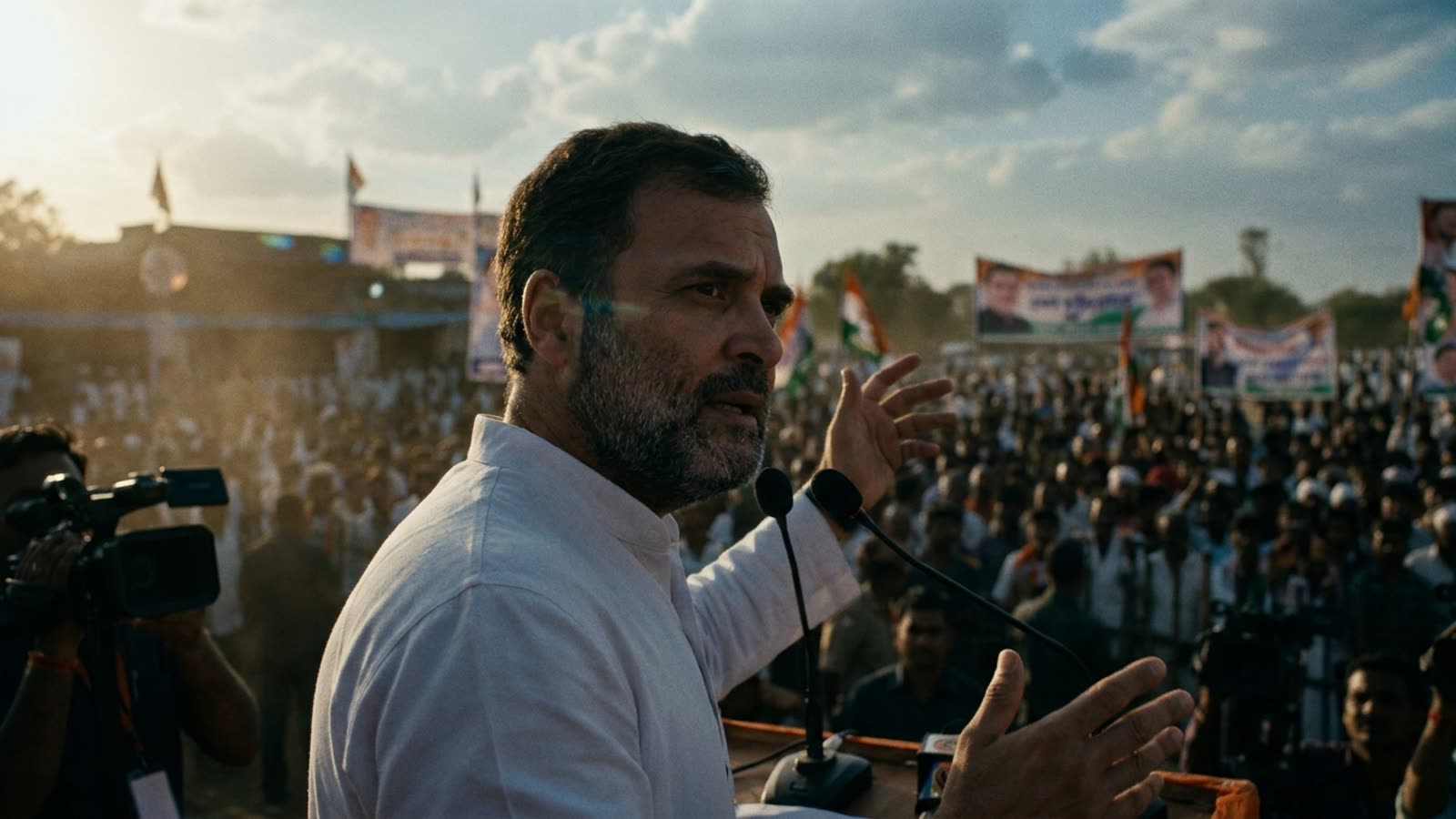
The Gandhi name remains the most potent brand in Indian politics, and also its heaviest inheritance. Rahul Gandhi, 56, great-grandson of Jawaharlal Nehru, grandson of Indira Gandhi, son of Rajiv Gandhi, has spent two decades trying to convert bloodline into ballot-box victory. He has failed, repeatedly and sometimes spectacularly. Now, with protests roiling Indian cities over unemployment, inflation, and the government's handling of caste-census demands, the leader of the opposition Indian National Congress believes his moment has finally arrived.
The arithmetic looks friendlier than it has in years. Prime Minister Narendra Modi's Bharatiya Janata Party lost its outright parliamentary majority in the 2024 general election and governs only through coalition partners whose loyalty is transactional. Street anger over joblessness—youth unemployment hovers near 45 percent by some estimates—has given Congress-aligned activists a mobilization hook that transcends the party's traditional secular-versus-communal framing. Gandhi's recent "Bharat Jodo Yatra" sequel, a cross-country march focused on economic justice, drew crowds that surprised even his own organizers.
The dynasty problem
Yet Gandhi's greatest asset is also his greatest liability. In a country where anti-elite sentiment runs hot, being the scion of three prime ministers invites the charge that he represents entitlement rather than aspiration. Modi has spent a decade painting him as "Pappu"—a Hindi diminutive suggesting a clueless rich kid—and the caricature has stuck with a significant slice of the electorate. Gandhi's occasional gaffes, including a 2019 speech in which he appeared to misunderstand basic economics, have fed the narrative.
His party, meanwhile, remains a family fiefdom in structure if not in name. The Congress Working Committee is stacked with loyalists; state-unit chiefs rise or fall on proximity to the Gandhis. That model worked when Congress dominated Indian politics, but it has proved brittle in an era of regional satraps and social-media-savvy rivals. The party's organizational rot—visible in its inability to contest local elections with anything like the BJP's ground game—will not be fixed by one charismatic march.
What the protests can and cannot do
The current unrest is real, but its political direction is uncertain. Many protesters are not Congress voters; they are young, urban, and skeptical of all established parties. Some are drawn to the Aam Aadmi Party or regional outfits that speak more directly to local grievances. Gandhi's challenge is to channel diffuse anger into a coherent national movement without being outflanked by nimbler competitors—or by Modi's formidable counter-mobilization apparatus, which has already begun framing the protests as "anti-national."
History offers Gandhi a cautionary tale. His mother, Sonia, rode a similar wave of anti-incumbency in 2004 to dethrone the BJP, but she had a coalition already in place and a prime-ministerial candidate (Manmohan Singh) who reassured middle-class voters. Rahul has neither. Congress's alliance-building has been haphazard, and Gandhi himself remains a polarizing figure whose personal approval ratings lag behind his party's.
Our take
Rahul Gandhi is not wrong to sense opportunity. Modi's aura of invincibility has cracked, and economic discontent is genuine. But sensing opportunity and seizing it are different skills, and Gandhi's career suggests the latter does not come naturally. He will need to do more than inherit his family's name; he will need to build something his family never had to—a modern, data-driven, ideologically coherent opposition capable of winning in the age of WhatsApp and algorithmic polarization. The protests have given him a springboard. Whether he can stick the landing is the question Indian democracy now turns on.