Most streetwear brands face a binary choice: stay small and revered, or grow large and resented. Palace has spent a decade dodging that trap, and co-founder Gareth Skewis seems almost amused that anyone finds it mysterious.
The formula, such as it is, involves saying no more often than yes—to investors, to wholesale accounts, to the temptation to flood the market with product. Palace drops remain genuinely limited, not artificially scarce. The brand collaborates with blue-chip partners (Gucci, Ralph Lauren, Adidas) without becoming dependent on any of them. And crucially, it has doubled down on owned retail at a moment when most competitors are retreating to e-commerce.
The physical-store thesis
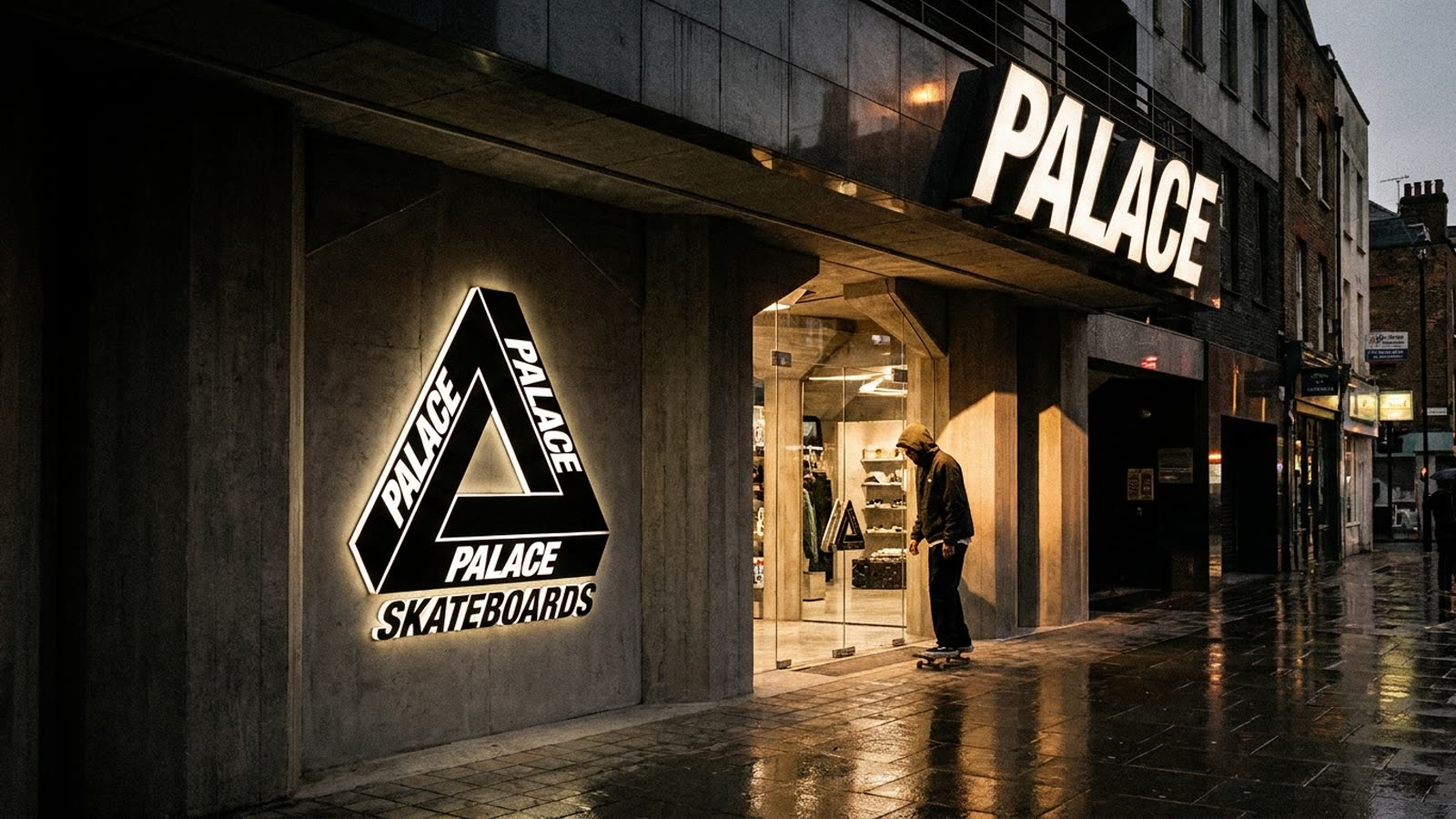
Palace now operates flagship locations in London, New York, Los Angeles, and Tokyo. Each functions less as a sales channel than as a cultural outpost—part skate shop, part community center, part content studio. The stores host video premieres, sponsor local skaters, and generate the kind of organic social media that paid campaigns cannot replicate. Skewis argues that the overhead is worth it precisely because it cannot be copied by a venture-backed competitor in six months. A Discord server is replicable; a decade of goodwill in Soho is not.
Why the collaborations haven't diluted the brand
The Gucci partnership in 2022 raised eyebrows among purists who worried Palace was selling out. Four years later, the collaboration looks more like a flex than a compromise. Palace set the creative terms, produced the campaign in-house, and walked away with a global audience that had never heard of the Tri-Ferg logo. The key, Skewis suggests, is treating every collaboration as a finite project rather than an ongoing revenue stream. When the capsule sells out, it is over. No restocks, no licensing extensions, no diffusion lines.
The limits of the model
Palace remains privately held and has never disclosed revenue. Industry estimates place annual sales somewhere between £80 million and £120 million—respectable, but a fraction of what Supreme commanded before its sale to VF Corporation. Skewis shows no interest in closing that gap. The brand's refusal to wholesale broadly means it will never achieve the ubiquity of a Nike SB or Stüssy. That is, of course, the point.
Our take
Palace's real innovation is not aesthetic; it is strategic patience. In an industry addicted to hype cycles and exit multiples, the brand has opted for slow compounding of cultural equity. Whether that model survives a generational shift in taste—or a founder's eventual departure—remains an open question. For now, Palace is the rare streetwear label that can dress a Gucci runway and a Peckham skatepark without losing either audience. That balancing act is harder than it looks, and Skewis knows it.