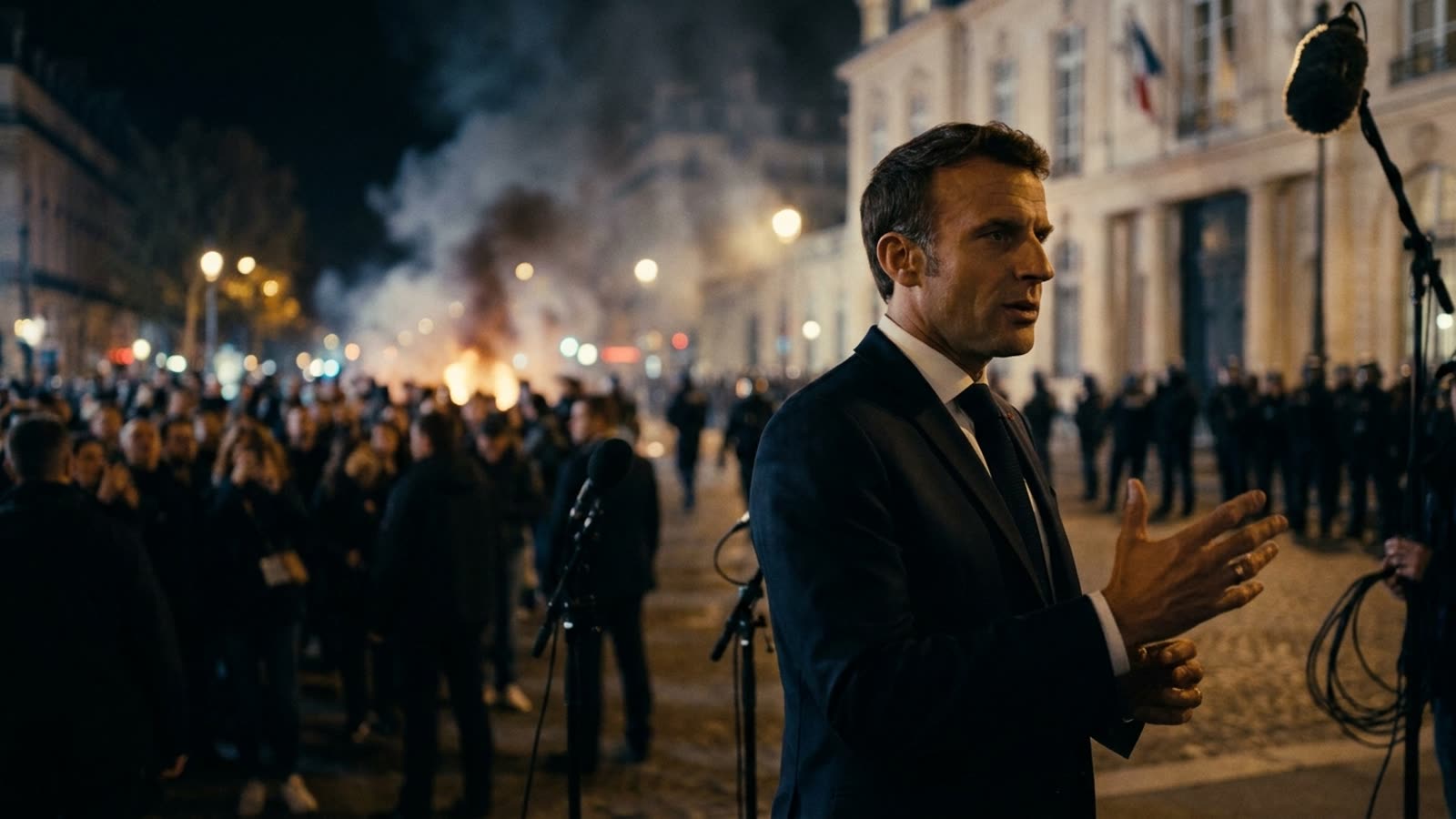
Emmanuel Macron's Sunday evening address to the nation was a study in diminished returns. Speaking from the Élysée Palace in the measured tones of a man who has done this before—too many times, perhaps—the French president called for "calm and order" while looting continued in parts of Paris and other major cities burned through their third consecutive night of disorder.
The riots, which began as protests against housing costs and have since metastasized into a broader expression of economic fury, represent the most serious domestic challenge of Macron's second term. They also expose a president who has run out of rhetorical runway.
The limits of the bully pulpit
Macron's address contained the expected elements: condemnation of violence, sympathy for legitimate grievances, promises of dialogue. What it lacked was any indication that the government possesses tools adequate to the moment. France has deployed tens of thousands of police officers. It has imposed curfews in several cities. None of this has quelled the unrest.
The president's approval ratings, already hovering near historic lows, offer little political capital to spend. His pension reforms of 2023 remain deeply unpopular. His party lost its absolute majority in the National Assembly. The far right and far left have both gained ground by channeling the same economic anxieties now exploding on French streets.
A European problem with French characteristics
France is not alone in facing cost-of-living fury—similar protests have swept across the continent in recent weeks. But the French iteration carries particular intensity, shaped by the country's tradition of street politics and a housing crisis that has pushed homeownership out of reach for much of the urban middle class.
Rents in Paris have risen more than forty percent since 2015. In Lyon and Marseille, the increases have been nearly as severe. For a generation of French citizens, the social contract that promised stability in exchange for work has been unilaterally revised.
The political vacuum
Macron cannot run again in 2027. His chosen successor, whoever that may be, will inherit a country whose institutions have been tested and found wanting. The president's opponents sense weakness: Marine Le Pen has called for his resignation, while Jean-Luc Mélenchon has demanded early elections.
Neither outcome is likely. Macron will almost certainly serve out his term. But he will do so as a diminished figure, a president whose calls for order are met with indifference by citizens who have concluded that order, as currently constituted, does not serve them.
Our take
Macron built his political brand on being the adult in the room, the technocrat who could transcend left-right divisions through sheer competence. That brand is now in ruins. The riots are not merely a law-enforcement problem; they are a verdict on a governing philosophy that promised prosperity through liberalization and delivered instead a country where the young cannot afford homes and the old fear for their pensions. Macron's address was pitch-perfect in tone and utterly irrelevant in substance. France needed a plan. It got a performance.