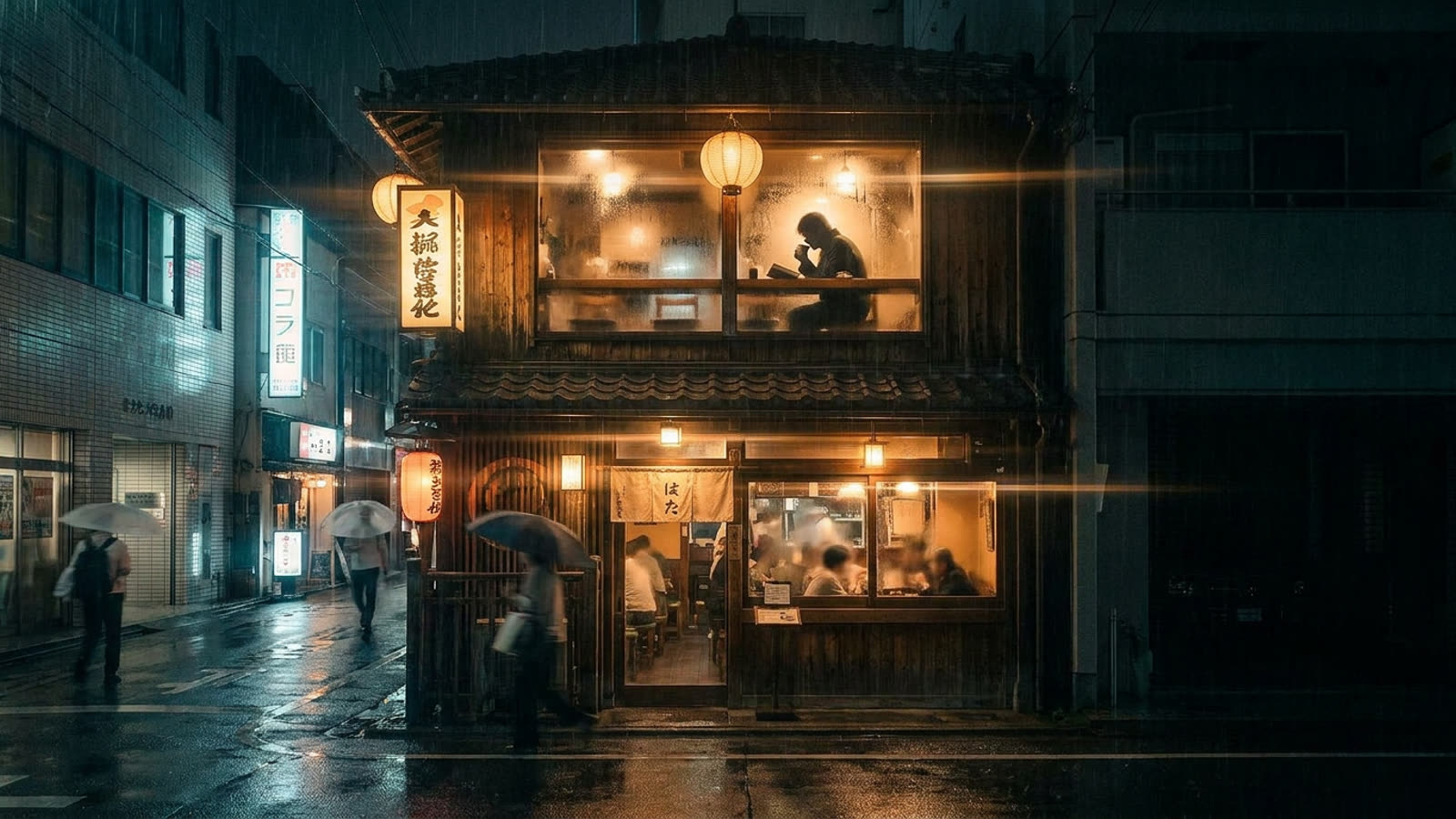
The kissaten is an anachronism that knows it. These dim, wood-paneled Japanese coffee houses—where a single cup takes twelve minutes to prepare and costs what a chain would charge for three—have no business surviving in a culture that invented the convenience store and perfected the capsule hotel. Yet they persist, and their persistence tells us something uncomfortable about what we've traded away in the name of speed.
The word itself is instructive: kissa means tea-drinking, ten means shop. Coffee arrived later, but the architecture of slowness was already in place. A kissaten is not designed for throughput. The seats face inward, not toward the door. The lighting discourages laptop screens. The music—usually classical or jazz from vinyl—is chosen by the owner, not an algorithm. You are a guest in someone's living room, not a customer optimizing your morning.
The economics of refusal
By any rational measure, the kissaten model should have collapsed decades ago. The economics are punishing: hand-drip brewing limits output, premium beans erode margins, and the entire proposition depends on customers who are willing to sit for an hour over a single ¥800 cup. Chain coffee arrived in Japan with force—Starbucks alone operates more than 1,800 locations—and the kissaten population has declined from an estimated 150,000 in the early 1980s to perhaps 60,000 today.
But the survivors have discovered something the spreadsheets missed. The kissaten sells time itself, or more precisely, the permission to waste it. In a society where train delays of ninety seconds prompt formal apologies, where salarymen sleep standing up, where productivity is a civic religion, the kissaten offers absolution. You are allowed to do nothing here. The owner expects it.
The master's hand
Watch a kissaten owner prepare a nel drip—the flannel-filter method that defines the genre—and you'll understand why automation hasn't conquered this corner of the market. The kettle moves in slow spirals, the water temperature matters to the degree, and the pour rate is adjusted by intuition accumulated over decades. It is, frankly, theatrical. But the theater is the product.
The great kissaten masters, some now in their eighties, learned their craft in an era before specialty coffee had a vocabulary. They don't speak of tasting notes or terroir. They speak of kodawari—an obsessive attention to one's chosen domain that borders on the spiritual. The coffee may or may not be objectively superior to what a third-wave roaster produces. That's beside the point. The kissaten sells the presence of someone who cares, visibly, about your experience.
Exported melancholy
The aesthetic has begun migrating. In Brooklyn and East London and Melbourne, you can now find kissaten-inspired spaces with dim lighting and jazz and deliberate slowness. Whether these transplants capture anything essential or merely cosplay atmosphere is an open question. The kissaten emerged from specific Japanese conditions—dense cities, long work hours, a cultural comfort with solitude in public—that don't translate automatically.
What does translate is the hunger. The Western converts to kissaten culture are often refugees from the attention economy, people who sense that something has been optimized out of their lives but can't quite name it. The kissaten names it: presence, patience, the radical act of being somewhere without documenting that you're there.
Our take
The kissaten will continue to shrink. The masters are aging, the rents are rising, and young Japanese are not exactly lining up to spend their twenties learning to pour water correctly. But the form has survived long enough to become a counter-statement, a physical argument against the premise that every moment must be monetized or measured. In a culture drowning in content, the kissaten offers something scarce: an hour that belongs to no one's algorithm but your own. That's worth more than the coffee.