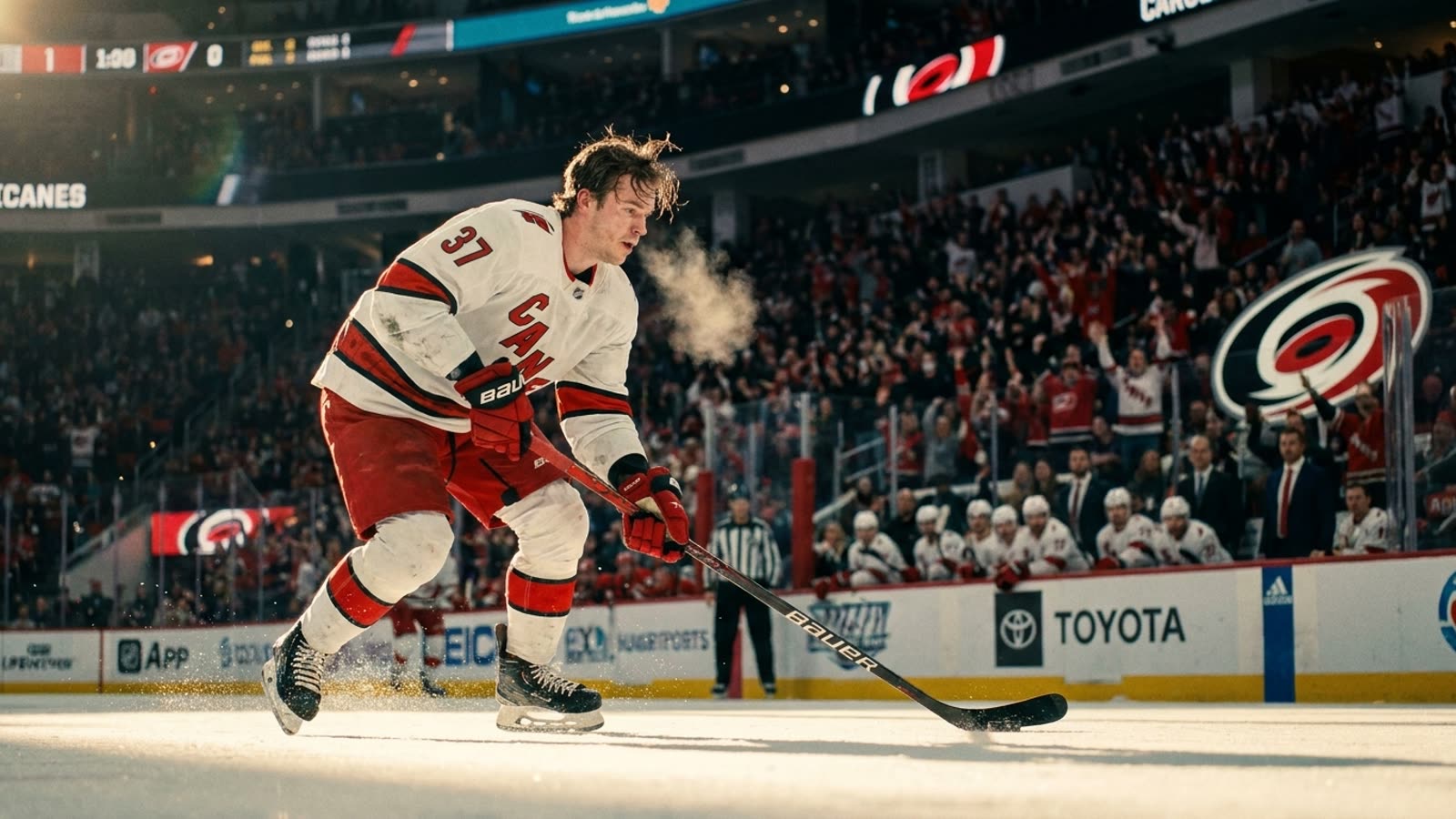
The Carolina Hurricanes have spent the better part of two decades wandering the wilderness between their 2006 championship and genuine contender status. That exile appears to be ending. Andrei Svechnikov scored twice to push Carolina to the brink of the Stanley Cup, and the franchise that once seemed destined to relocate is now one victory away from hoisting hockey's most coveted trophy.
The timing feels almost too neat. Twenty years after their lone championship—won in the immediate aftermath of the lockout that nearly killed the sport—the Hurricanes have built something sustainable in a market that skeptics insisted could never support elite hockey.
The Svechnikov factor
Andrei Svechnikov was the second overall pick in 2018, a selection that now looks like the pivot point of Carolina's rebuild. At 26, he has developed into precisely the kind of power forward the Hurricanes needed: physical enough to impose his will along the boards, skilled enough to finish in tight spaces, and clutch enough to deliver when elimination looms for the opponent.
His two goals followed a familiar pattern—one a product of relentless forechecking, the other a sniper's finish from the slot. Neither was pretty in the highlight-reel sense. Both were devastating in their efficiency. Svechnikov has now scored in four consecutive games, a streak that coincides exactly with Carolina's current winning run.
The family dimension adds texture. His older brother Evgeny, who bounced around the league for years before finding a home in Carolina's system, has been a healthy scratch for most of the playoffs. But the brothers share an apartment in Raleigh, and Andrei has credited Evgeny's presence with keeping him grounded during the postseason grind. It is a small detail, but hockey has always been a sport where small details compound.
A franchise transformed
Carolina's path to this moment has been anything but linear. After 2006, the Hurricanes made the playoffs just three times in thirteen seasons. Attendance cratered. Relocation rumors swirled with the regularity of tropical storms. The team cycled through ownership groups and general managers, each promising a turnaround that never quite materialized.
The current regime, led by general manager Don Waddell and owner Tom Dundon, took a different approach: patience married to opportunism. They drafted well, developed players internally, and made surgical trades rather than splashy free-agent signings. The result is a roster with remarkable depth—four lines that can score, three defensive pairings that can defend, and a goaltender who has quietly posted a .927 save percentage this postseason.
The contrast with their opponent is instructive. While other franchises have chased championships through expensive acquisitions, Carolina built theirs brick by brick. It is not the sexiest model, but it may be the most sustainable.
Our take
Carolina winning the Stanley Cup would be the best possible advertisement for small-market patience. The Hurricanes have done everything right for nearly a decade—drafting intelligently, developing prospects, avoiding the temptation to mortgage the future for a rental. If they close this out, the championship will belong to Svechnikov and his teammates, but the blueprint will belong to every franchise that has been told it cannot compete without a major-market checkbook. Sometimes the tortoise really does win.