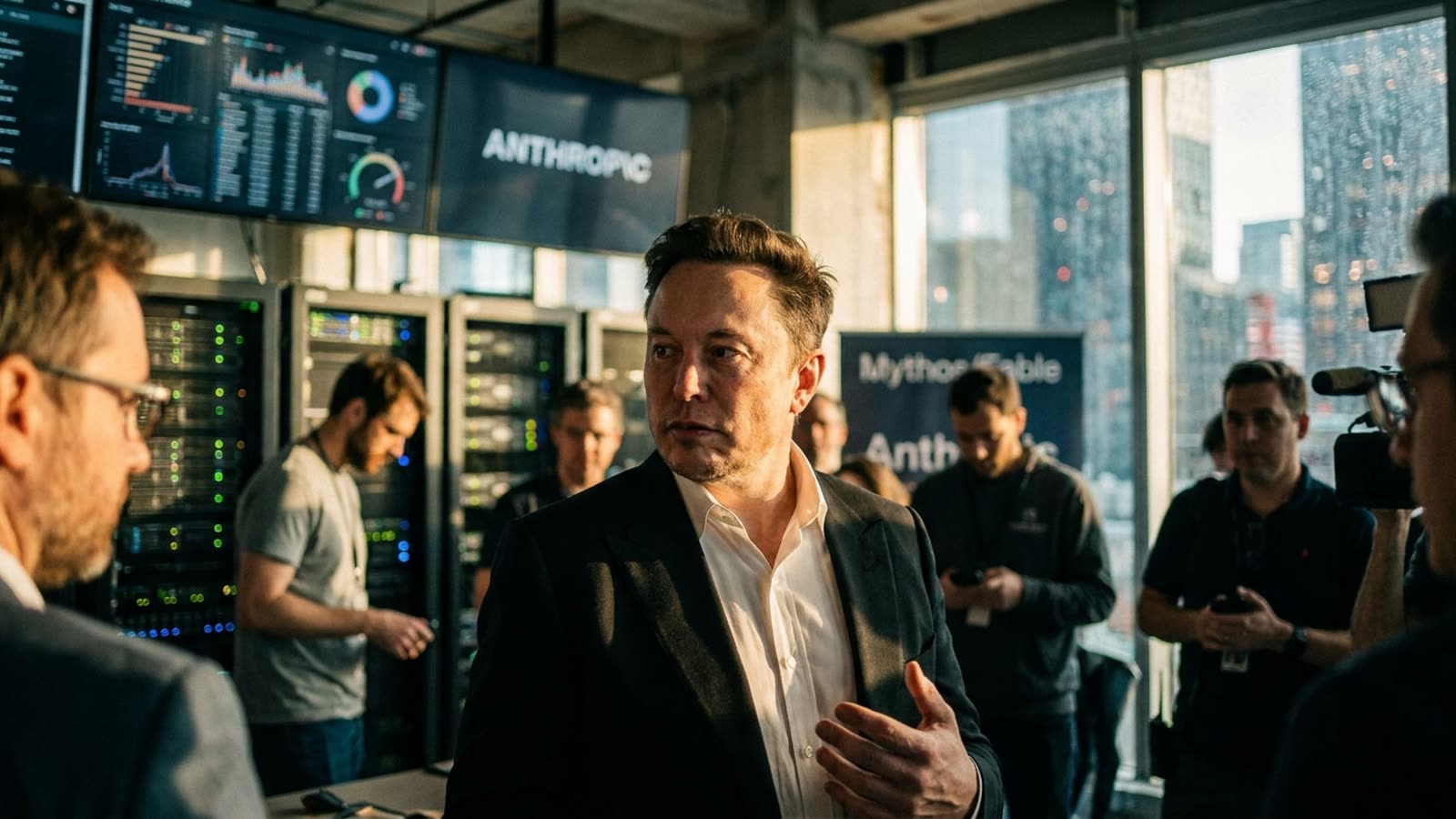
Elon Musk has spent the better part of three years positioning xAI as the scrappy insurgent against what he called the 'woke cartel' of OpenAI and Anthropic. He sued OpenAI, accused its leadership of betraying the nonprofit mission he helped fund, and built Grok as the deliberately unfiltered alternative to Claude's constitutional caution. So when Musk publicly praised Mythos/Fable this week and promised not to 'cut off' Anthropic from resources, the AI industry collectively paused to decode the message.
The shift is less magnanimous than it appears. Musk's xAI has achieved remarkable scale—Grok now powers Tesla's autonomous systems, X's recommendation engine, and a growing enterprise business—but it remains compute-constrained relative to its ambitions. The company's Memphis data center, once touted as the largest AI training facility in North America, is already operating at capacity. Meanwhile, the compute marketplace has become brutally competitive, with cloud providers increasingly reluctant to offer favorable terms to any single customer.
The Mythos/Fable Connection
Musk's praise for Mythos/Fable, the AI storytelling startup that has carved out a niche in interactive narrative, is curious precisely because it poses zero threat to xAI's core business. Fable's technology excels at character consistency and long-form narrative coherence—useful for entertainment, irrelevant to autonomous vehicles or enterprise search. The endorsement costs Musk nothing while signaling openness to the broader AI ecosystem.
The Anthropic pledge is more substantive. 'Cut off' implies infrastructure access, likely referring to the complex web of cloud computing relationships that undergird frontier AI development. Anthropic relies on Amazon Web Services for much of its compute; xAI has been building relationships with the same hyperscalers. A promise not to interfere suggests Musk is seeking détente rather than total war—or at minimum, wants to be seen seeking it.
Reading the Regulatory Tea Leaves
The timing coincides with intensifying scrutiny of AI market concentration in Washington. The Federal Trade Commission has been examining whether compute access constitutes a bottleneck that dominant players could exploit to disadvantage rivals. Musk, whose companies have faced antitrust attention across multiple sectors, may be positioning xAI as a good-faith actor before regulators define the rules of engagement.
There is also the matter of AI export controls, which have become a flashpoint between industry and government. Musk has historically opposed restrictions that would limit where American AI technology can operate—a stance that aligns with his global ambitions for Tesla and Starlink. Demonstrating cooperative instincts toward domestic competitors could strengthen his hand in arguing against international constraints.
Our take
Musk's conciliatory turn should be understood as tactics, not transformation. He remains locked in fundamental competition with Anthropic and others for talent, compute, and enterprise contracts. But the AI industry is entering a phase where the rules—regulatory, commercial, geopolitical—are being written in real time. Musk has always been skilled at shaping narratives before they calcify into constraints. His sudden friendliness toward rivals is less about making peace than about ensuring he has a seat at the table where the terms of future conflict will be set.