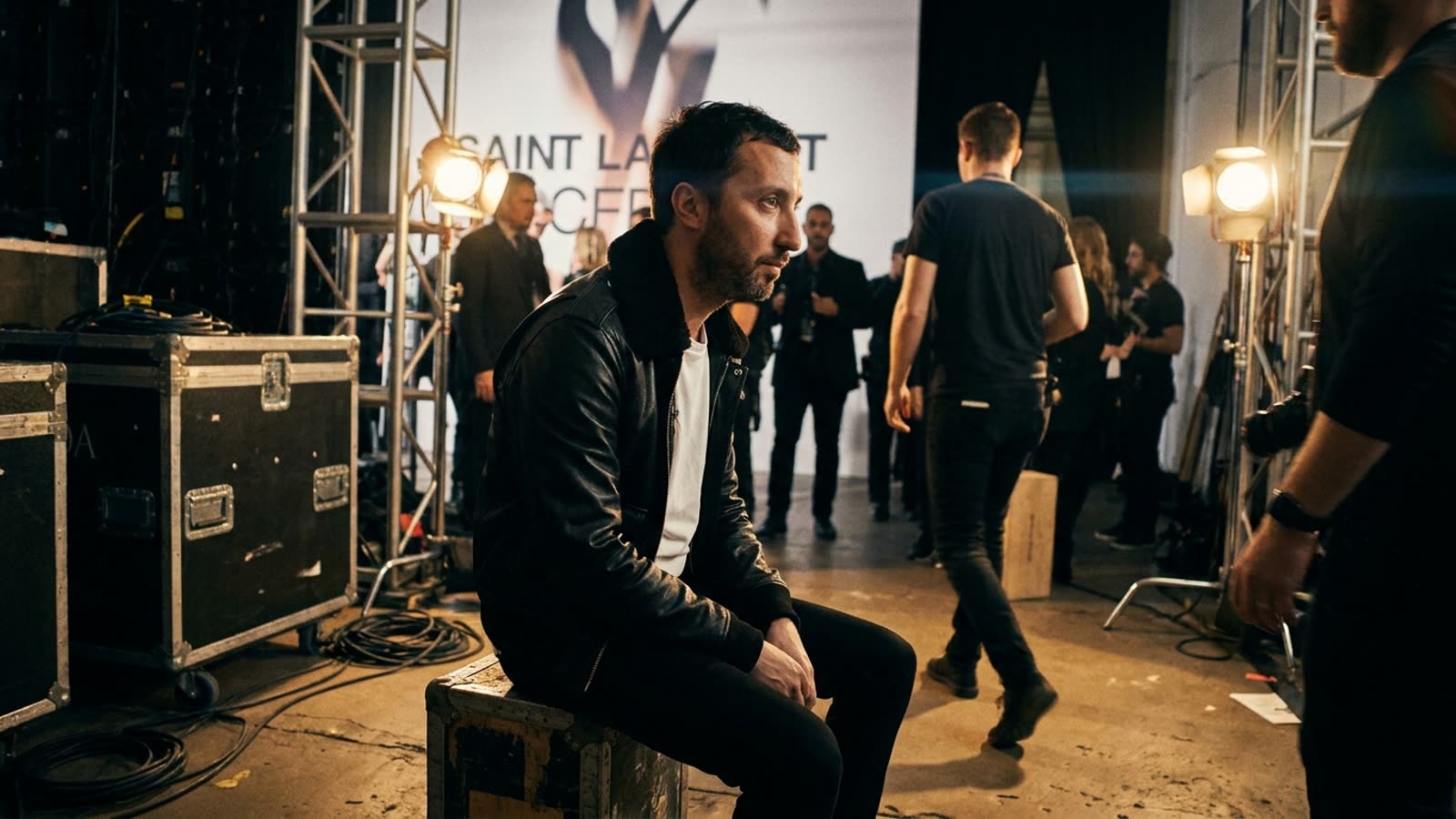
The Council of Fashion Designers of America has announced its 2026 nominees and honorees, and the list reads like a carefully negotiated peace treaty between heritage and relevance. Ralph Lauren and Carolina Herrera anchor the proceedings with the gravitas of monuments, while Public School New York represents the younger guard. But the headline belongs to Anthony Vaccarello, Saint Laurent's creative director, who will receive the International Designer of the Year award—a choice that reveals the CFDA's ongoing struggle to define American fashion in an era when nationality has become fashion's most fungible concept.
Vaccarello, the Belgian designer who has helmed the French house since 2016, has spent a decade refining Saint Laurent's particular brand of Parisian sleaze into something approaching commercial religion. His shows are exercises in controlled provocation, his clothes the uniform of women who want to look expensive and slightly dangerous. That the CFDA has chosen to celebrate him is not surprising—he is, by most measures, one of the most influential designers working today.
The nationality question
What makes the selection revealing is what it suggests about the CFDA's own anxieties. The organization exists, ostensibly, to promote American fashion. Yet its international award has increasingly become the ceremony's marquee honor, drawing more attention than the domestic categories. This is partly strategic—attaching American fashion's biggest night to global names generates international press—but it also reflects a deeper uncertainty about what American design actually is.
The domestic nominees tell their own story. Ralph Lauren, at 87, represents an America that exists primarily in aspiration: the Hamptons, old money, horses. Carolina Herrera, the Venezuelan-born designer whose house was recently acquired by a Spanish conglomerate, embodies immigrant elegance made good. Public School New York, founded by Dao-Yi Chow and Maxwell Osborne, offers streetwear-inflected tailoring that speaks to a younger, more diverse clientele. Together, they suggest American fashion is less a coherent aesthetic than a collection of parallel universes.
Legacy versus momentum
The CFDA's challenge is structural. Unlike the British Fashion Council, which has successfully positioned London as a incubator for experimental talent, or the Fédération de la Haute Couture, which guards Paris's historical primacy, the CFDA must reconcile commercial behemoths with emerging designers, sportswear heritage with red-carpet ambition. The result is ceremonies that feel less like coronations than coalition-building exercises.
Vaccarello's honor solves a specific problem: it gives the evening a protagonist whose work photographs well and whose name draws coverage. But it also underscores how dependent American fashion has become on borrowed glamour. The most talked-about moment of the CFDA Awards is increasingly likely to involve someone who has never shown in New York.
Our take
The CFDA Awards function best as an industry reunion, a night when American fashion pretends it is a unified enterprise rather than a loose confederation of competing interests. Honoring Vaccarello is smart programming—he is talented, photogenic, and his presence ensures European coverage. But the choice also feels like an admission that American fashion's most compelling story right now is its relationship to everywhere else. The ceremony celebrates American design by celebrating someone who represents the opposite. There is something honest in that contradiction, even if it is not what the organization intended to say.