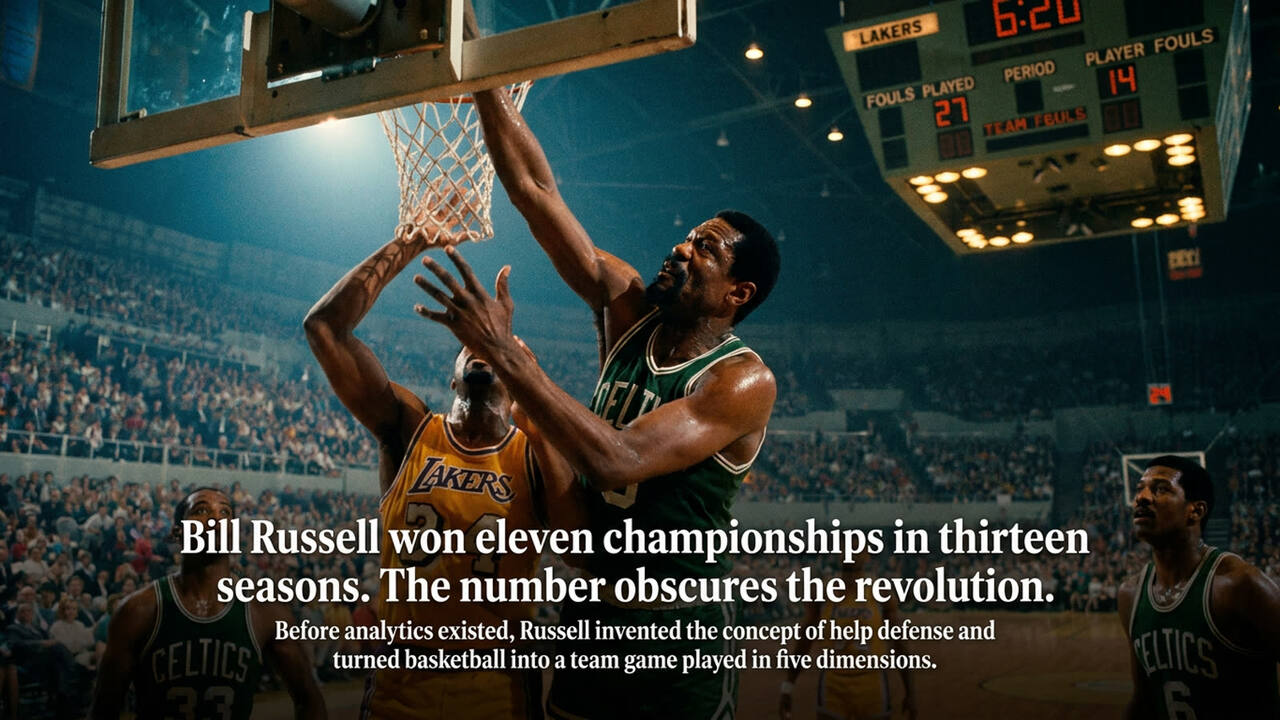
The statistic that defines Bill Russell's career is also the one that does him the least justice. Eleven championships in thirteen seasons with the Boston Celtics sounds like a typo, a clerical error from an era when professional basketball was played in smoky arenas before crowds that wouldn't fill a modern high school gym. The number invites dismissal: surely the league was weaker, the competition thinner, the achievement somehow less legitimate than what came after.
This is precisely backward. Russell didn't benefit from a primitive era — he ended one. Before he arrived in Boston in 1956, basketball was a horizontal game. Teams ran plays, took shots, and watched the ball go in or not. Defense was an individual assignment: your man, your problem. Russell looked at this arrangement and saw something no one else could see. He saw that a defender who could protect the rim didn't just stop his own man — he changed the calculus for everyone on the floor.
The geometry of intimidation
What Russell understood, decades before the term "help defense" entered coaching lexicons, was that basketball is played in space and time simultaneously. A shot blocker who stays glued to his assignment affects one player. A shot blocker who roams affects five. Russell's Celtics teammates could gamble on steals, overplay passing lanes, and take risks that would be suicidal in any other system because they knew Russell was waiting behind them, a last line of defense that never broke.
His blocked shots — a statistic the NBA didn't bother tracking during his career — were only the visible manifestation of something subtler. Russell changed shots that were never taken. He altered passes that were never thrown. He created hesitation in opponents who had never hesitated before. Wilt Chamberlain, the most physically dominant offensive player the game had ever seen, shot worse against Russell than against anyone else not because Russell could match his strength, but because Russell made him think.
The captain as system
Russell's defensive genius was inseparable from his leadership. He was the first Black head coach in NBA history when he took over the Celtics as player-coach in 1966, and he won two more championships in that role. But he had been coaching from the floor for years before that, directing traffic, calling switches, orchestrating a defensive scheme that existed nowhere in any playbook because it existed entirely in his head.
The Celtics of Russell's era were not stacked with superstars. They had excellent players — Bob Cousy, John Havlicek, Sam Jones — but nothing approaching the concentrated talent of later dynasties. What they had was a system, and the system was Russell. He made good defenders into great ones and great defenders into champions. He proved that basketball, unlike baseball, was a sport where one player could transform a franchise through sheer defensive will.
Our take
Modern basketball has rediscovered what Russell knew instinctively: that defense is about help, rotation, and collective intelligence rather than individual matchups. Every switching scheme, every drop coverage, every rim-protection strategy taught in coaching clinics descends from principles Russell invented through pure basketball intuition. The eleven rings are real, and they matter, but they're almost beside the point. Russell's true legacy is that he saw the game in a way no one had before, and once he showed everyone else, basketball could never go back to what it was.