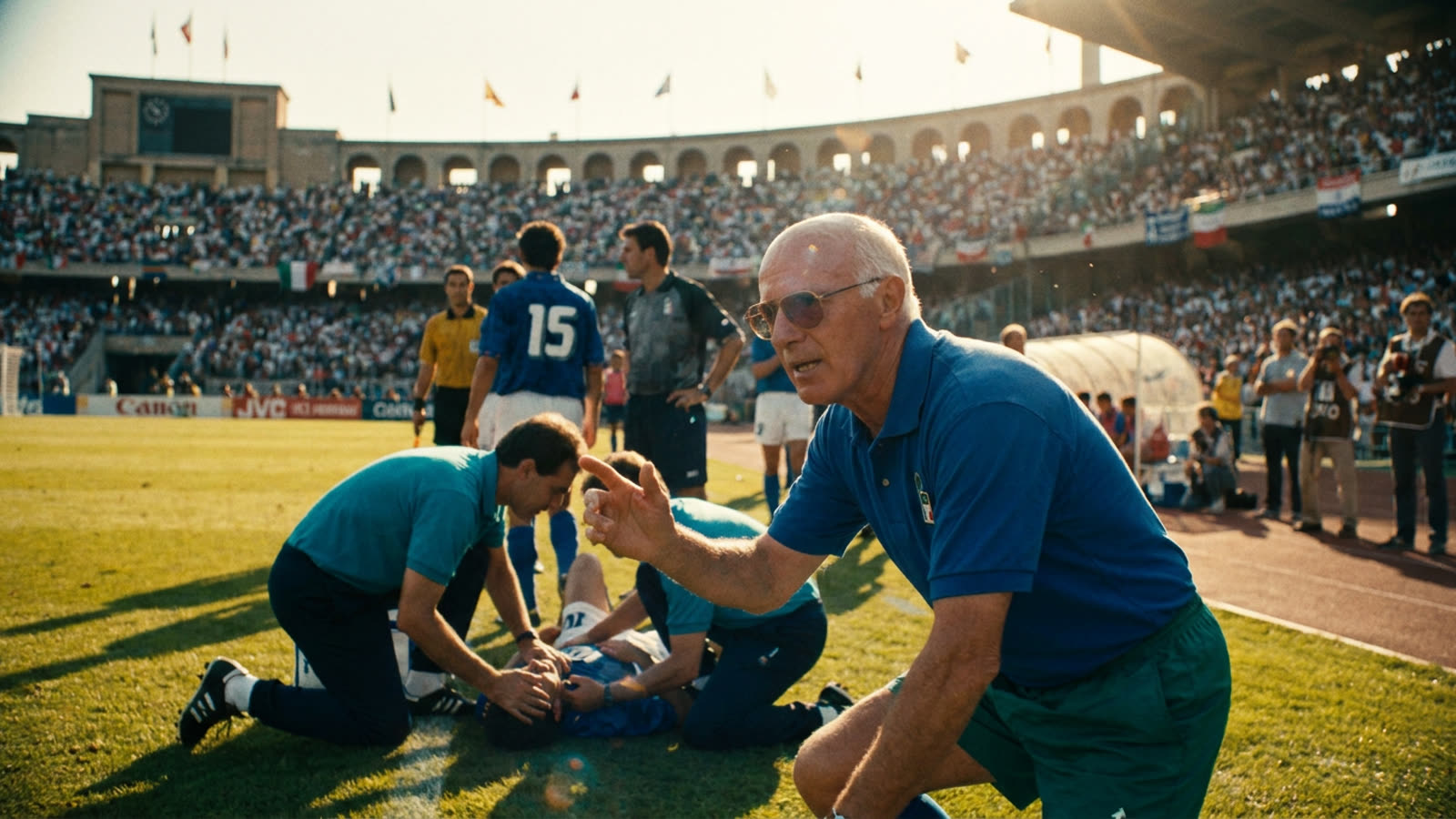
Before Arrigo Sacchi arrived at AC Milan in 1987, the path to managing elite football was straightforward: you played at the highest level, you retired, you coached. Sacchi had done none of this. His playing career peaked in the Italian amateur leagues, and he spent his twenties selling shoes for a living. When he told Silvio Berlusconi that he didn't need to have been a horse to be a jockey, he wasn't just defending his credentials — he was announcing a philosophical rupture with everything Italian football believed about itself.
What followed was the most concentrated period of tactical innovation the sport has ever seen. In four seasons, Sacchi's Milan won one Serie A title, two European Cups, two Intercontinental Cups, and two European Super Cups. More importantly, they changed how football thought about itself.
The system over the star
Italian football in the 1980s worshipped the libero — the free defender who swept behind the back line — and prized defensive solidity above all else. Catenaccio, the bolt, was doctrine. Sacchi considered this cowardice dressed up as pragmatism.
His Milan pressed high, defended zonally, and kept a flat back four that moved as a single organism. The offside trap was wielded as an offensive weapon. When opponents had the ball, Milan's players hunted in coordinated packs. When Milan had it, all ten outfield players participated in construction. The distances between lines were obsessively rehearsed: no more than 25 meters from the forwards to the defensive line.
This was not entirely new — the Dutch had pioneered total football in the 1970s — but Sacchi systematized it with a rigor that bordered on the obsessive. Training sessions lasted hours. Players walked through movements without a ball, memorizing spatial relationships. Franco Baresi, already one of the world's finest defenders, was asked to unlearn decades of instinct.
The men who made it breathe
Sacchi's genius was conceptual, but execution required exceptional players willing to subordinate individual brilliance to collective function. He found them. Baresi and Paolo Maldini formed a defensive partnership of almost telepathic understanding. The Dutch trio of Ruud Gullit, Marco van Basten, and Frank Rijkaard provided the technical quality and physical dynamism the system demanded.
The 1989 European Cup final against Steaua Bucharest remains the purest expression of Sacchi's vision: a 4-0 demolition in which Milan controlled every blade of grass. Van Basten scored twice, but the real story was the suffocation — Steaua barely crossed the halfway line with any coherent intent.
The following year, Milan repeated as European champions, beating Benfica 1-0 in Vienna. Two consecutive European Cups had been achieved only twice before in the competition's history.
The coaching profession, reimagined
Sacchi's deeper legacy lies not in trophies but in permission. He proved that a manager could be an intellectual, a systems thinker, someone whose authority derived from ideas rather than playing pedigree. The generation that followed — from Pep Guardiola to Maurizio Sarri to Thomas Tuchel — inherited a profession that Sacchi had expanded.
Guardiola has called Sacchi his primary influence, and the debt is visible: the high press, the positional play, the insistence that defending and attacking are not separate activities but expressions of the same philosophy. When Guardiola's Barcelona dismantled opponents with geometric passing patterns, they were speaking a language Sacchi had codified.
Our take
Football loves to romanticize the player-turned-manager, the man who learned the game in the trenches. Sacchi's career is a rebuke to that sentimentality. He understood that modern football was becoming too complex, too fast, too tactically dense to be mastered through intuition alone. It required study, abstraction, the willingness to see players as components in a larger design. That he did this while selling shoes until his mid-thirties makes the achievement more remarkable, not less. The beautiful game needed someone who watched it from the outside to see what it could become.