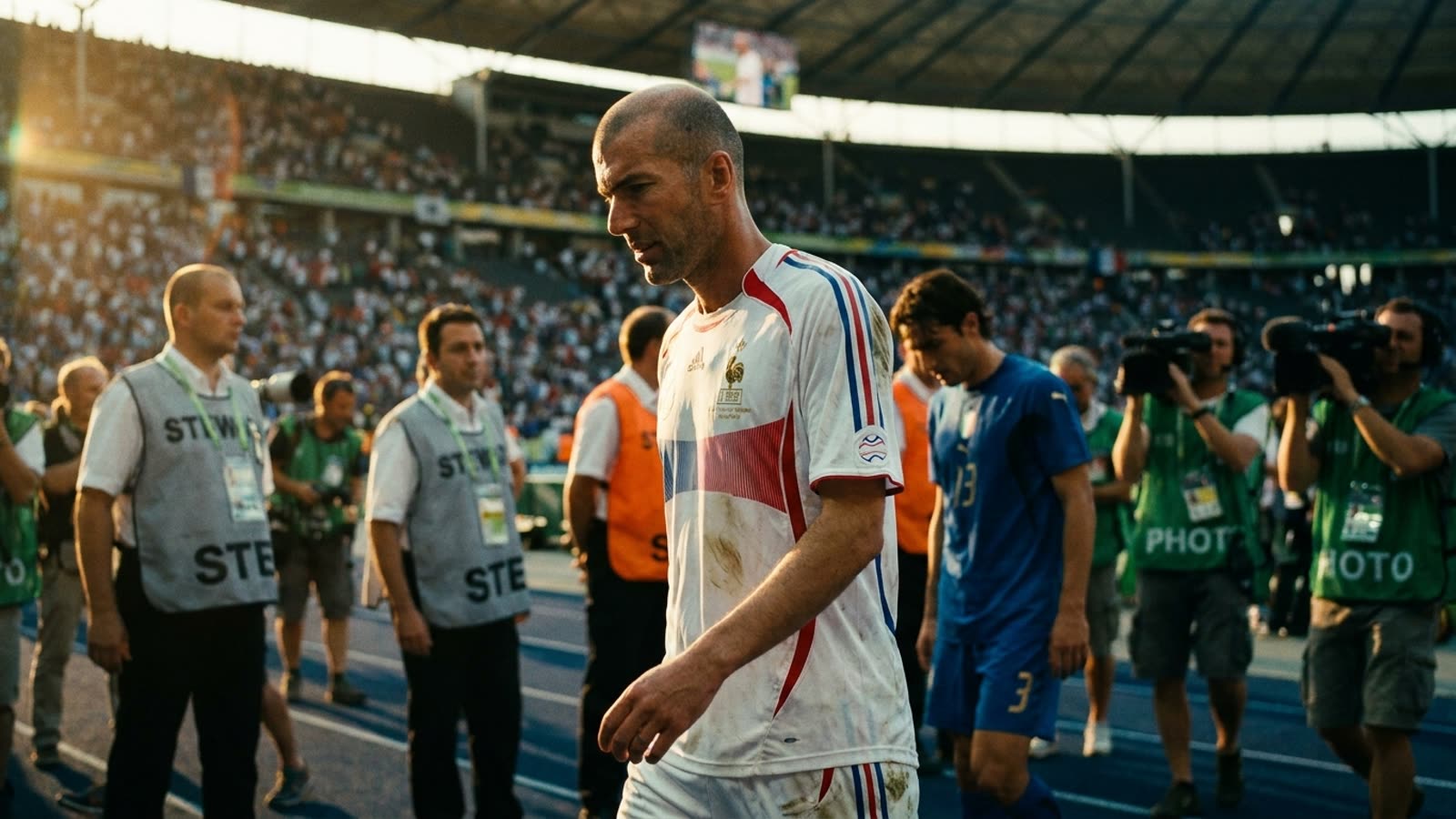
The greatest player of his generation walked off the pitch in Berlin with his eyes fixed somewhere beyond the stadium, past the golden trophy he would never touch, past Marco Materazzi still gathering himself from the turf. Zinedine Zidane had just committed the most inexplicable act of self-destruction in World Cup history, and somehow, impossibly, it only made us love him more.
This is the paradox that football has never quite resolved. Zidane's headbutt should have been a disgrace, a cautionary tale, the sad final chapter of an otherwise luminous career. Instead it became an icon — literally cast in bronze by Algerian artist Adel Abdessemed, exhibited at the Centre Pompidou, analyzed by philosophers and psychoanalysts with the same fervor as his roulettes and first touches.
The anatomy of a moment
The 2006 final was supposed to be Zidane's coronation. At 34, he had already announced his retirement. France had stumbled through the group stage before he dragged them, almost single-handedly, past Spain, Brazil, and Portugal. Against Italy, he opened the scoring with a Panenka penalty so audacious it seemed to mock the very concept of pressure — the ball kissing the underside of the crossbar before dropping in, Gianluigi Buffon frozen in disbelief.
Then came the 110th minute. Materazzi, the Italian defender, had been needling Zidane throughout extra time. Whatever was said — and the precise words remain disputed despite years of lip-reading analysis — it was enough. Zidane turned, walked calmly toward Materazzi, and drove his forehead into the Italian's chest with the deliberate force of a man who had made a decision and would not unmake it.
The red card was inevitable. France lost on penalties. Zidane's career ended not with a trophy lift but with a lonely walk past the World Cup, gleaming on its pedestal, tantalizingly close.
Why we forgave him instantly
The public reaction was remarkable. Polls in France showed overwhelming support for Zidane. Rather than condemning him, commentators tied themselves in knots explaining why this was somehow noble, or at least understandable. The headbutt became not a failure of discipline but a testament to authenticity — proof that even at the summit of his sport, Zidane remained irreducibly human, governed by codes of honor that superseded tournament football's manufactured stakes.
This interpretation is generous, perhaps too generous. But it speaks to something real about how we consume sporting greatness. We say we want perfection, but what we actually crave is the flaw that makes perfection believable. Maradona's Hand of God. Jordan's gambling. Zidane's headbutt. These are not footnotes to greatness; they are what make greatness legible to those of us who will never experience it.
The artist's signature
Zidane played football like a man solving equations no one else could see. His control was supernatural, his spatial awareness almost eerie. But there was always violence lurking beneath the elegance — not the cynical violence of a hatchet man, but something more primal. He had been sent off fourteen times in his career before Berlin. The headbutt was not an aberration; it was, in its terrible way, a signature.
What Materazzi said to provoke him matters less than what Zidane's response revealed: that for all his balletic grace, he was never fully domesticated by the sport's demands for composure. He played as if something essential was always at stake, something beyond points and trophies. When that something was threatened, he acted.
Our take
The headbutt was wrong. It cost France a World Cup and denied Zidane the storybook ending he had earned. But football is not a storybook, and the moment's enduring power lies precisely in its refusal to resolve neatly. Zidane gave us a final image that was ugly, confusing, and utterly unforgettable — which is to say, he gave us something true. The trophy went to Italy. The myth belongs to him.