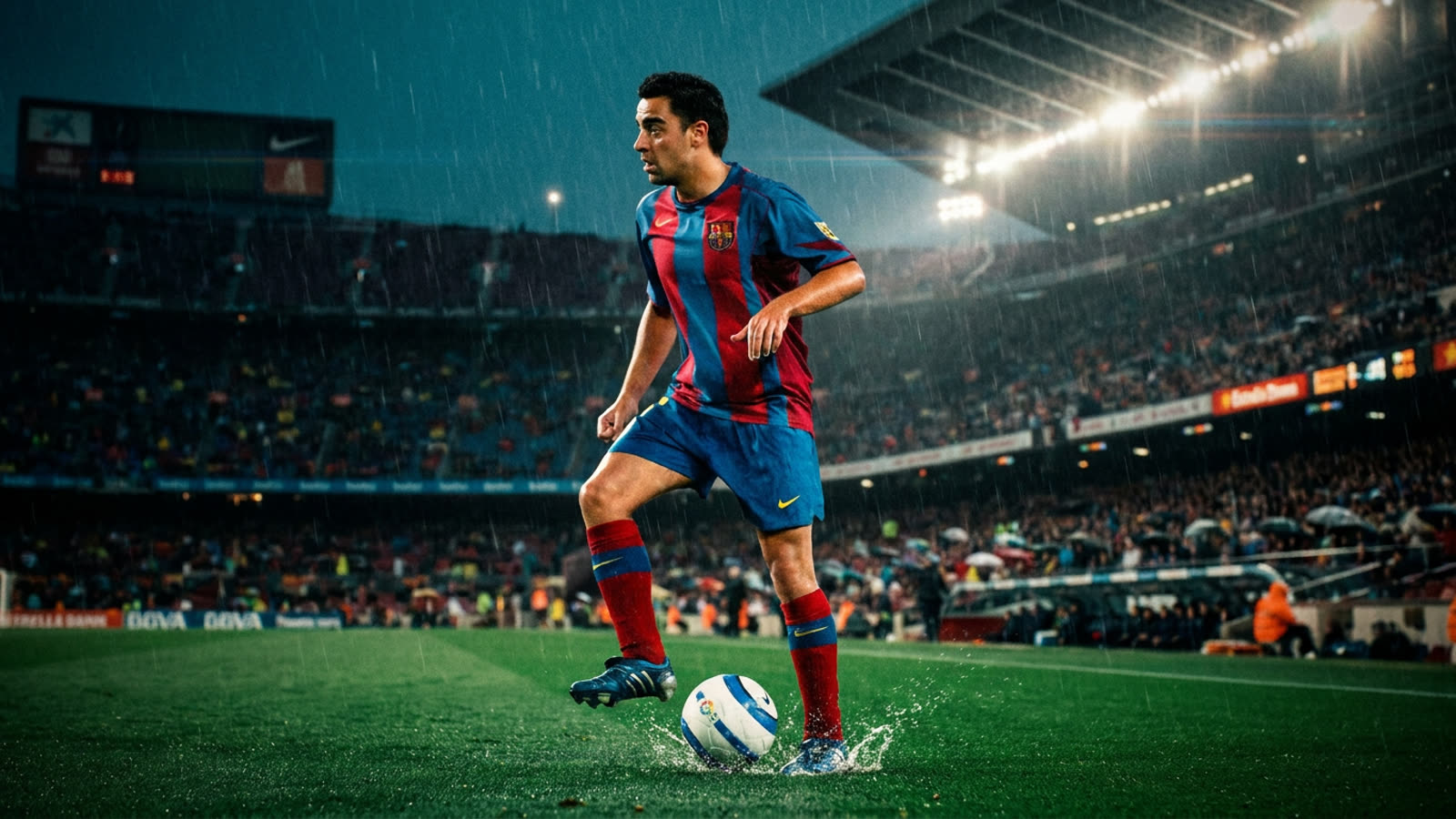
There is a particular kind of genius that looks, from the outside, like nothing much at all. Xavi Hernández spent his career making football appear simple—short passes, quick turns, an almost irritating insistence on keeping the ball rather than doing something dramatic with it. Scouts who watched him as a teenager at La Masia reportedly worried he was too small, too slow, too unspectacular. They were measuring the wrong things.
What Xavi possessed was an internal clock calibrated to a different frequency than everyone else's. He knew not just where his teammates were, but where they would be, and crucially, when the opposition's defensive shape would offer a gap worth exploiting. His passing statistics—completion rates that hovered in the low nineties across his peak years—tell only part of the story. The more revealing number was how rarely Barcelona lost possession in dangerous areas when he was orchestrating play.
The philosophy made flesh
Barcelona's tiki-taka era produced several extraordinary players, but Xavi was its ideological core. Pep Guardiola's system demanded a conductor, someone who could dictate rhythm against opponents who often parked ten men behind the ball. Xavi responded by treating each match as a problem in spatial geometry, probing and recycling until the solution revealed itself. His partnership with Andrés Iniesta became football's most elegant double act—Xavi the architect, Iniesta the artist who painted in the spaces Xavi created.
The approach required supreme confidence in a counterintuitive idea: that patience is aggression by other means. Critics called it boring. Opponents called it suffocating. Over four seasons from 2009 to 2012, Barcelona won everything worth winning, and Xavi was named in the top three for the Ballon d'Or three consecutive years without ever claiming the prize. The award's bias toward goal-scorers and dribblers meant the game's most influential player of his generation collected runners-up medals.
International validation
Spain's transformation from perennial underachievers to dominant force owed everything to Xavi's vision. The national team had talent for decades but lacked a coherent identity. Under Luis Aragonés and then Vicente del Bosque, Spain adopted Barcelona's principles wholesale, with Xavi as the fulcrum. The result was unprecedented: a European Championship, a World Cup, and another European Championship in succession. No other nation has managed that sequence.
The 2010 World Cup final against the Netherlands remains instructive. Facing a Dutch side that had abandoned its own passing traditions for cynical physicality, Spain absorbed punishment and kept circulating the ball. Xavi completed more passes in that single match than some teams managed across entire tournaments. The winning goal came late, but the control was absolute throughout.
Our take
Xavi's career offers a rebuke to the metrics-obsessed modern game. His value was never easily quantifiable—no expected-goals model captures what it means to set a tempo, to make opponents chase shadows, to turn football into a kind of collective meditation. Now managing Barcelona, he faces the impossible task of teaching intuition. Some things cannot be coached, only demonstrated. For a generation of midfielders who grew up watching him, the lesson was clear: the ball moves faster than any player, so move the ball.