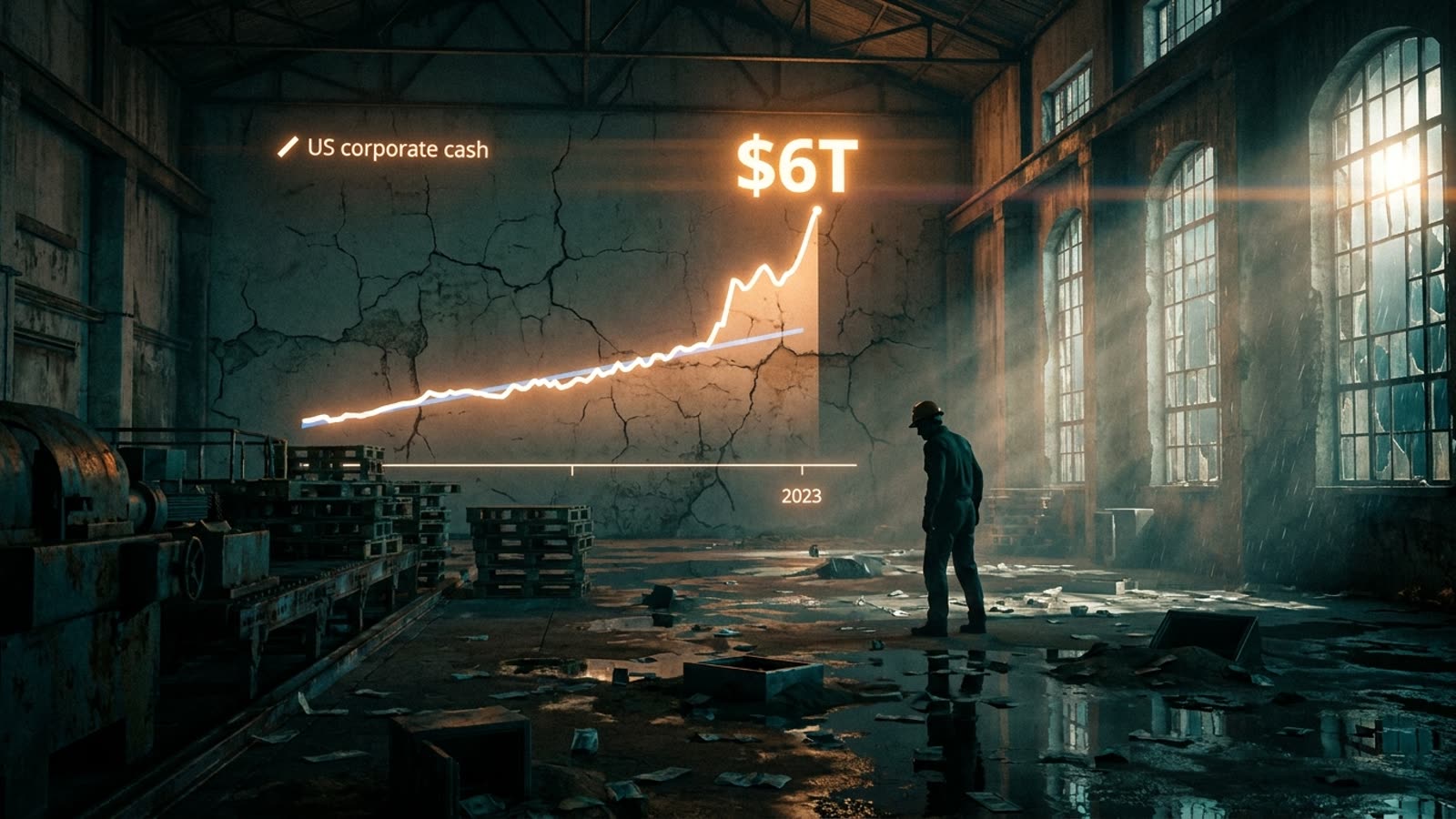
The quarterly earnings call has become a masterpiece of cognitive dissonance. Executives announce billions in profit, then pivot seamlessly to explaining why they cannot afford raises, expansions, or the new equipment the factory desperately needs. The cash is there—visible on the balance sheet, earning interest in money market accounts—yet somehow perpetually unavailable. This is not hypocrisy so much as it is the logical endpoint of a financial philosophy that has quietly reshaped how corporations think about money itself.
The phenomenon has a name among treasury professionals: strategic liquidity. The less charitable term is cash hoarding. Either way, the numbers are staggering. Major corporations routinely maintain cash positions that would have seemed pathological to their predecessors. What earlier generations of managers would have called dead money—capital sitting idle rather than generating returns—is now rebranded as prudent risk management.
The fear that never fades
The 2008 financial crisis broke something in the corporate psyche that has never fully healed. Companies that watched peers collapse not from bad products or poor strategy but from sudden liquidity crunches learned a lesson they refuse to unlearn. Cash is not just an asset; it is insurance against the unknowable. The firms that survived were often those with the deepest reserves, regardless of whether those reserves were earning optimal returns.
This trauma response has calcified into doctrine. Treasury departments now model scenarios that would have seemed paranoid before—simultaneous credit market freezes, supply chain collapses, and demand shocks. The response to each hypothetical disaster is the same: more cash. The buffer grows, then grows again, and eventually the buffer becomes the strategy.
The shareholder value trap
Paradoxically, the same financial orthodoxy that demands maximum shareholder returns also encourages cash accumulation. Stock buybacks—the preferred method of returning capital to shareholders—require timing and flexibility. A company cannot announce a buyback program without the cash to execute it. Dividends create expectations that become nearly impossible to reverse. Better, the thinking goes, to maintain optionality by keeping the powder dry.
The result is a strange equilibrium where companies are simultaneously too profitable to justify their caution and too cautious to deploy their profits. Employees asking for wage increases are told the money is committed. Suppliers requesting better terms are informed that margins are tight. The cash pile, meanwhile, continues its quiet accumulation.
The opportunity cost nobody calculates
What does not appear on earnings calls is the counterfactual: what that capital might have built. The factory that was not modernized. The research program that was not funded. The acquisition that went to a competitor with a higher risk tolerance. These ghosts do not haunt balance sheets, but they shape economies.
The aggregate effect is a kind of corporate risk aversion that ripples outward. When large firms refuse to invest, their suppliers see reduced orders. When cash sits in treasuries rather than circulating as wages or capital expenditure, velocity slows. The hoarding instinct, rational for any individual firm, becomes collectively self-defeating.
Our take
The corporate cash paradox is not a mystery; it is a choice dressed up as necessity. Companies have decided that the lessons of past crises outweigh the opportunities of the present, and they have constructed elaborate justifications for what is ultimately a failure of imagination. The cash is not unavailable—it is being saved for a rainy day that management has decided is always just over the horizon. At some point, the horizon never arriving becomes its own kind of storm.