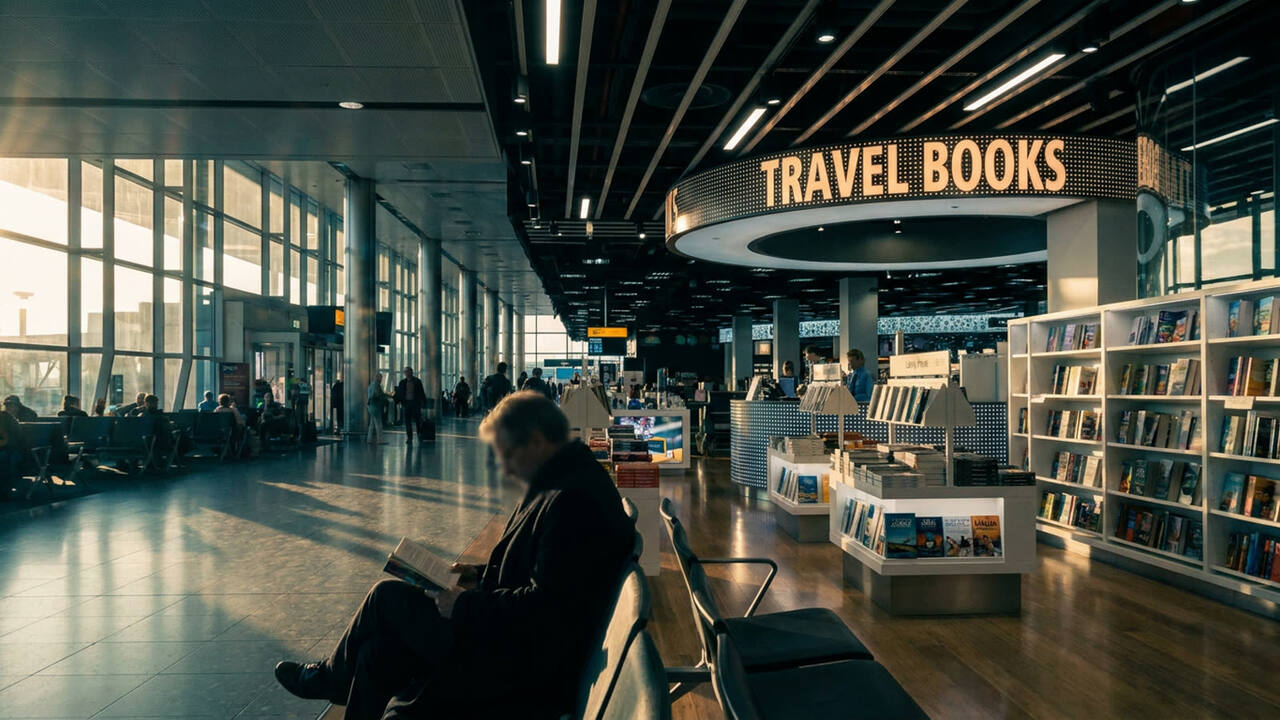
There is a particular species of purchase that exists nowhere else in consumer life: the airport book. It is not quite an impulse buy, not quite a considered one. It is acquired in a liminal state, somewhere between security theatre and boarding-gate anxiety, by a traveller who has already surrendered control of their schedule and is now, briefly, willing to surrender control of their reading list. The airport bookshop understands this psychology better than almost any other retail format on earth.
The format should be extinct. E-readers arrived more than fifteen years ago promising to collapse entire libraries into a device thinner than a magazine. Smartphones followed, offering podcasts, streaming video, and the bottomless scroll. Yet walk through any major international terminal and the bookshop endures — often thriving, frequently expanding, reliably stocked with the same curious mixture of literary fiction, celebrity memoir, and business manifestos promising to unlock your potential in seven habits or fewer.
The economics of captivity
Airport retail operates under conditions that would be illegal if they weren't so convenient. A captive audience, stripped of alternatives, with time to kill and money already mentally allocated to "travel expenses." Bookshops exploit this brilliantly. The average dwell time in an airport bookshop is nearly triple that of a high-street equivalent, and conversion rates — the percentage of browsers who actually buy — are substantially higher. The customer has already accepted that the next several hours belong to someone else. A paperback costing more than it would on Amazon feels less like a markup and more like a reasonable toll for entertainment.
The retailers know their audience. Airport selections skew toward the accessible, the discussable, the gift-able. Literary prizes matter enormously here; a Booker or Pulitzer sticker functions as a decision-shortcut for the time-pressed traveller who wants to feel they've chosen well. Thrillers dominate because they promise propulsive distraction. Self-help sells because airports are places of transition, and transition invites reinvention fantasies.
The physical object as ritual
Something else is happening, though, beyond mere captivity economics. The persistence of the airport bookshop suggests that physical books serve a function that digital alternatives cannot replicate — not despite the travel context, but because of it. A paperback is a commitment device. It occupies space in a carry-on, which means it must be read or carried home in mild shame. It cannot notify you. It cannot be interrupted by a work email. In an environment designed to maximise anxiety and minimise autonomy, the paperback offers a small rebellion: you choose when to engage, and nothing can pull you out except your own wandering attention.
There is also the matter of performance. A book cover signals something to fellow travellers in a way that a Kindle screen cannot. The executive reading a biography of a historical statesman, the creative professional with the cult novel, the parent with the parenting guide — each is constructing a public identity, however briefly. The airport is a stage, and the book is a prop.
Our take
The airport bookshop survives because it solves a problem that technology created rather than eliminated. The more our devices colonise every spare moment, the more valuable becomes a format that resists interruption. The paperback purchased at the gate is not a retreat from modernity; it is a negotiated truce with it. As long as humans feel the need to signal, to escape, and to arrive somewhere having finished something, the airport bookshop will remain — fluorescent-lit, overpriced, and utterly indispensable.