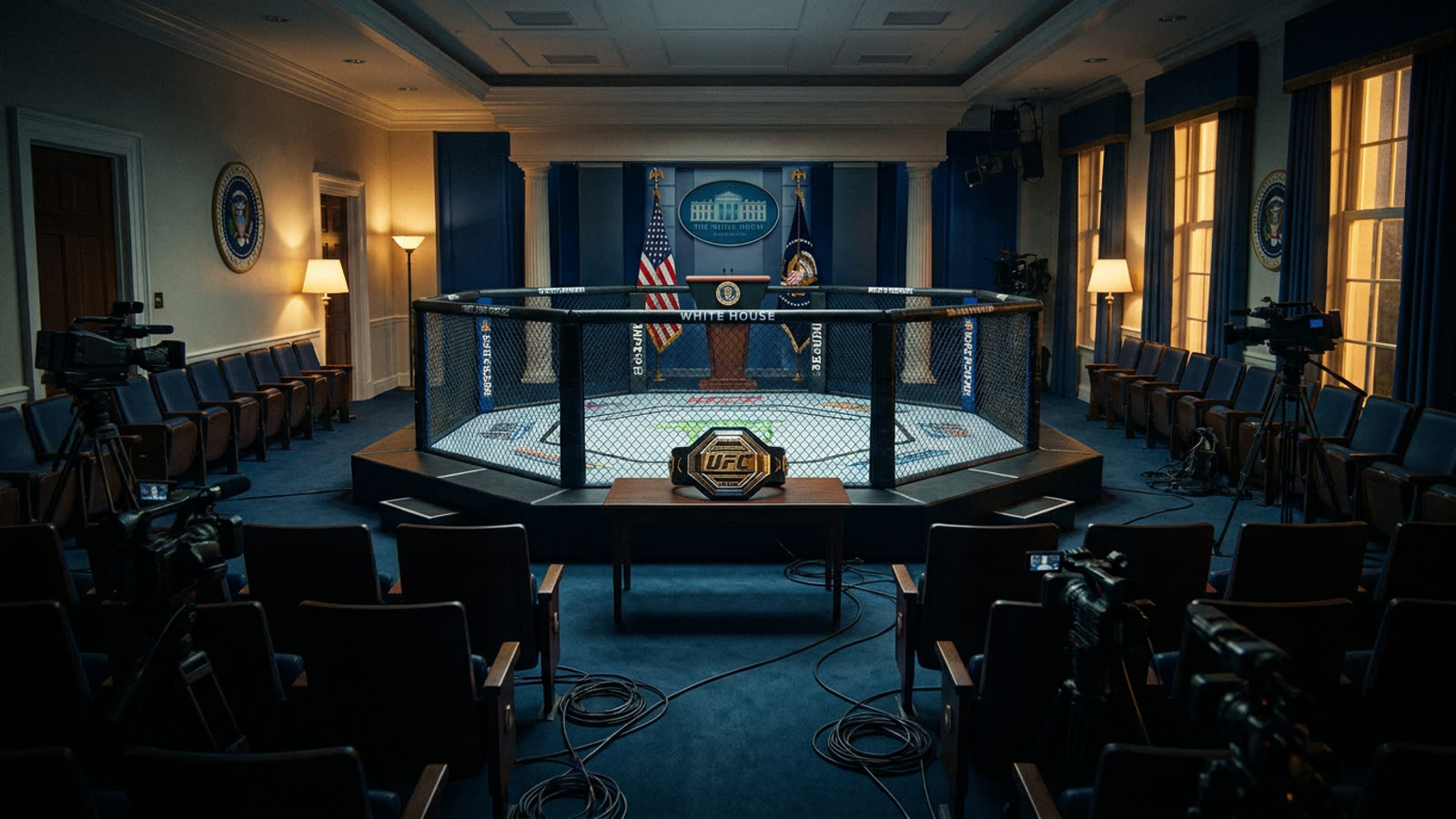
A federal judge on Friday denied an emergency motion seeking to block this weekend's UFC event at the White House, clearing the final legal hurdle for what will be the first professional combat sports competition held on the grounds of the executive mansion. The ruling, delivered with notable brevity, found that plaintiffs lacked standing to challenge what the administration characterizes as a private event on public property.
The decision lands at an odd intersection of constitutional law, entertainment spectacle, and the ongoing redefinition of presidential norms. Whatever one thinks of mixed martial arts—and reasonable people disagree—the sight of an octagon erected on the South Lawn represents something genuinely novel in American governance.
The legal argument that wasn't
The plaintiffs, a coalition of government ethics watchdogs and one Democratic congressman, argued that hosting a commercial sporting event at the White House violated the Emoluments Clause and constituted an improper use of federal property. The judge disagreed on procedural grounds before reaching the merits, finding that generalized concerns about institutional degradation do not confer legal standing.
This is technically correct and entirely unsatisfying. The standing doctrine has long served as a convenient off-ramp for courts reluctant to wade into politically charged disputes. Friday's ruling continues that tradition. The judge did not say the event was appropriate; she said the people complaining about it had no business being in her courtroom.
What crypto has to do with it
The event's guest list reads like a who's who of cryptocurrency executives, many of whom have become significant political donors since the administration's embrace of digital assets. UFC's own crypto partnerships have deepened in recent years, creating a web of commercial relationships that will be on full display Saturday night.
None of this is illegal. All of it is clarifying. The merger of political access, entertainment spectacle, and financial interest has rarely been so literal. The octagon is simply the most visible manifestation of relationships that usually operate with more discretion.
The normalization problem
Four years ago, a UFC fight at the White House would have dominated news cycles for weeks. Today it barely cracks the top three stories. This is the real significance of Friday's ruling—not the legal reasoning, which was narrow and predictable, but the cultural context in which it arrived.
Americans have developed an extraordinary capacity to absorb the unprecedented. Each boundary-pushing event recalibrates expectations, making the next transgression seem marginally less shocking. The judge's ruling is a data point in this larger pattern: institutions declining to check behavior they might once have questioned, not because the behavior has become acceptable but because the energy required to object has been exhausted.
Our take
The Constitution will survive a cage fight on the South Lawn. The Republic has endured worse. But there is something melancholy about watching the gap between what is legal and what is dignified widen in real time. The judge was right that the plaintiffs lacked standing. She was also right to issue her ruling without editorial comment. Courts are not arbiters of taste. The rest of us, however, are free to note that some things can be simultaneously lawful and lamentable. Saturday's event qualifies.