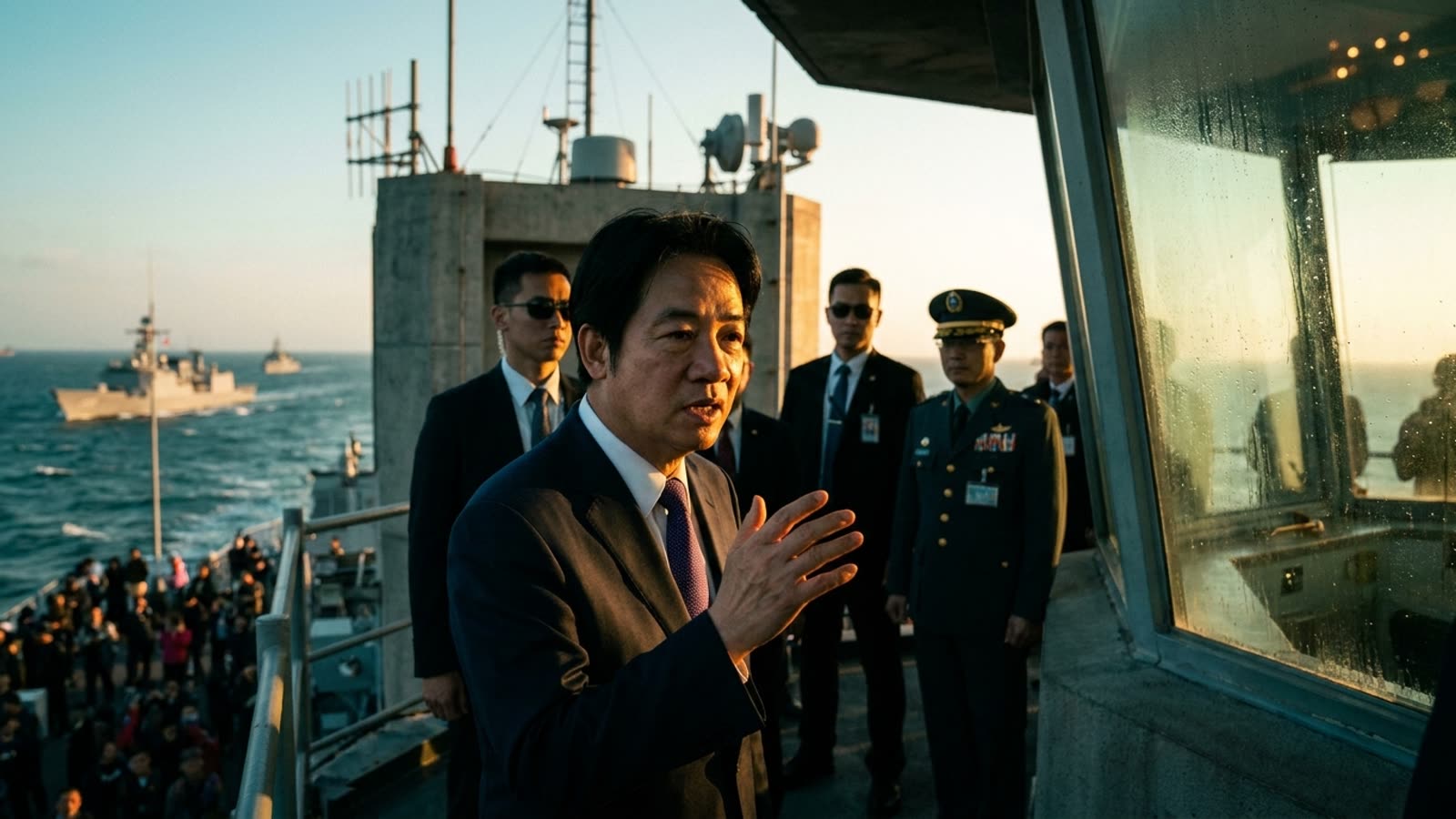
Twelve months into his presidency, Lai Ching-te finds himself governing an island that exists in a permanent state of strategic ambiguity—claimed by Beijing, armed by Washington, and recognized by almost no one. His first year was defined less by legislative breakthroughs than by the sheer act of keeping Taiwan functional while Chinese warplanes crossed the median line with metronomic regularity. Year two promises more of the same, only louder.
The calculus is brutally simple. Beijing views Lai, a former independence-leaning firebrand who has since moderated his rhetoric, as more dangerous than his predecessor Tsai Ing-wen precisely because he is harder to caricature. His government has avoided provocative gestures while methodically expanding defense spending, stockpiling critical semiconductors, and cultivating ties with European parliaments that would have seemed fantastical a decade ago. The strategy is not to win a war but to make one unthinkable—or at least prohibitively expensive.
The military math
China's People's Liberation Army now conducts what analysts call "gray zone" operations almost continuously: fighter sorties, naval patrols, and cyberattacks calibrated to exhaust Taiwan's defenses without triggering an American response. Taipei's answer has been asymmetric investment—mobile missile launchers, sea mines, and a reserve mobilization system modeled partly on Finland's. The goal is porcupine deterrence: make the island too spiny to swallow quickly, buying time for international intervention that may or may not arrive.
The diplomatic tightrope
Lai's foreign policy walks a razor's edge. He cannot declare independence without inviting catastrophe, yet he cannot accept Beijing's "one country, two systems" formula without political suicide at home. The result is a studied vagueness that frustrates maximalists on both sides. His recent news conference emphasized "peace through strength," a phrase borrowed deliberately from Cold War Washington—a signal to American hawks that Taipei speaks their language.
Meanwhile, Taiwan's semiconductor leverage remains its most potent diplomatic card. TSMC's fabs produce the vast majority of the world's advanced chips; any conflict that disrupts them would crater the global economy. Lai's government has leaned into this dependency, framing Taiwan not as a liability for the West but as critical infrastructure.
Our take
Lai's Taiwan is not asking for rescue; it is asking for time. The island's strategy of quiet resilience—military modernization without bluster, diplomatic engagement without provocation—offers a template for small democracies facing authoritarian pressure everywhere from the Baltics to the South China Sea. Whether it works depends on variables Taipei cannot control: American resolve, Chinese patience, and the unpredictable chemistry of great-power competition. But after a year of holding the line, Lai has earned the right to be taken seriously.