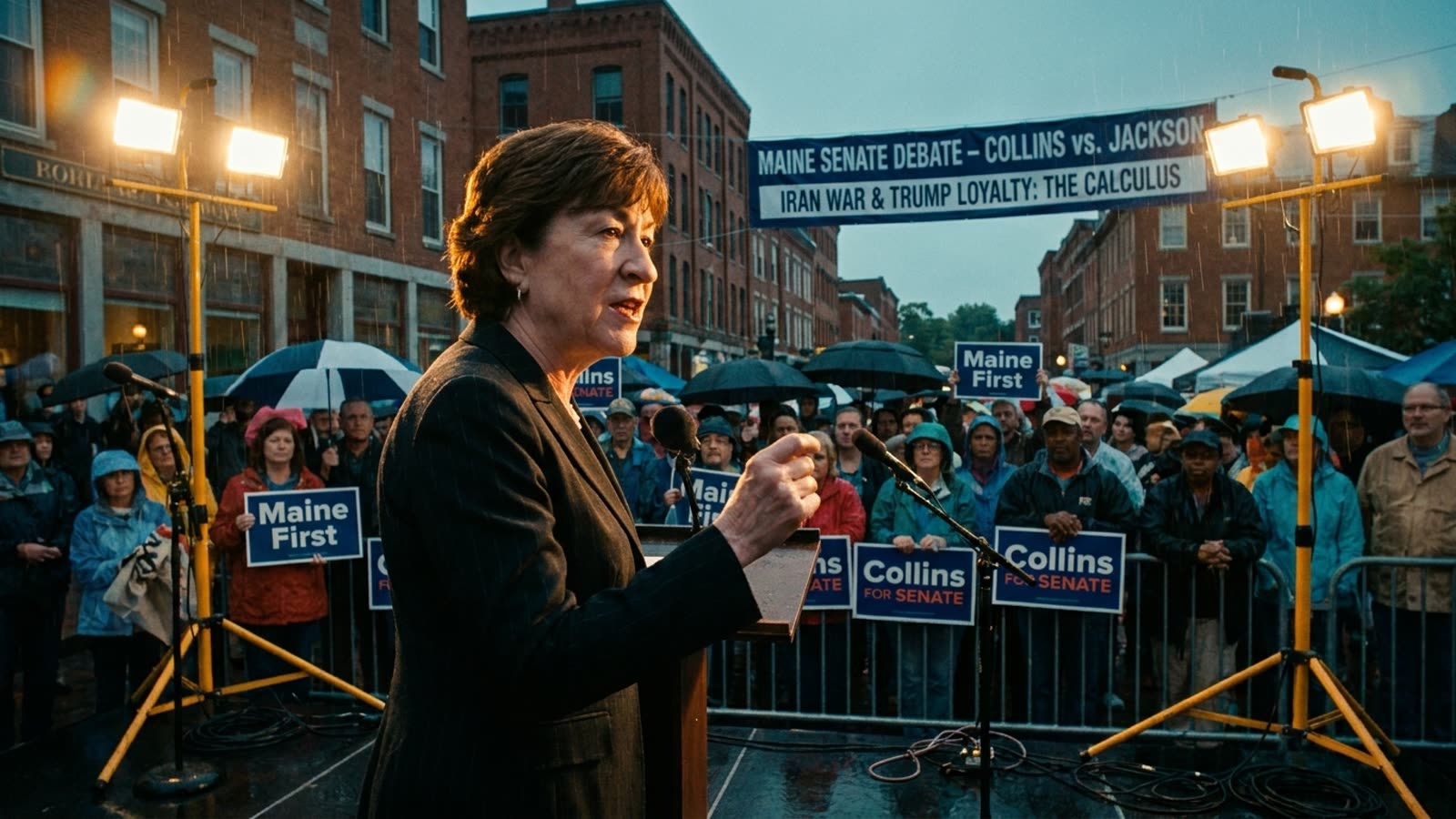
Susan Collins has survived longer than almost any moderate Republican in the Senate, threading needles that would snap lesser politicians in half. But the third debate in her reelection campaign against Maine's Democratic Senate President Troy Jackson made clear that her famous balancing act may finally be running out of road.
The 90-minute exchange in Bangor was personal, heated, and clarifying. Jackson hammered Collins on her 2018 vote to confirm Brett Kavanaugh, her support for the 2017 tax cuts, and what he called her "convenient amnesia" about Donald Trump's excesses. Collins, for her part, painted Jackson as a "Pelosi puppet" who would rubber-stamp a Democratic agenda out of step with Maine's independent streak. Neither candidate emerged unscathed, but the debate's real revelation was structural: Collins is now fighting on terrain that no longer favors her.
The Iran war changes everything
The conflict with Iran, now in its fifth month, has reordered American politics in ways that are only beginning to crystallize. Collins voted for the initial authorization of military force but has since called for a "reassessment" of the mission's scope — a position that satisfies almost no one. Jackson attacked her for enabling the war; Republican base voters in Maine's rural Second District view her hedging as betrayal. The war has made her triangulation look less like principle and more like calculation.
Gas prices, up more than a third from a year ago, featured prominently. Collins blamed the Biden-era energy policies that preceded the current administration; Jackson blamed the war itself and the Trump White House's refusal to pursue diplomatic off-ramps. Neither had a satisfying answer for voters paying over five dollars a gallon.
Trump loyalty as litmus test
Collins's relationship with Trump has always been her most precarious tightrope. She voted to convict him in his second impeachment trial, earning his lasting enmity, yet she has endorsed his 2026 midterm agenda and campaigned alongside his surrogates. Jackson repeatedly invoked her Kavanaugh vote as evidence that her independence is performative. Collins countered that she has broken with her party more than any other Republican senator — a claim that is technically true but increasingly irrelevant to a base that demands fealty.
The debate's most charged moment came when Jackson accused Collins of "hiding behind bipartisanship while enabling extremism." Collins shot back that Jackson had never passed a significant bill in his career. The exchange was revealing: both candidates are running against caricatures of the other, and both caricatures contain enough truth to sting.
Maine's weird math
Maine allocates one electoral vote per congressional district, and its politics are genuinely idiosyncratic. Collins won her last race by nearly nine points, but that was before the pandemic, before January 6th, and before the Iran war. Recent polling shows the race within the margin of error. Jackson is running up margins in Portland and its suburbs; Collins is banking on the rural north. The state's ranked-choice voting system adds another layer of uncertainty.
Our take
Susan Collins is not a bad senator. She is, in many ways, exactly the kind of institutionalist that a functional democracy needs. But the institution she has spent four decades serving no longer exists in recognizable form, and her survival skills — the careful hedges, the procedural concerns, the bipartisan photo ops — look increasingly like artifacts from a bygone era. Maine voters will decide whether they want a senator who remembers how the Senate used to work or one who promises to fight for how they wish it would. Neither option is obviously correct, which is perhaps the most honest thing one can say about American politics in 2026.