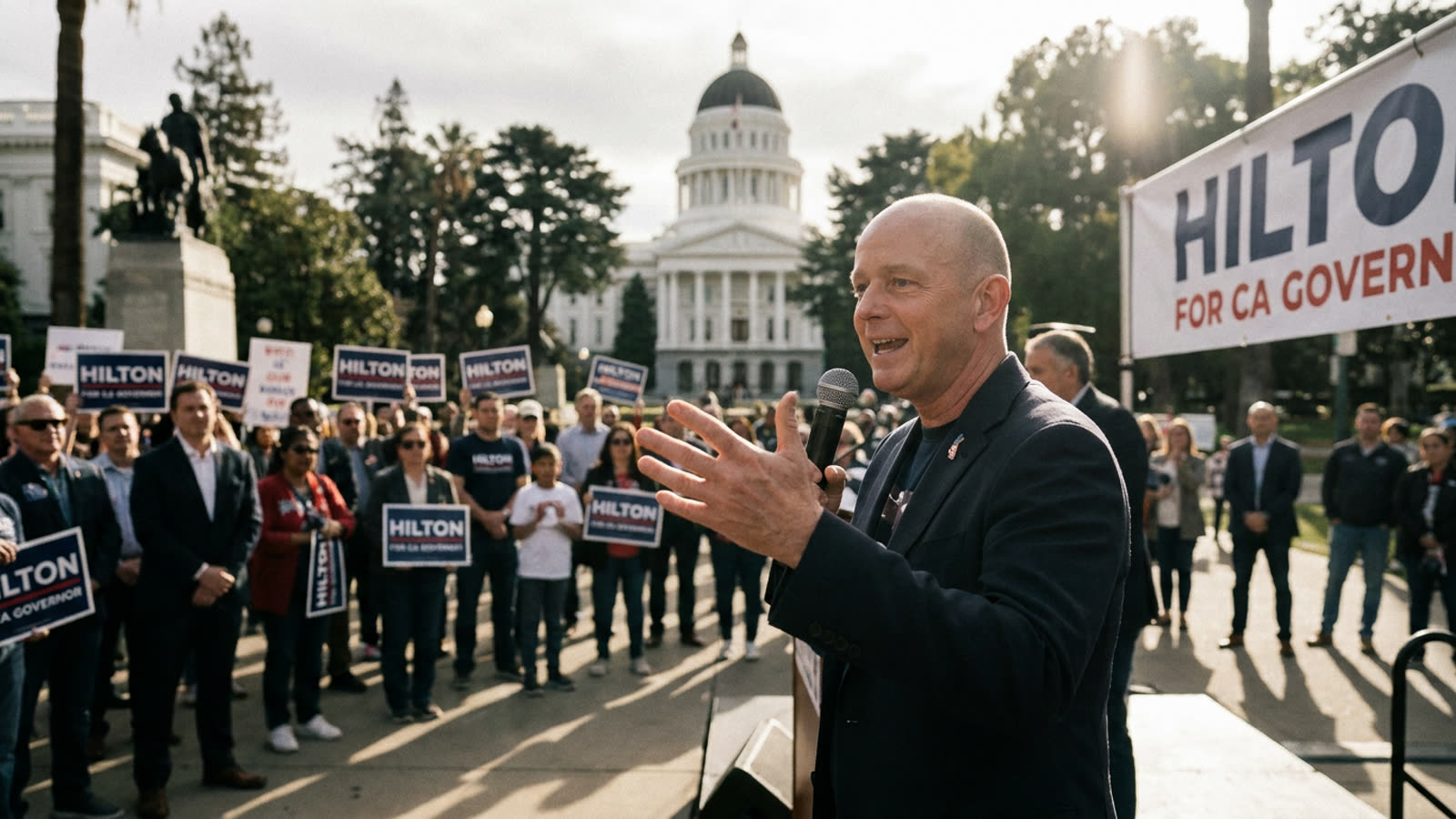
The California Republican Party has spent the better part of this century as a political ghost story—a cautionary tale about what happens when a party alienates the fastest-growing demographic groups in a state. Steve Hilton's projected advancement to the fall gubernatorial election suggests the ghost may be ready to haunt again.
Hilton, the British-born former adviser to David Cameron who reinvented himself as a Fox News populist, has threaded a needle that eluded every GOP hopeful since Arnold Schwarzenegger's sui generis celebrity candidacy. He has made it through California's jungle primary with enough crossover appeal to pose a genuine threat in November.
The Hilton formula
What distinguishes Hilton from the parade of Republican also-rans who have crashed against California's blue wall is his ideological promiscuity. He campaigns on housing deregulation and homelessness with the fervor of a YIMBY activist, attacks tech monopolies from the populist right, and conspicuously avoids the immigration maximalism that turned Pete Wilson's 1994 Proposition 187 into the GOP's long-term suicide note in the state.
His accent helps. Hilton sounds like a visiting professor, not a talk-radio host, even when delivering red-meat lines. His Silicon Valley residency—he founded a tech startup after leaving Downing Street—gives him fluency in the language of the state's dominant industry without the taint of being a creature of it.
What Democrats should worry about
California's Democratic establishment has grown complacent in its dominance, and complacency breeds vulnerability. The state's homelessness crisis, insurance market collapse, and persistent electricity reliability problems have created an opening for a candidate who can credibly promise competence without triggering partisan antibodies.
Governor Newsom's departure to focus on his presidential ambitions has left the Democratic bench thinner than it appears. The party's nominee will need to run on a record of one-party rule during a period when that rule has delivered visibly mixed results.
Our take
Hilton probably still loses in November—California's structural Democratic advantage is simply too large for a single charismatic candidate to overcome. But "probably loses" is a different sentence than "will certainly lose," and the Republican Party has not been able to write that sentence about California in a generation. If Hilton runs within single digits, he becomes a template. If he wins, he becomes the most consequential Republican politician in America not named Trump. Neither outcome should be dismissed.